Singsing Waterfall, Lovina: How to Visit

You hear the falls before you see them. I came up the back road from Lovina on a rented Honda Scoopy, the smell of wet jungle thick after a morning shower, kecak frogs ringing from somewhere in the rice fields below. Five kilometres inland, past two warungs and a slumbering temple dog, the road dips and the engine drops to a whisper, and underneath it there it is: a soft hiss, the kind that sounds like tape static, then a drumming as I get closer. That is Singsing. Lovina sits down at sea level and most travellers don’t bother climbing the back roads to find it, which is exactly why you should.

This is not a guide written from a tour brochure. So here is how to get to Singsing Waterfall without paying the inflated tour-driver price, what to actually expect when you arrive, and which combinations make it worth a half-day rather than a quick stop.

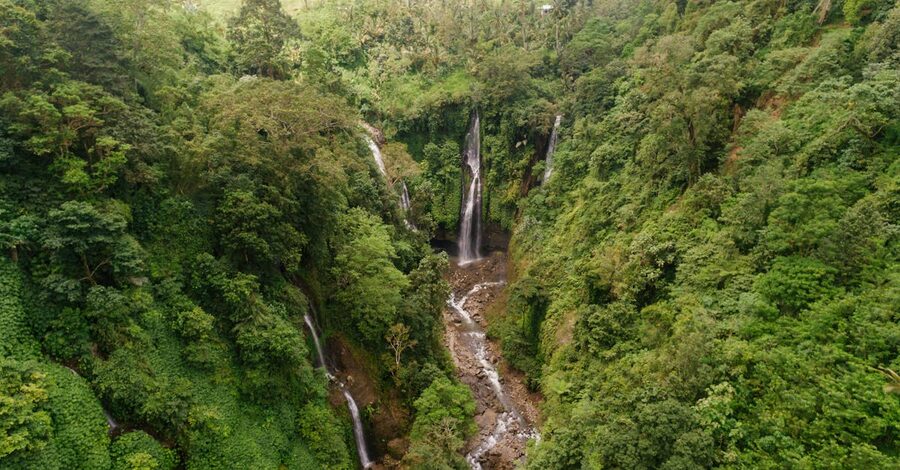
Cascading waterfall in a north Bali jungle valley
The interior of Buleleng regency is wetter, greener, and far quieter than the south of the island. Singsing sits in a forested hill like this one, about five kilometres inland from Lovina.

Where Singsing actually is

Singsing Waterfall sits in Banjar sub-district of Buleleng regency, on Bali’s north coast, roughly five kilometres west of Lovina along the main Singaraja-Seririt road. The signed turn-off (Jalan Singsing) climbs about another kilometre south through the village of Temukus to a small parking area at the trailhead. If you punch “Singsing Waterfall” into Google Maps you will get there, just be aware there is a totally different “Singsing” near Tabanan in the south, so triple-check that the pin sits in Buleleng before you set off. The pin you want shows the GPS coordinates roughly 8°11′ S, 115°00′ E. If your map app puts you in Tabanan, you’ve got the wrong one.

The falls themselves are two cascades about a hundred metres apart, each maybe twelve metres high. Locals call the first one Singsing 1 and the upper one Singsing 2. Some maps and signs spell it “Sing Sing” as two words, others “Singsing” as one. I am going with “Singsing” throughout because that is how Google Maps and the Buleleng regency tourism office spell it. If you’ve only got time for one, the lower fall is easier and prettier in dry season; the upper one is bigger and worth the extra slog if it’s been raining.

Getting there without overpaying

A rider on a scooter in front of green Bali rice fields
Hire a scooter in Lovina for around Rp 70,000 a day (about $4.50) and you can ride to the falls in fifteen minutes. A driver from south Bali will quote you twenty times that for a return trip.

From Lovina (the cheap, sensible option)

If you are already staying in Lovina or Singaraja, this is a non-issue. Rent a scooter for the day, almost every guesthouse in Lovina has one or knows someone who does. Expect to pay roughly Rp 70,000 to Rp 100,000 per day (about $4.50 to $6.30) for a basic Honda Scoopy or Vario, plus around Rp 20,000 of petrol from a Pertamini roadside seller. The ride from central Lovina is fifteen minutes if you go gently. Take the main coast road west toward Seririt, pass the big Krisna souvenir hangar, look for the brown tourism sign on the inland side, and turn left up the lane to Temukus. The road is paved the whole way.

If you don’t want to drive yourself, a local ojek (motorbike taxi) from Lovina will run you maybe Rp 50,000 to Rp 75,000 each way. Tell them to wait, agree the return price up front, and you’ve got a three-hour outing for under Rp 200,000. Grab and Gojek work patchily this far north of Denpasar; don’t count on them.

From south Bali (Kuta, Seminyak, Canggu, Ubud)

This is where it gets expensive. You are looking at three to three and a half hours by car each way, depending on traffic and whether you go over the mountains via Bedugul or around the long coast road through Tabanan. A private driver for the day will quote Rp 700,000 to Rp 1,200,000 (around $44 to $76), which is reasonable filling a back seat with three friends and combining stops. Poor value for one waterfall.

Real advice: don’t come north for Singsing alone. Build it into a Lovina overnight (the dolphin tour the next morning justifies the bed), or skip Singsing and visit a closer south-Bali waterfall like Tegenungan or Tibumana from Ubud.

The day-tour combo trap

Tour operators in Kuta and Seminyak sell “North Bali Waterfall Tour” packages bundling Singsing with Sekumpul, Gitgit, the Banjar hot springs, and a dolphin breakfast for around Rp 850,000 per person. The value depends on how many waterfalls you actually want in one day. Two is plenty. Four becomes a tour-bus march. Ask up front what entrance fees aren’t included, and what time the pickup is (a 5 a.m. pickup is brutal).

Entrance fees, parking, and the donation question

There is officially no entrance fee at Singsing Waterfall, which makes it one of the cheapest falls on the island and one reason it stays uncrowded. What you actually pay:

  • Parking, around Rp 5,000 (about $0.30) for a scooter, slightly more for a car. Cash to the attendant in the small kiosk at the trailhead.
  • An informal “donation” of Rp 10,000 to Rp 20,000 if a local volunteer is at the path entrance maintaining the trail. This goes to the village banjar, the community council, and pays for keeping the trail clear and the rubbish picked up. I always pay it.
  • A guide, optional, around Rp 50,000 to Rp 100,000 if you want one to take you up to the upper fall. I have done it both ways. With a guide is safer in wet season, alone is fine in dry season if you have decent shoes and pay attention.

One charge that is not part of the falls but applies to being on Bali at all: the Bali tourism levy (officially Pungutan Wisatawan Asing, foreign tourist levy), introduced 14 February 2024. Every foreign visitor pays Rp 150,000 (about $10) per visit, ideally before arrival via lovebali.baliprov.go.id. You get a QR code by email. Domestic tourists are exempt. It does not directly affect the cost of the falls but it is a real cost that did not exist a few years ago.

The trail to Singsing 1 (the lower fall)

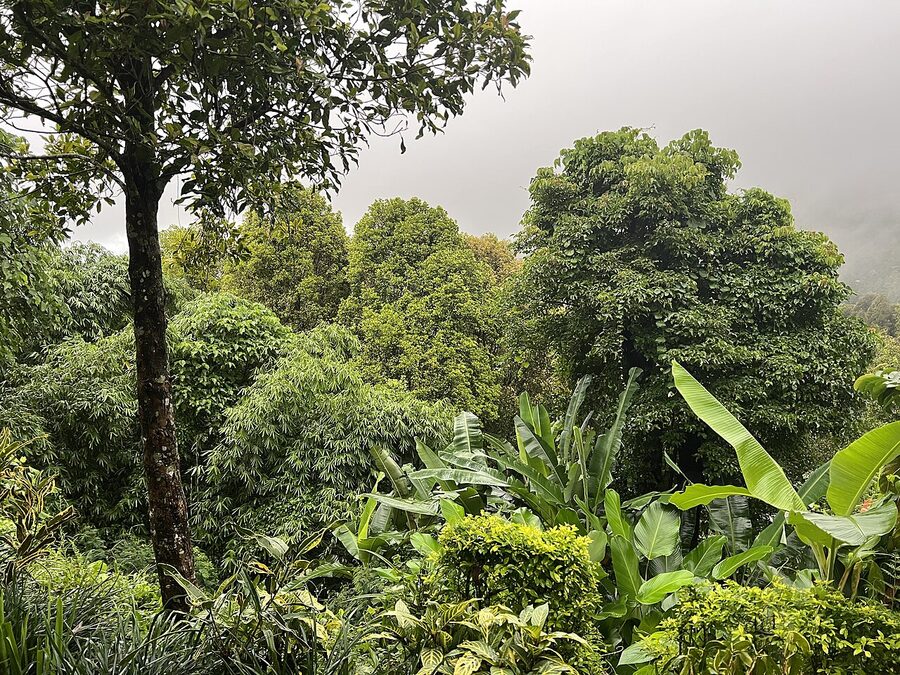
A walking trail through dense Bali greenery
The path down to the lower fall is short but slick after rain. Wear actual shoes, not flip-flops.

From the parking area, the path is signposted in faded paint to the right of the small bale banjar (the village’s open-walled community pavilion). You walk past a couple of warungs, then drop into a forested gully on a stepped path of dark volcanic stone. It is steep in two short sections and slippery in three more. Total walking time, ten to fifteen minutes downhill.

The first thing that hits you, before the fall comes into view, is the noise gradient. You go from frogs and chickens at the top to a thudding white roar at the bottom in maybe four minutes. Then a turn in the path opens out and Singsing 1 is right in front of you: a narrow plume off a black basalt cliff face, falling into a pool the colour of green tea. The pool is not as pristine as Instagram filters suggest. The colour comes from minerals (some say mild sulphur, in keeping with the geothermal area around Banjar), and there is usually a film of leaves and pollen on the surface. I would still swim in it. I have. It’s fine.

Better than the swim is sitting on a flat rock and just listening for fifteen minutes. I came at 8 a.m. on a Tuesday and had the place entirely to myself for forty minutes. By 10 a.m. it was busier, by noon there were maybe twelve people. Mornings are the right call.

The trail to Singsing 2 (the upper fall)

Up from the lower pool, the path continues. This is the part most day-trippers skip. It is a steeper track that takes another fifteen to twenty minutes uphill and a final scramble over wet rocks to a taller fall set in a tighter amphitheatre of jungle. The pool at the base is deeper and better for an actual swim, around chest height in the middle.

The path here is harder and the warning is real. After recent rain, the rocks are like wet glass and there are sections where a slip would mean a long, ugly fall. This is where I would take the local guide, and where the Rp 50,000 is well spent. If the upper fall has dried to a trickle in late August and September, turn back at the lower one.

When to go

Bali has two seasons, wet (roughly November to March) and dry (April to October). Each has tradeoffs at Singsing.

  • End of wet season, late February to early April: maximum water volume, both falls full, pools deep, jungle electric green. Slippery but manageable.
  • Early dry season, May and June: still good flow, much drier path, fewer mosquitoes. The best overall window.
  • Peak dry season, July to early September: lower flow, especially at Singsing 2 which can become a thin trickle. Lower pool still swimmable. Singsing stays quieter than south Bali falls because so few tourists make it up here.
  • Wet season, December and January: storms and a real risk of the path closing. Check with your guesthouse the morning of.

For time of day, the answer is always early. Be at the parking area by 8 a.m., at the lower fall by 8.15, swim before 9, hike the upper fall before 10. From mid-morning the light drops behind the cliff and the trickle of European tourists picks up.

What to bring

This is a short walk and a small fall, not a serious trek, but the basics matter:

  • Shoes with grip. Not flip-flops. Old running shoes you do not mind getting wet are perfect.
  • A dry bag or zip-loc for your phone. You will get spray on you near both falls.
  • Swimwear under your clothes, plus a sarong or quick-dry towel. No proper changing rooms.
  • At least a litre of water per person.
  • Small notes for parking, the donation, and a cold drink at the warung at the top on the way back.
  • Mosquito repellent in wet season.
  • A small bag for your own rubbish. The path is clean because visitors carry their plastic out.

The touts at the entrance, and what to actually say

The most annoying part of Singsing is not the trail. It is the small group of self-appointed “guides” hanging around the parking area trying to upsell. The opening line is usually that the path is “very dangerous” and you “must take a guide” for both falls. The path is not very dangerous to the lower fall. You do not have to take a guide if you have any hiking experience.

What works: a polite tidak, terima kasih (no, thank you), a smile, and continue walking. If you genuinely want a guide for the upper fall, agree the price up front, around Rp 50,000 to Rp 75,000 for both falls. If you do not want one, you are not being rude by saying no. Pay the parking attendant and the trail-maintenance volunteer regardless. Skipping the guide is fine. Skipping parking is mean.

Photography notes

You are shooting in deep shade in a tight gully, so the rules are different from a beach or rice-terrace shoot. Morning light between about 8 and 10 is when a thin shaft of sun reaches the lower pool through the canopy. Lock your white balance manually, the auto setting in tropical shade tends to go too cool. For long-exposure silky-water shots you will need an ND filter. Phone cameras handle this scene surprisingly well now, just step back from the spray. The classic shot is the lower fall framed by the overhanging vines on the right. The cliché shot is a person in swimwear standing in the middle of the pool.

Food and water before and after

There is no proper restaurant at Singsing itself. The two warungs at the trailhead sell bottled water, packaged snacks, instant noodles, and cold soft drinks. Useful, but not lunch.

Eat in Lovina before or after. Warung Bu Ana on the main road serves some of the best satay on this stretch of coast and a plate of nasi campur (mixed rice with three or four small dishes) for around Rp 25,000. La Costa Beach Lounge in central Lovina does ikan bakar (grilled fish) for Rp 80,000 to Rp 120,000, fresh from the dawn catch. For a cheap and proudly unspecial meal, any small warung along Jalan Raya Lovina will plate you up nasi goreng for Rp 20,000 to Rp 30,000 and the kind of sambal that makes you sweat a bit.

What to combine Singsing with

Singsing on its own takes about ninety minutes including the walk down and back. To make a real morning or half-day out of it, pair it with one or two of these. All are within a fifteen-minute drive.

Banjar Hot Springs (Air Panas Banjar)

Entrance to Banjar Hot Springs in north Bali, with souvenir stalls and visitors
The entrance to Banjar Hot Springs is humble, but the three terraced pools fed by carved dragon-mouth spouts are worth the small price. Bring a dry change of clothes. Photo by Jorge Lascar / Wikimedia Commons (CC BY-SA 2.0)

Ten minutes by scooter from Singsing, in the hills behind the village of Banjar, sit three terraced pools fed by mineral-rich, lukewarm sulphur water that pours out of carved stone dragon mouths. Entrance is around Rp 20,000 to Rp 30,000 for foreigners, depending on season. The water is not screaming hot, more bath-warm, but the smell of the sulphur and the sound of the carved dragons is fantastic. Locals come for the supposed skin-healing properties. Get there before noon, after that it fills up with bus tours.

If you want to follow the local way, some of the older Balinese still do a kind of melukat (a Hindu purification ritual) at hot or cool springs in this region. The ritual is not performed at Banjar specifically, but the sense that water is sacred and not just for swimming runs through every local interaction with these places. Be quiet and respectful. There is more on those traditions in our piece on Bali’s Hindu religion.

Brahma Vihara Arama Buddhist Monastery

Buddha statue at Brahma Vihara Arama monastery in Banjar, Bali
Brahma Vihara Arama is the largest Buddhist temple complex on Hindu-majority Bali. Sarong required, no entrance fee, donation expected. Photo by Eric Bajart / Wikimedia Commons (CC BY-SA 3.0)

Five minutes from the hot springs and tucked into a hillside above the village of Banjar Tegehe is the largest Buddhist temple complex in overwhelmingly Hindu Bali, Brahma Vihara Arama. Built in the 1970s, it includes a small replica of Borobudur, a meditation pavilion that is sometimes used for retreats, and gardens you can wander through quietly for an hour. Sarong is required at the entrance, they lend you one. There is no formal entrance fee but there is a donation box and Rp 20,000 to Rp 50,000 is expected.

It is genuinely tranquil and a good cultural counterpoint to a morning of waterfall and water. If you have any interest in the layered religious history of north Bali, an hour here will tell you more than a guidebook. For a wider read on what you are walking through, see our culture section.

Munduk and the Melanting / Banyumala falls

A tall waterfall in the jungle near Munduk, north Bali
If Singsing is the warm-up, Munduk is the main event. About thirty minutes uphill from Lovina, the cooler highland air alone is worth the drive. Photo by jmhullot / Wikimedia Commons (CC BY 3.0)

If Singsing left you wanting more waterfall, drive thirty minutes uphill into the cool highlands of Munduk and you have a string of bigger, more dramatic falls. Melanting and Munduk Tutub waterfalls are the easiest to reach, both around Rp 20,000 entrance, both involving a fifteen to twenty minute walk down and back. Banyumala Twin Waterfalls, slightly further, is one of the most photographed falls in north Bali for good reason. Sekumpul, about an hour east, is the biggest fall on the island at around 80 metres, but the trek down is steep enough that I would treat it as its own day trip rather than a Singsing add-on.

The Munduk drive is also worth doing for itself. You climb out of coastal heat into clove and coffee plantations, the air drops five degrees, and you pass two of the three holy lakes (Tamblingan and Buyan) on the way back if you loop south. There is more on north Bali nature trips in our beaches and nature section.

Lovina the night before, or the morning after

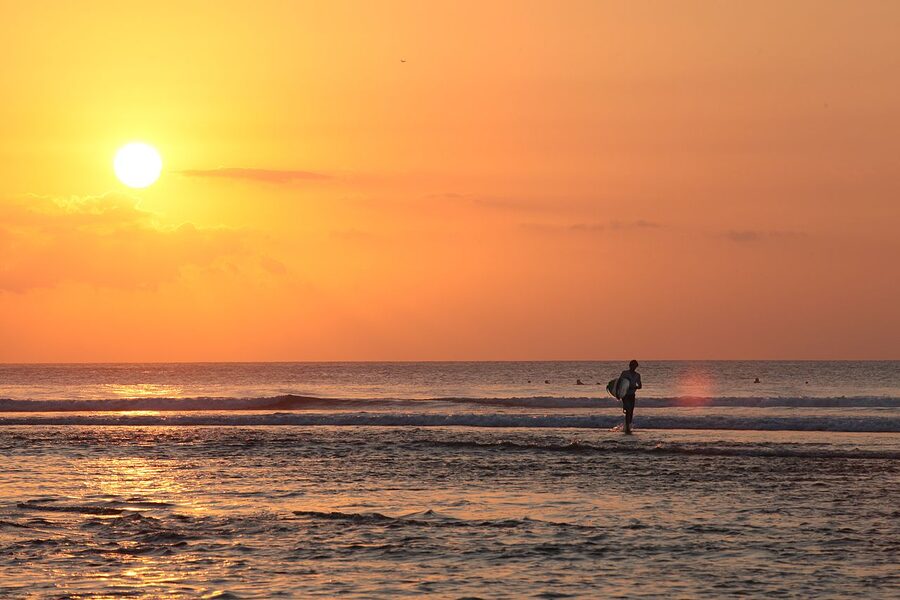
Sunset over a calm Lovina beach, north Bali
Lovina sunsets are quieter than the south coast equivalents, no beach clubs and no thumping bass. Photo by ind1go / Wikimedia Commons (CC BY 2.0)

The case for staying a night in Lovina is partly the falls and partly the dolphins. Lovina has a jukung (traditional outrigger fishing boat) tradition of dawn dolphin tours. The spectacle gets criticised online as too chaotic, with too many boats chasing the same pod, but early in the season (March, April, May) and mid-week, it is calm and lovely. A shared boat costs around Rp 100,000 per person, a private one Rp 200,000 to Rp 250,000 for up to four. Departure is 6 a.m. sharp from the beach in front of the dolphin statue. Back on the sand by 9 a.m.

Hotels in Lovina range from cheap (Suka Suka Homestay, around Rp 250,000 with breakfast) through mid-range (Lovina Beach Resort, Bagus Beach Resort, around Rp 700,000 to Rp 1,200,000) up to The Damai at around Rp 3,000,000. The owner at Suka Suka brings you tea in the morning and tells you which warungs to go to.

Dolphins, not just for show

Dolphins jumping near a Lovina jukung boat at sunrise
Early in shoulder season the dolphin pods are smaller and the boats fewer. Mid-week is calmer than weekends.

Three things to know. The dolphins are wild, sometimes you see fifty in a pod, sometimes none, treat it as a sunrise boat ride that occasionally features cetaceans. Push back politely if your skipper races other boats to chase a pod, responsible operators hold position. The boats are open-air outriggers and the temperature drops in dry season, bring a fleece. I forgot once and did not forget twice.

The Tugu Belanda detour for history nerds

If you walk past the upper fall and continue uphill on Jalan Singsing for another twenty minutes (or drive it), you reach the Tugu Belanda, a roughly fifteen-metre white obelisk built by the Dutch colonial administration to commemorate the soldiers who died in the Banjar war of 1868. The original obelisk was destroyed in the 1950s as an Indonesian nationalist statement, then rebuilt in 1992 as a record of Balinese resistance rather than Dutch glory. There are no plaques in English. Worth the half-hour if you read Indonesian or use a phone translator. If not, you are not missing the falls.

Things people get wrong about Singsing

  • “There is a Rp 50,000 entrance fee.” There is not. There is parking and an optional donation. If anyone charges Rp 50,000 to enter, you are being scammed by an opportunist.
  • “It is the most beautiful waterfall in Bali.” It isn’t. It’s a small, pretty, accessible waterfall that’s good for a quiet morning. If you’ve only got one day for waterfalls and you’re coming from the south, drive to Sekumpul or Banyumala instead.
  • “You need a 4×4 to get there.” You need a scooter or a normal car. The road is paved.

A practical itinerary if you only have one morning

One morning in north Bali, starting from a Lovina hotel:

  • 5.45 a.m.: walk five minutes to the dolphin statue.
  • 6.00 a.m.: dolphin tour departs. About two hours on the water.
  • 8.15 a.m.: back on the beach, breakfast at the hotel.
  • 9.30 a.m.: ride fifteen minutes to Singsing. Park, hike, swim.
  • 11.00 a.m.: ride ten minutes to Banjar Hot Springs.
  • 12.30 p.m.: ride five minutes to Brahma Vihara Arama.
  • 1.45 p.m.: back to Lovina, lunch at La Costa or Warung Bu Ana.
  • 3.00 p.m.: nap. You earned it.

That is aggressive, and you will have seen dolphins, two waterfalls, a hot springs, and a Buddhist temple by the time south Bali tourists are finishing breakfast. For the relaxed version, drop the temple or the hot springs, add a slow lunch.

Stop if

Skip Singsing if you’ve only got three days in Bali and you’re based in the south; the maths doesn’t work. Skip it in heavy December storms, the trail genuinely closes sometimes. And skip the upper fall if you are travelling with small kids or have any knee issue, the lower one is enough.

Otherwise, set a 6 a.m. alarm in Lovina, eat a banana, hire a scooter, and go. The road is short, the parking is cheap, the falls are quiet, and that combination is harder to find on Bali than it used to be. For more on what to do in this part of the island, see our things to do section.