Ngaben: The Balinese Cremation Ceremony
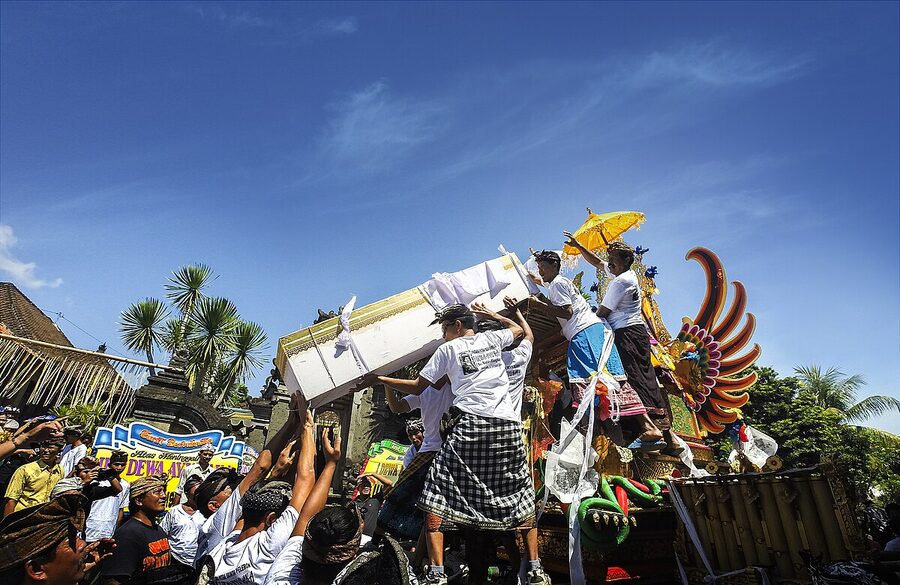
The procession came around the corner of a side road off Jalan Raya Andong in Ubud and I almost walked straight into it. Twenty men under a bamboo platform, the platform carrying a tower maybe four metres tall painted in red and gold, the family in white walking ahead, the gamelan in the back of an open-bed truck. I had been on the way to lunch and stopped because there was no choice. Two Australian tourists nearby were filming on their phones from the front. A woman in white came over, said something quietly, and the phones went down. The procession moved past, the tower swaying with each step, and the road that had been a road thirty seconds earlier was now somebody’s funeral.

Ngaben pelebon procession with bade tower carried by family bearers in Bali
A pelebon procession in Ubud. The tower is heavy enough that bearers swap out every few hundred metres. Photo: shankar s. / CC BY 2.0 (via Wikimedia Commons)

What I had stumbled into is called ngaben (eng-AH-ben), the Balinese cremation ceremony. What I want to do here is the thing nobody quite did when I started reading about it: explain what is actually happening, why it matters this much to the family, and how to be near one without making it about you.

This is the most important ceremony in this person’s life. It is also, very often, the most expensive and most logistically complicated week the family will undertake for a decade. If you are in Bali while one is happening near you, you are watching something the family has saved for, planned for, and prayed for. Treat it that way.

Ngaben is a cremation, but mostly it is a release

The English word “cremation” gets the mechanism right and the meaning wrong. Ngaben comes from api, meaning fire, and the point of the fire is not to dispose of a body. The point is to free the soul, called atman or atma, from the physical shell holding it.

Balinese Hindu cosmology teaches that the body is built from panca mahabhuta, the five great elements: earth, water, fire, air, and ether. When somebody dies, those five elements are still bound up in the body, holding the soul to the material world. Burning is the only ritual considered powerful enough to break the bond and return each element to where it came from. The soul, once freed, can either reincarnate into a new body, very often a newborn in the same family line, or in rare cases reach moksha, full liberation from the cycle of rebirth.

Ngaben pyre symbolic procession returning the five elements to the universe Bali
The fire returns the five elements to the universe. The white cloth is a guide rope for the soul. Photo: Nyengendadi / CC BY-SA 4.0 (via Wikimedia Commons)

This is the bit that tripped me up the first time I read about it. The funeral does not look like a Western funeral because it is not really a funeral. It is closer to a launch ceremony. There is grief, there is family in white, there is incense, but there is also gamelan music loud enough to feel in your chest, kids running, and the deliberate festive atmosphere the Balinese consider the correct send-off. Open weeping is discouraged. The teaching is that tears can become a hurdle, slowing the soul down at the moment it needs to be free.

If you have read the Balinese Hinduism guide on this site, you will recognise where ngaben sits in the larger framework. Balinese ritual life is organised into five categories of sacred duty called Panca Yadnya, and the category that contains ngaben is Pitra Yadnya, sacrifices for the ancestors. The event is, in Balinese eyes, the family discharging a debt to the dead. It is not optional. Skipping it is considered a failure of duty so serious that families will go into debt or wait years for the right communal ceremony rather than not do it.

The wadah and the lembu, or how to read the procession

Two objects do most of the visual work in a ngaben procession, and once you can name them you can read what is going on.

The first is the wadah, sometimes called the bade: the multi-tiered tower you see being carried. Built from bamboo, wood, paper, gold leaf and dyed cloth in the weeks before the ceremony, it is a model of the Balinese cosmos. At the base sit a turtle and two snakes, representing the underworld. Above that comes a section painted with leafy forests, the world of humans. At the top sits a small pagoda called a meru, representing heaven, the realm the soul is travelling toward.

Wadah bade cremation tower being carried through Bonyoh village Karangasem Bali
A smaller wadah on its way through Bonyoh village in Karangasem. The dust kicks up when bearers break into a half-run. Photo: Imadedana / CC BY-SA 4.0 (via Wikimedia Commons)

The number of tiers signals the family’s social standing and the spiritual weight of the deceased. A regular family ngaben might use a one-tier or three-tier tower. A royal cremation, called pelebon, can run to nine tiers and stand ten or fifteen metres tall, which is why royal ceremonies need bamboo bracing crews and electrical workers to lift cables along the route.

The second object is the lembu, the bull-shaped sarcophagus that receives the body for burning. The bull is not random. It is Nandi, the mount of Shiva, and Shiva in Balinese Hinduism is the destroyer-transformer aspect of the divine, the god most directly associated with the dissolution of form. Putting the body inside Nandi for cremation is, conceptually, handing the deceased directly to Shiva for the next stage of the journey.

Decorated red lembu bull sarcophagus with ceremonial umbrellas before ngaben Bali
A red lembu waiting on its bamboo platform. The colour and ornamentation usually take a banjar’s craftsmen weeks of work. Photo: shankar s. / CC BY-SA 2.0 (via Wikimedia Commons)

Caste reads off the lembu too. A white bull is traditional for a Brahmana, the priest caste. Black bulls or, in some regions, lions and deer are used for other castes. Smaller animal effigies appear depending on village tradition: gold-painted bulls, fantasy beasts called singha with lion bodies and elephant trunks. None of it is decorative. Each form encodes who the deceased was.

The procession through the village is meant to be confusing

The first time you watch a procession move through narrow village lanes, the route looks chaotic. Bearers run a few metres, stop, hoist the tower up and down, spin it through a half-turn, then run another stretch. At every intersection they spin the tower again, sometimes a full three rotations.

The chaos is the point. The route is being deliberately disordered to confuse the soul, which at this stage is loose between the body and the cosmos. If the soul could remember the way back to the family compound, the belief goes, it might try to return and become trapped on earth as an unhappy spirit. Spinning the tower at intersections breaks its sense of direction. The spirit, disoriented, looks up to the meru at the top of the tower and travels onward instead.

Ceremonial Balinese funeral procession with locals carrying an ornate white bull effigy through a village street
A white bull lembu under bougainvillea. The bearers will spin the platform a half-turn at the next junction.

The gamelan that walks behind the procession is a specific percussion ensemble called gamelan beleganjur, sometimes translated as “battle gamelan”. The original purpose was to scare off demons along the route. The cymbals and gongs are played at a marching pace, slightly off-beat, deliberately chaotic. It is the sound that, if you are anywhere in the village, will tell you a procession is coming before you see it.

Gamelan beleganjur musicians in white seated at ngaben procession Bali
A gamelan beleganjur ensemble waiting under a banyan tree before the procession sets off. Photo: shankar s. / CC BY 2.0 (via Wikimedia Commons)

The setra: where the burning happens

Every Balinese village has a setra, a dedicated cremation ground usually on the seaward edge of the village in line with the temple of the dead, the Pura Dalem. They tend to be open fields with permanent bamboo structures, ash-darkened ground, and a few bale shelters for priests and family.

The wadah arrives. Bearers lower it onto a pavilion. The body, wrapped in white cloth and accompanied by holy water and offerings, is transferred from the tower into the lembu. The priest, called a pemangku for village ceremonies or a pedanda for the full Brahmin priesthood, performs the final mantras. Family members place small personal items inside the lembu: a favourite shirt, prayer beads, photos.

Balinese pemangku priest in white holding traditional offerings during a ceremony
A pemangku in his white headcloth, offering basket in hand. The bamboo handle is for sprinkling holy water onto the lembu before the fire is lit.

Then comes the fire. Traditionally the priest lights a sacred torch and the lembu is set alight from underneath. In modern practice many families use a propane blowtorch to get the fire going quickly and reliably. It is not disrespect, it is a practical concession to wet-season humidity and the ritual calendar’s time windows.

Lembu bull effigy fully burning during a Balinese ngaben cremation ritual
The lembu fully alight. The white cloth on the bamboo overhead is a baldachin protecting the priest’s working space. Photo: shankar s. / CC BY 2.0 (via Wikimedia Commons)

The burning takes hours. Family members stay throughout, sometimes singing, often quiet, occasionally sharing food. Other villagers rotate in and out. The wadah, used for the procession but not the actual cremation, is broken up and burned alongside, returning all of its symbolism to ash.

Burning ngaben pyre with cremation tower elements in a Bali village setra
Mid-afternoon at a village setra. The crowd gradually thins as the fire burns down, but family stay. Photo: Krisnayuda3 / CC BY 4.0 (via Wikimedia Commons)

By evening the lembu is reduced to ash, charred bamboo and a small pile of bones. The family returns the following day to collect the ash, place it in a yellow coconut shell or similar container, and prepare for the next stage.

Twelve days later: the nyekah and the dispersal

The fire is not the end. Twelve days after the cremation, in most traditions, the family performs nyekah, the dispersal ceremony. The collected ashes are carried in procession to the sea or, if the village is far inland, to a flowing river that reaches the sea.

The procession is smaller than the cremation parade and quieter, immediate family rather than the whole village. At the water, the priest performs further mantras and the container of ash is poured into the surf. Returning the elements to the ocean completes the cycle. The body’s earth and water rejoin earth and water, the fire has done its work, and the soul, now fully unbound, is free.

Ngaben procession at the sea Nusa Penida Bali with bade tower carried into shallow water
A coastal village ngaben on Nusa Penida. The tower is taken into the shallows for the final dispersal. Photo: Imadedana / CC BY-SA 4.0 (via Wikimedia Commons)

Some families perform an additional rite weeks or months later called memukur, in which a small effigy of the deceased is consecrated and burned. This ceremony elevates the soul to the status of a deified ancestor who can be petitioned and remembered at family temple anniversaries. From that point on, the deceased is no longer a recently-departed individual but an ancestor of the family line, addressed at every family ceremony for generations.

What it actually costs, and why ngaben massal exists

A solo ngaben is expensive. The wadah and lembu have to be commissioned and built. The priest receives a fee. The gamelan has to be paid. The whole village turns up to help and they need to be fed, sometimes for two or three days. Offerings, called banten, are crafted by the women of the family for weeks using fresh flowers, palm leaves, fruit, rice cakes, and small symbolic items, and the materials add up.

Balinese canang sari offering with flowers, rice and incense on dark stone
Banten in their simplest daily form, a canang sari. A ngaben ceremony will use thousands of these plus much larger offerings.

The cost band you will hear quoted is roughly Rp 30 million to Rp 150 million (about $1,900 to $9,500) for a private family ngaben, with the upper end much higher again for elaborate ceremonies. That is a serious sum in a country where the average rural Balinese family income is a small fraction of that figure per year.

Which is why ngaben massal exists. A mass communal ceremony, organised by the local community council called the banjar, gathers families across the village who have lost loved ones in the past few years. They share the wadah, the priest, the gamelan, the offerings, and the catering. A single ngaben massal might process and cremate twenty or fifty bodies on the same day, dropping the cost per family to roughly Rp 5 to 10 million (about $320 to $640) per individual.

Ngaben massal mass communal cremation ceremony at Padangtegal Ubud Bali with multiple wadah towers
A ngaben massal at Padangtegal in Ubud. Each tower carries a separate family’s deceased; the village runs the ceremony every five to ten years. Photo: Kochiana / CC BY-SA 4.0 (via Wikimedia Commons)

This is why you will sometimes hear that a body has been temporarily buried for years before the cremation. The family is not neglecting the dead. They are waiting for the next ngaben massal so the ceremony can happen properly without bankrupting them. The temporary grave at the village Pura Dalem is a holding state, not a final resting place. When the ceremony comes, the bones are exhumed, cleaned, and brought to the cremation ground. Banjars typically organise a ngaben massal every five to ten years; in larger villages, every two or three.

Bali group cremation ceremony 2013 ngaben massal multiple pyres at sunset
Late afternoon at a group cremation. Multiple pyres burn at once during a ngaben massal; the smoke is part of the ritual atmosphere, not an accident. Photo: Daniel Hoherd / CC BY 2.0 (via Wikimedia Commons)

Royal pelebon: when ngaben becomes a public event

A small fraction of cremations are royal ceremonies, called pelebon rather than ngaben, and these are scaled up to a degree that has to be seen to be understood. Royal pelebon use towers of nine tiers or more, lembu the size of small trucks, processions involving thousands of bearers working in shifts, and crowds of tens of thousands lining the route. The Ubud royal family has held several over the past two decades and each has made international news.

If a pelebon is happening during your stay you will know about it. The local press, your hotel, your driver, and the warung ibu down the road will all mention it. Schools close. Roads close. The whole town turns out. These are the only ngaben that come close to being a public spectacle, and even then it is a public ritual, not entertainment. Behave accordingly.

So can you actually attend, and how?

Mostly you do not attend in any active sense. Mostly you witness. There is a meaningful difference.

If you happen to be in a village when a ceremony is happening, observe from the side, give the family room, and let the procession move past you the way the locals do. Do not follow it into the cremation ground unless you are explicitly invited. Most cremations are private family affairs even if the procession is on a public road, and most family members are happy for respectful onlookers to witness from the edges as long as the onlookers behave.

Balinese ngaben procession with ceremonial red umbrellas and bearers in white
Onlookers standing back from the procession. Note the distance the umbrella-bearers maintain from the actual route.

If you are invited to a private ngaben, usually because you are connected to the family or the homestay where you are staying, you go in proper dress, you bring a small donation, and you follow the lead of the family and the priest at every step. Mass ngaben and royal pelebon are by their nature more public; the rules of respect do not change because the crowd is bigger.

Respectful-observer rules I wish someone had told me first

These are not Western etiquette politeness. They are specific things the family will notice and that other Balinese onlookers will, quietly, judge you for if you get them wrong.

Dress. White or muted dark colours, never bright resort wear. Cover shoulders and knees. If you are close to the ceremony, a sarong and sash are required, the same as for entering any temple. Sarong shops near the procession rent or sell them for around Rp 50,000 to Rp 150,000 (about $3 to $10).

Stand lower than the family and the priest. Spiritual hierarchy in Bali is partly literal. Your head should never be above the head of a priest, a family elder, or any of the bearers carrying the deceased. Don’t climb a wall for a better photo.

Do not photograph the body. This includes the moment the body is transferred from the wadah to the lembu, and the body once it has been placed inside. The procession itself is photographable from a respectful distance with the family’s tacit agreement; the body is not.

Ask before photographing the family. Wide procession shots of the bearers, the gamelan, the tower in motion are usually fine. Close-up portraits of grieving family members are not, unless someone has nodded yes.

No drones. Ever. A drone over a ngaben procession is the single fastest way to get every Balinese person within a kilometre furious with you. The airspace above a soul-release ritual is not yours to fly through.

Black and white image of crowd at a Balinese offering ceremony in white dress
If you are close enough to the family that you are part of the crowd, you are close enough to be in white. The dress code matters.

Do not step over offerings. Banten on the ground are altars. Step around them, never over. Do not point your foot at a priest, an offering, or any sacred object.

Stay quiet during the prayers. Conversation during processions and meal breaks is normal; conversation during the priest’s mantras is not.

Donate quietly. Most ceremonies have a discreet donation box near the entrance. Rp 50,000 to Rp 100,000 (about $3 to $6) is a normal amount; more if you have been personally invited. Hand it over with two hands, no fuss, no photo.

Leave when asked, immediately. If anyone, family or banjar volunteer, indicates you should leave or move, you do, without negotiation. There may be a stage of the ritual that is not for outsiders.

How to know one is happening before you walk into it

Ngaben do not run on a published calendar. The date for each ceremony is chosen by the priest in consultation with the family, based on the 210-day Balinese pawukon calendar and the auspicious days within it. The short version: you will not know in advance unless someone local tells you.

Which means the practical advice is to ask around. If you are staying in a village in the Ubud area, in Gianyar, in Bangli, in Karangasem, or any of the older inland villages, mention to your homestay host or driver that you are interested in seeing a procession respectfully if one is happening. They will often know what is on in the next week.

Balinese gamelan musicians playing percussion instruments at a village ceremony
Gamelan groups rehearse for ceremonies in the days before. If you hear a beleganjur ensemble practising in the late afternoon, a procession is coming up.

Other clues. White and yellow cloth tied around banjar gates often signals an upcoming ceremony. The sound of gamelan rehearsal in the late afternoon, a few days running, is a strong sign a procession is being prepared. Asking at a warung is an underrated tactic; the ibu who has been there forty years knows the village calendar better than any guidebook. Order a plate of nasi goreng, eat slowly, and ask politely whether there are any upacara coming up.

What you might see if you stay long enough

If you spend more than a week or two in Bali, especially outside the south coast bubble, the odds of stumbling into a procession get high. Across the island, with hundreds of villages and the long delays between death and cremation, there are ngaben happening somewhere most weeks of the year.

The most likely first encounter is a small village procession: a modest wadah, a smaller lembu, perhaps fifty people in white walking ahead, the gamelan in a pickup truck, scooters held up behind. Ten or fifteen minutes to pass. Busy rather than solemn. A ngaben massal, when one happens, is bigger by an order of magnitude: multiple wadah lined up at the assembly point, several lembu in different colours, gamelan ensembles from three or four villages combined, a crowd in the thousands.

Balinese woman in yellow kebaya praying by the sea with offerings on a stone platform
The sea is where the cycle ends, twelve days after the fire. Offerings are usually left at the water’s edge by individual family members.

“Should I even be here?”

I have thought about this question every time I have been near a ngaben and I have not arrived at a clean answer. The family is grieving. The ceremony is sacred. The tourist on the corner taking phone photos is, on the face of it, an intrusion.

What I have settled on is this. The Balinese themselves treat ngaben as a public ritual in the sense that the procession runs on a public road and the village setra is open ground. Locals from neighbouring villages turn up and watch all the time. An outsider who behaves the way the locals do is, in my experience and in what Balinese friends have told me, considered a respectful witness to something that is, by religious design, communal.

Balinese temple altar with fruit offerings smoke and priest in white during ceremony
The offerings table at a ceremony. Even the food laid out for guests is part of the ritual structure, not catering.

The line gets crossed when the witness becomes the consumer. The selfie taken with a burning lembu in the background. The drone overhead. The tourist who grabs at the procession to get to the front. A camera shoved in a child’s face. These are the things I have seen go wrong and they have always made me wince.

Ngaben is one of the moments when Bali shows you what it really runs on. The temples and the rice terraces and the beach clubs are surface. The thing underneath is a community that has chosen to spend a meaningful chunk of its time and money and labour on the proper release of its dead, and that does this not as a tourist performance but as the central duty of being Balinese. If you can stand at the side of a road and witness that without making it about yourself, you are doing the right thing.

Ngaben sits inside the broader category of Balinese sacred duty I touched on at the top. The culture archive on this site covers Galungan, Nyepi, melukat purification, and the temple system that all of it operates within. If you are still in the early planning stages, the flights to Bali primer handles the logistics of getting here, and the things to do archive rounds out the rest.

Should you stumble into a procession on your way to dinner, the way I did off Jalan Raya Andong, my advice is this. Stop. Move to the side. Take your hat off. Watch. Be quiet. When it has passed, walk on. The family will have been doing this for weeks before you arrived and they will be doing it for days after you leave. Your job is to be a small, respectful presence at the edge of something that is not yours.

Balinese Hinduism: A Traveler’s Guide to Agama Hindu Dharma

Six in the morning in Sanur, and I’m watching an ibu in a kebaya bend down on the kerb outside her warung to set down a small palm-leaf tray. There’s a marigold on top, a smear of red rice, a cracker still in its wrapper, and a single stick of incense already smoking. She wafts the smoke upward with her right hand, mutters something I can’t make out, and walks back inside. Two metres away her son is hosing down the pavement; the offering will be stepped on, swept off, possibly eaten by the cafe dog within the hour. She’ll make another one tomorrow at sunrise, and the day after, and every day until she dies.

That tray is called canang sari (essence basket), and what I just described isn’t decoration or folklore. It’s the daily front line of a religion that the woman herself, if you asked, would name Agama Hindu Dharma (Hindu Dharma religion). Most travel writing flattens it to “Bali is Hindu” and moves on. The longer you stay, the more you realise the religion behind what you’re watching is older, weirder, and far more specific than the word “Hinduism” suggests on its own.

Two canang sari offerings stacked on a stone shrine in Bali, with incense smoking and flowers, rice and a small cracker on top
The morning canang sari, photographed before anyone has had a chance to step on it. The cracker on top is a recent addition; small treats for the spirits are very Balinese.

What “Balinese Hinduism” actually means

Bali is the only Hindu-majority province in Indonesia, in a country where Hindus make up just 1.7% of the population. About 87% of Balinese identify as Hindu, which works out to roughly 3.8 million people on the island, and they are the largest single concentration of Hindus in Indonesia. The religion has an official state name, Agama Hindu Dharma, and a national council called Parisada Hindu Dharma Indonesia that handles theology and ritual standards. So far, so tidy.

It gets complicated when you start asking how Balinese Hinduism actually relates to the Hinduism practised in India. The honest answer is: not very directly. Hindu and Buddhist ideas began arriving in the Indonesian archipelago from around the first century CE, mostly via Java rather than straight from India, and they were grafted onto a much older Austronesian layer of ancestor worship, animism, and sacred-landscape beliefs. Those older beliefs were never really displaced. They were folded in. You see them most clearly in the Bali Aga villages of the central highlands, where the temple Pura Pucak Penulisan still venerates squatting ancestral statues that have been dated to roughly 2,000 years old.

The shape you see today was largely set after the collapse of the Hindu-Javanese Majapahit empire. In 1343 Majapahit’s Prime Minister Gajah Mada conquered Bali, and over the next two centuries Javanese aristocracy, Old Javanese (Kawi) literature, temple architecture, and Brahmanical ritual flowed across. As Islam rose on Java in the 15th and 16th centuries, more Hindu courts, priests, and artists fled east. The most influential, the priest Dang Hyang Nirartha, arrived in 1492 and reshaped the priesthood; he popularised the empty stone-throne padmasana shrine you see in temples all over the island.

The strangest chapter is more recent. In 1952 the new Indonesian Ministry of Religion decided that to count as an officially recognised religion you needed a single supreme god, a holy book, codified law, and a prophet. Balinese Hindus were declared “people without a religion” and theoretically up for conversion. They didn’t accept it. Through a series of student exchanges with India and a long internal debate, they reframed Balinese Hinduism as monotheistic, articulated Sang Hyang Widhi Wasa as a single supreme principle, and got Hindu Dharma formally recognised in 1958. So when you read that the Balinese worship “one supreme god behind many manifestations”, that wording is partly theology and partly a 20th-century compromise with Indonesian state law. Both things are true at once.

The supreme god, the trimurti, and the cast of thousands

The supreme being is Sang Hyang Widhi Wasa (the Divine Ordainer of the Universe), sometimes shortened to Acintya, “the unimaginable”. Officially he is the source of everything; in practice, very little daily worship is directed at him by name. Most ritual life is aimed at the manifestations.

The big three are the trimurti: Brahma the creator (red, the south), Wisnu the preserver (Vishnu in Indian Hinduism, blue or green, the north), and Siwa the destroyer-transformer (Shiva, white, the east). In Bali, Siwa often holds the central position because of the Shaivite priesthood Nirartha set up. Beyond the trimurti you get a sprawling pantheon, plus deities you won’t find in India at all. Dewi Sri (the rice goddess) is the one to know if you spend any time in the rice terraces; she predates Hinduism’s arrival but has been gently aligned with Lakshmi over the centuries, and farmers still build small bamboo shrines to her in the paddies.

Then there are Hyang (spirits of mountains, trees, springs, and rivers), Bhatara Kala (god of time and dangerous transitions), Rangda the witch-queen locked in eternal combat with the lion-like protector Barong in dance dramas, and Bhoma, the wide-mouthed face guarding temple gates and front doors. And there are the deified ancestors, Bhatara Kawitan, founders of family lines venerated at clan temples and (in the Balinese view) still capable of influencing the lives of the living.

If that sounds polytheistic, the official answer is technically no, because everything is a manifestation of Sang Hyang Widhi. The lived answer is that the cast is enormous and people have favourites, and that’s the point.

The five duties: Panca Yadnya

The framework that organises ritual life is the Panca Yadnya, the five sacred sacrifices. Yadnya means a sincere offering, not just goods on a tray; the labour and intention count as much as the materials. Every ceremony you watch in Bali fits into one of these five.

  • Dewa Yadnya, offerings to gods and deities. The temple-festival side: Galungan, Saraswati, Pagerwesi, the temple-anniversary odalan.
  • Pitra Yadnya, duty toward ancestors and the dead, including the ngaben cremations and family-shrine offerings to remembered ancestors.
  • Manusa Yadnya, the human life-cycle: birth rituals, the first 105 days when a baby may not touch the ground, the otonan 210-day birthday, the puberty metatah tooth-filing, weddings.
  • Resi Yadnya, the duty to support priests and religious teachers.
  • Bhuta Yadnya, offerings to the lower spirits and chaotic forces. This is why you see segehan, small offerings on banana-leaf squares, scattered on the ground at thresholds and crossroads. You’re feeding the rough crowd so they don’t make trouble.

That fifth one is quietly the most interesting. Most religions try to expel the malevolent forces. Balinese Hinduism feeds them. The whole worldview is balance between sekala (the seen) and niskala (the unseen), and between constructive and destructive energies, not the elimination of one side. The same family that sets out a beautiful canang sari at the household shrine in the morning will toss a rougher segehan, with a splash of arak, on the ground at the gate to keep the bhuta fed. It isn’t superstition tacked onto religion. It is the religion.

Two calendars, no Diwali

Bali runs on two religious calendars at once, and you need to roughly understand both or you’ll never know what’s happening on a given day.

The first is the Pawukon, a 210-day cycle made up of ten concurrent week systems running from one to ten days long. Most temple anniversaries (odalan), Galungan, Kuningan, Saraswati, Pagerwesi, and the Tumpek series are calculated off the Pawukon. Because 210 days fits inside a solar year more than once, festivals like Galungan happen twice in some calendar years. In 2026, Galungan falls on 17 June and Kuningan on 27 June; in 2027 it’s 13 January and 23 January.

The second is the Saka, a lunar calendar inherited from India and roughly 78 years behind the Western year. It governs Nyepi, the Day of Silence, which marks Saka new year and falls each March. In 2026 Nyepi is on 19 March; in 2027 it’s 9 March. There’s no Diwali in Bali, by the way. Galungan is the rough functional equivalent (good over evil, ancestors visiting), but the calendar is different and the rituals are completely Balinese.

Galungan and Kuningan: the ancestors come home

Tall arching bamboo penjor pole decorated with palm fronds and offerings, installed at the side of a road in Ubud during Galungan
If you arrive in Bali and see arched bamboo poles like this lining every village road, you’re inside the Galungan window. The penjor goes up the day before and stays for over a month. Photo by Tigerente / Wikimedia Commons (CC BY-SA 4.0).

Galungan is the most important annual festival and the easiest to miss as a traveller because no single day is the spectacle. It’s a ten-day stretch celebrating the victory of dharma over adharma, with the ancestral spirits descending to visit the family compounds and returning to heaven on Kuningan, ten days later.

The visible sign is the penjor: bamboo poles three or four metres tall, bent at the top under the weight of palm-leaf decorations, rice cakes, and small offerings, planted in front of every Hindu household up and down the village road. The day before Galungan is Penampahan, when families slaughter pigs and chickens for the feast. The day after is Manis Galungan, family-visiting day. Then Kuningan itself, marked by yellow rice (kuning means yellow) offerings and prayers in the morning before noon.

If your trip overlaps with Galungan, drive a back road through any village in the morning to see the penjor properly. And if you’re invited to a family compound, accept; this is the one week of the year when Balinese family life is at its most welcoming and most concentrated.

Nyepi and the night of the ogoh-ogoh

A large papier-mache ogoh-ogoh demon effigy carried on a bamboo platform by men in red shirts during a Bali parade
An ogoh-ogoh on parade the evening before Nyepi. Each banjar makes its own; the bigger and uglier, the better. They’re burned later that night so the demons inside have nothing to come back to. Photo by FaizAttariqi / Wikimedia Commons (CC BY-SA 4.0).

If Galungan is the festival you might miss, Nyepi is the one you cannot. The Day of Silence runs 06:00 to 06:00 the next morning and the entire island shuts down: no flights in or out, the airport closes, all roads close, no fires or electric lights at night, no work, no travel, no entertainment. The only people on the streets are the pecalang, customary security men in black-and-white check sarongs who patrol to make sure nobody breaks the rules. Tourists are not exempt. You can do as you like inside your hotel with the curtains drawn but you cannot leave. Two Polish nationals were deported in 2023 for ignoring this. Don’t be them.

The day before is the spectacle. In the afternoon every banjar parades its ogoh-ogoh, a giant papier-mache demon built over a bamboo frame and decorated with cloth, paint, and tinsel. They’re hauled around the streets to draw out evil spirits, then burned in cemeteries that night so the spirits have nothing to inhabit. Younger Balinese spend weeks building these and the artistry has become genuinely impressive; some of the better ones get bought by museums afterward.

Three to four days before Nyepi is Melasti, the procession to the sea. Long lines of villagers in white walk to the nearest beach, carrying the sacred objects from their temples on canopied litters, to be cleansed in salt water. The 2026 Nyepi date is 19 March; Melasti runs in the days before.

The Day of Silence itself is genuinely something. With every motorbike off the road and the airport closed, Bali becomes the quietest tropical island on earth. The night sky over Ubud or Sidemen on Nyepi is among the best stargazing of any populated place I’ve been. Just don’t try to walk to a viewpoint to see it; you’ll get a polite escort back to your room.

Saraswati, Pagerwesi, and the Tumpek series

Beyond Galungan and Nyepi, the Pawukon throws up a steady drip of smaller festivals across the year. Saraswati (Saturday in the last week of the Pawukon) honours the goddess of knowledge. Books and lontar manuscripts are blessed at home and at school. The reading-of-books-is-not-allowed rule for the day itself is one of those Balinese paradoxes; the books are for honouring, not for use. Four days later comes Pagerwesi, the “iron fence” day, when people fortify themselves spiritually against negative forces. Quieter, more inward, mostly spent in prayer.

The Tumpek series runs through the Pawukon every 35 days and dedicates a Saturday to a different category of beings. Tumpek Landep blesses metal objects, originally weapons and now cars, motorbikes, and laptops; if your scooter has fresh palm-leaf decorations on the handlebars one morning, that’s why. Tumpek Uduh (also called the Green Festival) blesses trees and plants. Tumpek Kandang blesses livestock and pets, the day when you see Balinese farmers feeding their cattle special offerings and city dogs in temporary tinsel collars.

The temple system: every village has three, every coast has its own

The split candi bentar gateway at Pura Lempuyang in east Bali, framing the cloudy mountain landscape between the two stone halves
Pura Lempuyang in the east, one of the directional temples that anchor the island’s spiritual perimeter. The famous photo with the mountain reflected in a “lake” between the gates is staged with a mirror under the camera; the actual view is this one and it’s better.

The conservative count is over 20,000 temples on the island. Bali has no real shortage of pura. They aren’t congregational in the church sense; people come for festivals and family rites, not weekly services, and most of the time a temple is empty except for the resident priests and the daily housekeeping.

The basic template you’ll see in every traditional village is the kahyangan tiga, the three village temples. Pura Puseh is the temple of origin, dedicated to the ancestors and the village founders. Pura Desa is the central village temple, used for community ceremonies. Pura Dalem, often near the cemetery on the seaward (kelod) side of the village, is dedicated to Durga and the chthonic forces; it handles death rites and the spirits of the recently dead. Three temples per village times the number of villages on Bali is most of how you get to 20,000.

Above the village level is the sad kahyangan, the six (or by some counts nine) directional great temples that anchor the spiritual geography of the island. The list varies but commonly includes Pura Besakih (the mother temple, on Mount Agung), Pura Lempuyang (east, with the famous “Heaven Gate”), Pura Goa Lawah (the bat cave on the southeast coast), Pura Luhur Uluwatu (southwest, on the cliff), Pura Luhur Batukaru (west, on Mount Batukaru), and Pura Pusering Jagat (centre, in Pejeng).

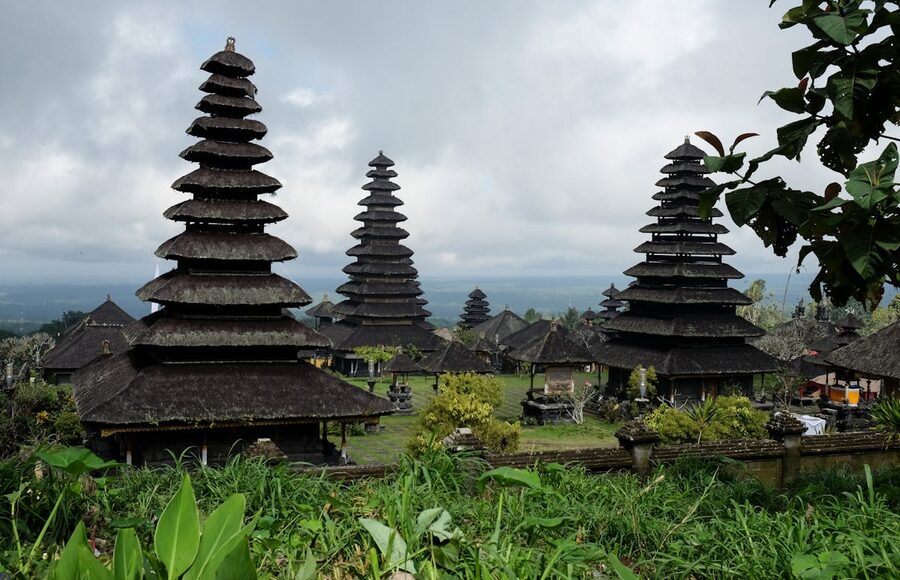
Pura Besakih, the mother temple

Besakih is the holiest temple in Bali, a complex of 23 separate temples spread over six terraced levels on the southwest slope of Mount Agung at almost 1,000 metres elevation. Stone bases at several of the temples resemble megalithic stepped pyramids and have been dated to at least 2,000 years old; the site was almost certainly sacred long before Hinduism arrived. By the 15th century Besakih was the state temple of the Gelgel dynasty. The story locals tell is the 1963 Mount Agung eruption: the lava flows came within metres of the temple complex but missed it. People took it as a sign the gods wanted to demonstrate power without destroying what the faithful had built.

Be honest before you visit. Besakih has had a long-running problem with illegal levies; foreign tourists at the gate are sometimes asked for an additional 50 USD or 200,000 IDR (about $13) over and above the official entry, with fictional charges for cleaning, sarong rental, and “compulsory” guides. Pay the official entrance ticket of around Rp 60,000 / about $4 for foreigners, decline anything else, and don’t engage if someone follows you up the path. The view of the meru towers stepped up the volcano is worth the visit if you can get past the touts.

Sea temples and mountain temples: the kaja-kelod axis

Pura Tanah Lot temple silhouetted on its rocky tidal islet at sunset, with orange sky and the Indian Ocean in the background
Tanah Lot at sunset. Be there an hour before dusk in dry season and you can usually find a spot on the western cliff away from the main viewing area; the temple itself is closed to non-Hindus.

The Balinese cosmos is organised on a single axis: kaja (toward the mountains, sacred) and kelod (toward the sea, less sacred and home to chaotic forces). Mountains are where the gods live. The sea is where the demons end up. So you get pairs of temples; sea temples that contain and balance the kelod forces, and mountain temples that honour the high gods.

The famous sea temples are Pura Tanah Lot on its rocky islet and Pura Luhur Uluwatu on the southwest cliffs. Tanah Lot at sunset is the iconic photograph; come early in dry season and stay through dusk. Uluwatu pairs well with the Kecak fire dance at sunset (tourist-targeted but uses real ceremonial form). Watch out for the Uluwatu monkeys; they steal sunglasses and phones and they know exactly what they’re worth.

On the mountain side, beyond Besakih, there’s Pura Lempuyang in the east (the Heaven Gate temple), Pura Ulun Danu Beratan on Lake Beratan in the central highlands (the photogenic shrine that appears on the Rp 50,000 note), and Pura Luhur Batukaru on the western volcano.

Subak water temples

One temple type easy to miss is the subak, which manages irrigation of the rice terraces. Subak is a UNESCO-recognised system that coordinates water sharing between rice fields through a network of small temples and democratic farmer councils. It’s one of the most concrete expressions of Tri Hita Karana (the three causes of well-being: harmony with the divine, with people, with nature) in Balinese life. If you walk through the rice terraces in Jatiluwih or above Sidemen, the small thatched shrines you see in the paddies are subak temples. Don’t enter, don’t sit on the rice bunds beside them, and don’t disturb the offerings.

Daily and lifecycle ritual: from canang sari to ngaben

The morning canang sari

Back to the offering on the kerb. Canang sari is the simplest daily offering and you’ll see thousands every day if you know where to look. The basket is woven from a strip of palm leaf folded and pinned with bamboo. Inside go layers of materials, each with meaning: betel leaf, betel nut, gambier, lime, and a little tobacco at the base, symbolising the trimurti through colour. Then a cross of flowers in four directions: white east (Iswara), red south (Brahma), yellow west (Mahadeva), blue or green north (Wisnu). On top, a few grains of rice, sometimes a small biscuit, a coin or paper note for the “essence” (sari) of the offering, and a stick of incense to carry the prayer upward.

The making takes ten or fifteen minutes per offering. A typical Balinese household sets out fifteen to twenty every morning at the family shrine, the kitchen, the well, the gates, and the main pathways, plus more on Kajeng-Keliwon (every fifteen days), full and new moon, and the major festivals. The labour is enormous and almost entirely done by the women of the household. Good Balinese-Hindu mothers teach daughters to weave canang baskets from about age eight.

The other small offering you’ll see, on the ground at thresholds and crossroads, is segehan: a banana-leaf square with a few rice grains, salt, and sometimes a splash of arak or a scrap of meat for the bhuta. Don’t step over either kind. Walk around. If you accidentally crush one, don’t make a fuss; the offering’s essence has already gone up with the smoke anyway. Just be more careful next time. Larger ceremonies use larger offerings: banten is the generic word, banten gede the elaborate palm-leaf towers a metre tall packed with cooked food and fruit and flowers that women carry on their heads to temple festivals. Daksina is a particular cylindrical offering used at major rites.

Melukat and tirta: holy water everywhere

Worshippers and visitors standing in the spring water of Pura Tirta Empul in Bali, queuing under a row of stone water spouts during melukat purification
The melukat queue at Tirta Empul. Each spout has its own purpose; locals know which to skip (the last one or two are for the dead). Wear a green or yellow swim sarong and bring a change of clothes. Photo by Chainwit. / Wikimedia Commons (CC BY 4.0).

Balinese Hinduism is sometimes called Agama Tirtha, the religion of holy water. Tirtha is a specific category of consecrated water, made by priests through mantra and mudra (ritual hand gestures), used to bless people, objects, and the dead. Ordinary water is yeh in Low Balinese; tirtha is the High Balinese word, deliberately different because the substance is different.

The signature water ritual you can witness or take part in is melukat, ritual purification. The most famous spot is Pura Tirta Empul near Tampaksiring (about 45 minutes north of Ubud), where you queue along a line of stone spouts in the spring-fed pool and bow under each one in sequence, head first then face. Ask a local for the order. The last one or two spouts are reserved for cleansing after a death and you skip them if nobody you love has died recently. Wear a yellow or green sarong (provided for around Rp 25,000, about $1.60), take it seriously even if you’re not Hindu, and leave your menstrual cycle out of it (a real cultural rule, not optional).

The north coast around Lovina has a quieter melukat tradition. Springs at Banyuwedang, small temple pools near Singsing Waterfall, and the Buddhist springs at the Brahma Vihara Arama near Banjar all see local melukat at certain times of year. Far fewer tour buses, much closer to the real thing.

Ngaben: the cremation

A wadah cremation tower carried in procession during a Balinese ngaben ceremony, with mourners in white and black ceremonial dress
A ngaben procession in Ubud. The tower is rotated three times at every major crossroad to confuse the lower-realm spirits trying to claim the soul. Photo by trezy humanoiz from Denpasar / Wikimedia Commons (CC BY 2.0).

Of all the rites in Bali, the cremation is the most important, the most expensive, and the most likely to feel strange to a Western traveller. Ngaben (also called pelebon for the higher castes) is the ceremony that releases the soul from the body so it can move to the upper realm and eventually be reborn. The body itself is not the point. It’s a temporary container; burning it cleanly is what matters.

Because the rite is expensive, smaller families often bury the dead temporarily in the cemetery near the pura dalem and wait until they can pool funds, or join other families for a mass cremation that splits the cost. When the day comes, a wadah (a multi-tiered tower of bamboo, paper, and cloth) and often a lembu (a hollow black bull-shaped sarcophagus) are built in the days beforehand. The body is washed, dressed, carried in procession with gamelan musicians playing the martial beleganjur rhythm, and at every crossroads the wadah is rotated three full turns to confuse the lower-realm spirits trying to grab the soul. At the cremation ground the body is transferred from the wadah into the lembu and the whole thing is burned. Twelve days later the family collects the ashes, packs them into a coconut shell, and scatters them at the sea or a river.

If you happen on a public ngaben, watch from a respectful distance. Don’t block the procession, don’t photograph close-up faces of the family, don’t climb anything to get a better angle. The mood is genuinely not solemn in a Western funeral sense; the families I’ve seen are more focused than mournful, because the work is to send the soul on properly. Crying is considered to slow the soul’s departure. So if it looks weirdly cheerful, that’s the religious reasoning, not disrespect.

Other lifecycle rites you might encounter: the otonan (210-day Pawukon birthday, the first being a major event when the child is finally allowed to touch the ground), the metatah tooth-filing in adolescence (the six upper canine teeth are filed flat to symbolise control over the six base human emotions), and weddings, which run several days. Foods like nasi kuning and sate are core to ceremonial meals; for the deeper history of rice and fried-rice variants in Indonesian sacred and daily food, see our nasi goreng article.

Caste in modern Bali

A row of Balinese women dressed in matching gold and red traditional kebaya at a temple in Bali
Ceremonial dress for women at a temple festival, kebaya top with sash, sarong and hair tied up. The colours and the tightness of the sash matter; loose ones are rude.

Bali has a caste system, but it doesn’t work the way Indian caste does and it has lost most of its social bite over the past century. The categories, called wangsa or varna, are four: Brahmana (priestly families who supply the high pedanda priests), Satria (royal and noble lines), Wesia (administrators and merchants, never large in Bali), and Sudra, which is everyone else and accounts for around 90% of the population.

The most visible trace today is in personal names. Sudra Balinese typically use first-born names like Wayan, Putu, or Gede; second-born Made or Kadek; third-born Nyoman or Komang; fourth-born Ketut, after which the cycle repeats. Brahmana names start with Ida Bagus (men) and Ida Ayu (women). Satria use Cokorda, Anak Agung, or Dewa. “Wayan” turns up everywhere because at least a quarter of the population starts there.

What caste does not do in Bali, in the way it still does in parts of India, is determine occupation, restrict marriage absolutely, or exclude anyone from the religion. Sudra Balinese have always fully participated in temple worship and ritual life. Inter-caste marriage is common. Reformist movements in the 20th century pushed hard to widen the priesthood beyond hereditary Brahmana families and largely succeeded. Caste in Bali today is mostly a cultural and family-history identity, not a hierarchy.

How to behave at a ceremony, as a respectful guest

Three people in white ceremonial Balinese dress standing on the shore at Umeanyar Beach during a Melasti procession in north Bali
Worshippers at Umeanyar Beach during Melasti, the procession to the sea before Nyepi. White is the colour to wear if you’re attending; coloured tops are rude. Photo by Aryakori / Wikimedia Commons (CC BY-SA 4.0).

If you’re invited to or come across a temple ceremony as a traveller, a few real rules to follow.

Sarong and sash, always. Inside any temple you need a sarong (kamen) covering the lower body and a sash (selendang) tied at the waist. Most tourist-admitting temples provide both at the entrance for a small donation (Rp 10,000-30,000, around 60 cents to $2). If you’ll be visiting temples regularly, buy your own at Sukawati, Klungkung, or Ubud markets; Rp 50,000-100,000 ($3-6) and you’ll use it constantly. Shoulders and knees covered. Hair tied up for women.

White or modest colours for ceremonies. White tops are most respectful with darker sarongs. Avoid bright reds and oranges in temple grounds; those are reserved for specific deities. Avoid all black at non-funeral events.

Menstruating women should not enter the inner courtyard of a temple. A real cultural rule, not a preference, based on the idea that any blood is impure in temple space. Most large tourist temples don’t ask, but the rule still officially applies; sit out and wait outside if it’s a small village temple where you’re conspicuous.

Never stand higher than a priest, the offerings, or anyone praying. If a procession passes, sit or kneel. Don’t shoot from above looking down at people in prayer. Drone photography of ceremonies is increasingly resented by Balinese and sometimes banned outright by the local banjar.

Don’t photograph the actual prayer or holy water. The Kramaning Sembah moment, when the priest rings the bell and worshippers raise flowers in cupped hands, is private. Watch, don’t shoot. Same for the receiving of tirtha and bija (the water-soaked rice grains pressed onto the forehead). Walk around prayer rows, never through them. Step around offerings, not over them.

Donate at the offerings box, not in someone’s hand. Most temples have a wooden box near the inner gate. Rp 20,000-50,000 ($1.50-3.50) is reasonable, more if there’s an active ceremony. Ignore anyone outside the box asking for “guide fees” unless you specifically want a guide.

For more on specific celebrations, dance forms, and what to expect by region, the culture section goes deeper. For itinerary planning around the major temples, see things to do.

Where to actually see this religion in everyday life

You don’t need to chase the famous temples to encounter Balinese Hinduism. The village temples and household compounds are where the religion lives. A few easier observations:

  • Walk any village road between 06:00 and 08:00 and you’ll see canang sari being placed everywhere. Sanur, Ubud back streets, Sidemen, Munduk, the sleepy north around Lovina.
  • If your trip overlaps with Galungan or Kuningan, drive a back road from Ubud to Bedulu or Sidemen to Klungkung in the morning. The penjor lining the road for kilometres is one of the great everyday sights of Bali.
  • For temple festivals (odalan) on a 210-day cycle, the schedule is hard to predict unless you’re staying with a local family. Ask whoever runs your homestay; they’ll know what’s happening at the village temple that week and walk you through the etiquette.
  • Tirta Empul gets two thousand visitors a day at peak. For melukat without the queue, ask in Ubud about the smaller springs at Pura Beji Sangsit (north coast) or Sebatu (north of Ubud).
  • Cremations are unpredictable but a guide or driver can tell you if there’s a public ngaben on. The big Cokorda royal cremations in Ubud are spectacular and televised.

The thing the brochures get wrong about Bali is that they sell you the sunsets and the beach clubs and let you believe the religion is local colour, a temple silhouette behind your cocktail. Spend a fortnight here and you see it the other way around. The clubs and cafes are a thin layer over a working ritual society where every doorstep, mountain, spring, rice paddy, and name still has a place in a long-evolved cosmology. Notice it, walk around the offerings, and leave the priest’s bell to do its work.