Where to Stay in Bali: An Area-by-Area Guide for First-Timers and Returnees
The first decision matters more than the second. Get the area wrong and the rest of the trip is fighting traffic to undo it. I have stayed in eleven different parts of Bali across four trips since 2019, and the pattern is brutal: pick the right base and the island feels effortless. Pick the wrong one and you spend half your holiday in a Grab car staring at brake lights on Jalan Sunset. Here is how Bali’s main areas actually feel, who each is for, and how to pick fast.

Lush green rice terraces in Bali
The image of Bali sells the holiday. The reality is that you choose between rice fields, beaches, surf cliffs, or volcano air, and they are an hour or three apart.

The 30-second decision matrix

Before the area-by-area catalogue, three questions sort about 80% of first-time travellers into the right base. Answer them straight and skip ahead.

1. Beach and bars, or culture and rice fields? If you came for the swimming pool and the espresso martinis, you want the south coast (Seminyak, Canggu, Berawa, Pererenan, Uluwatu). If you came for temples, dance, yoga, and green: it’s Ubud and only Ubud. There is no compromise area that does both well. The drive between them is 90 minutes on a good day and two hours on most days.

2. First trip, or returning? First-time travellers do better in Seminyak, Sanur, or Ubud. The infrastructure is dense, English is widely spoken in restaurants, and you can walk to dinner. Returnees can handle Sidemen, Munduk, Amed, or the Nusas, where you need a scooter or a driver to do anything and the menu is written in Bahasa Indonesia first.

3. How much driving do you tolerate per day? If the answer is “as little as possible”, base in one place per trip. Pick whichever area answered question one. If you happily ride a scooter or hire a driver for 250-400k a day (about $16-26), you can split a week into two areas: south coast plus Ubud is the classic combination, and it works.

If you answered “beach”, “first trip”, “minimal driving”, you want Seminyak or Sanur. If you answered “culture”, “first trip”, “happy with a driver”, you want Ubud. If you answered “beach”, “returning”, “scooter”, you want Canggu, Pererenan, or Uluwatu. If you answered “anything”, “returning”, “I want it quiet”, you want Sidemen or Munduk. The rest of this guide is the long version.

Aerial view of Canggu beach at sunset
Canggu at golden hour from the air. The strip you can see has filled in dramatically since 2019. The traffic on the spine road has filled in even faster.

Bali geography in two minutes

The island isn’t huge. End to end is roughly 145 km. But the road network is a mix of one-lane village roads and a single coastal highway, and from Canggu to Amed in a car can take five hours including the inevitable lunch stop. So distances on a map lie a bit. Here is the mental model that worked for me by trip three.

South Bali is where about 70% of accommodation sits. It runs from Kuta and Legian (cheap, loud, near the airport) up the coast through Seminyak and Berawa to Canggu and Pererenan, then south around the Bukit peninsula to Jimbaran, Nusa Dua, and Uluwatu. This is the beach-bar-villa-pool zone.

Ubud and central Bali sit inland, an hour north of the south coast. Cooler, greener, no beach access. Yoga, rice terraces, temples, jungle.

East Bali covers Sidemen, Padangbai, Candidasa, and Amed. Slower, more traditional, harder to reach. The east is where I started returning to Bali for instead of just visiting.

North Bali means Lovina and the Munduk highlands. Black-sand beaches, dolphin tours, mountain villages. Five hours from the airport, so it’s a multi-night detour rather than a base.

The offshore islands (Nusa Lembongan, Nusa Penida, the Gilis) sit a 30-90 minute fast boat ride east. Different government, different feel, often cheaper, almost always slower-paced. Worth two to four nights of any trip longer than ten days.

Aerial view of luxury cliffside villa with infinity pool in Bali
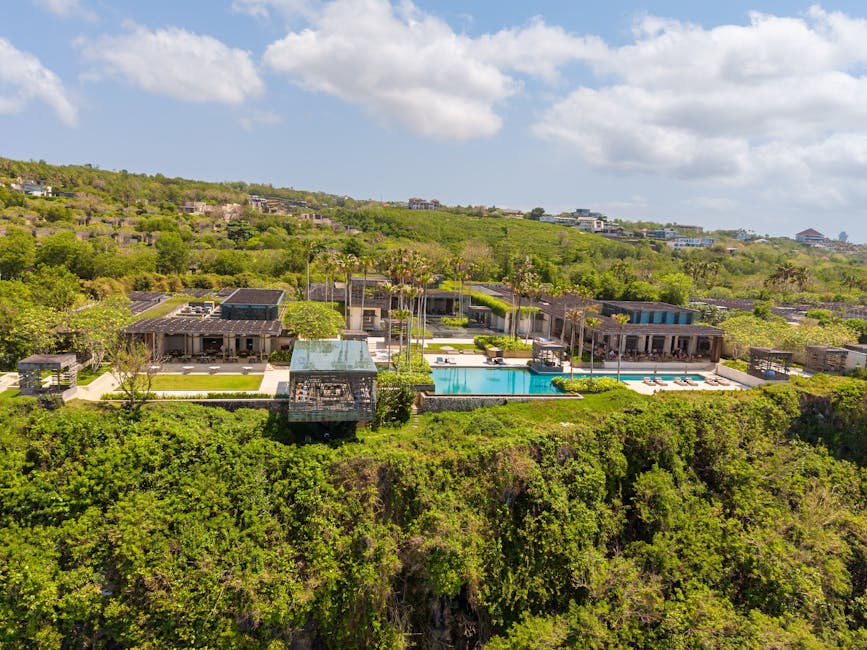
The villa-with-pool image is a Bali cliché for a reason. From around $80 a night you can have a private pool. Most won’t be cliffside.

Ubud: culture, yoga, rice fields, no beach

Ubud is the cultural capital and the obvious answer if you don’t care about swimming in the sea. It sits at about 200 metres elevation an hour north of the airport (90 minutes if you arrive after 4 p.m.). The town is built around the Ubud Royal Palace, the Saraswati lily-pond temple, and the Sacred Monkey Forest. Walk in any direction for fifteen minutes and you’ll find rice fields, a gamelan rehearsal in a banjar (the local neighbourhood council), or a yoga studio with a 7 a.m. class. The food scene is the most interesting on the island, and Ubud invented the modern Bali vegetarian restaurant.

Aerial view of green rice terraces around Ubud, Bali
The rice fields north of Ubud town. If you base near Penestanan or Sayan, this is your morning walk view.

Who Ubud is for: first-timers who want culture more than beach, returnees doing a yoga or art week, families with kids who like animals (the Monkey Forest plus the river-walk path is a brilliant day), digital nomads who don’t surf, anyone in the wellness category.

Who Ubud is wrong for: beach holidays, party crowds, people who hate driving (it’s an hour to the closest beach in Sanur, longer to anywhere else), anyone who can’t tolerate humidity at 25 degrees with no breeze.

Where to stay in Ubud: central Ubud (around Jalan Hanoman or Jalan Monkey Forest) is walkable but loud and traffic-heavy. Penestanan is fifteen minutes walk west and quieter, with a nicer concentration of cafes. Sayan and Kedewatan are luxury-villa zones above the Ayung River, very pretty, but you need a driver to get into town. For tier-by-tier prices: a homestay with breakfast runs Rp 350,000-500,000 a night (about $22-32). A mid-range pool villa or boutique guesthouse is Rp 900,000-2,200,000 ($58-140). Real luxury (Mandapa, Como Shambhala, Bambu Indah, Four Seasons Sayan) starts around Rp 8,000,000 ($510) and runs into multiple thousands of dollars.

If you want a deeper sense of how the temples and ceremonies actually work before you book, our guide to Balinese Hinduism walks through the daily offerings and the calendar.

Long-tailed macaque in the Sacred Monkey Forest, Ubud, Bali
The Sacred Monkey Forest sits at the south end of Jalan Monkey Forest. Take off any necklaces, sunglasses, or hair clips before you go in. They will be removed for you otherwise.

Two things first-timers in Ubud get wrong: they book Tegalalang for the rice-field photo and find a queue of forty people for the same swing. Drive an hour further to Jatiluwih instead, or walk the Campuhan Ridge at 6 a.m. They also try to do a sunrise Mount Batur hike on the same day they arrive in Bali. Don’t. The 2 a.m. wake-up after a long-haul flight is brutal. Save it for day three.

Sanur: calm beach, families, a slower south

Morning view of Sanur Beach, Bali with traditional jukung outrigger
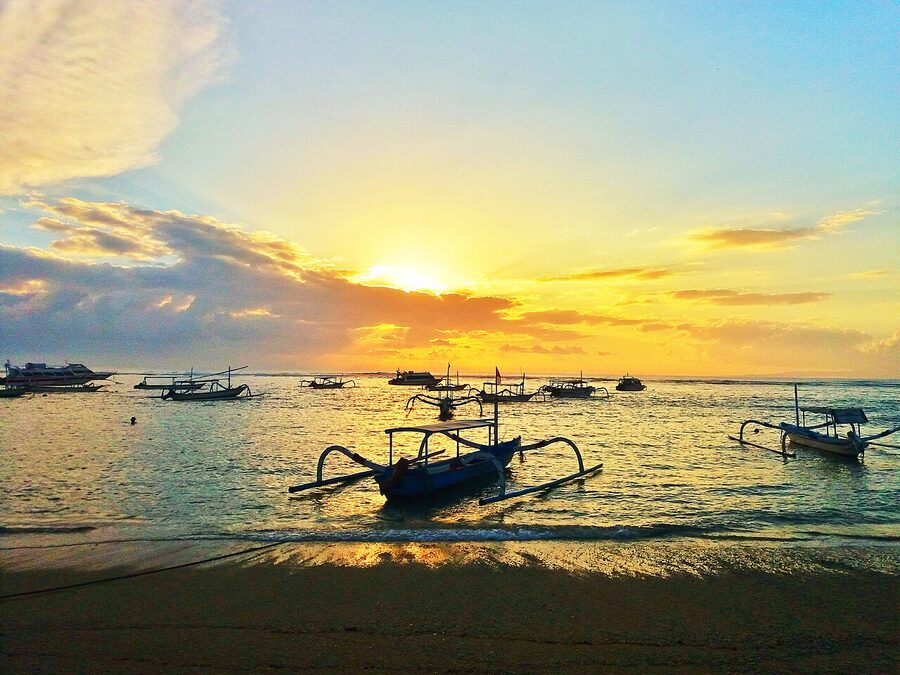
Sanur at sunrise. The reef fifty metres offshore kills the surf, which is why families and older travellers love it. Photo by Danangtrihartanto / Wikimedia Commons (CC BY-SA 4.0)

Sanur was the original beach resort area in Bali, developed in the 1960s by the Hotel Bali Beach (now the Inna Bali Beach), and it has the easiest beach in Bali. Easy because the reef five minutes offshore takes the swell down to lake-flat by the time it reaches the sand. You can swim. Kids can swim. Older travellers who can’t deal with the Kuta-Canggu shorebreak can swim. There’s a paved beach path you can walk for five kilometres from the south end at Mertasari past the Bali Hyatt to the north end at Hotel Sanur Beach, and it’s the only stretch of Bali coastline I’ve ever genuinely cycled along without fearing for my life.

Who Sanur is for: families with kids under twelve, older travellers, people whose holiday is books-and-pool not bars-and-pool, anyone catching a fast boat to the Nusa islands or the Gilis (the Sanur harbour is your departure point), divers using Sanur as a base for east-coast trips. There’s a strong long-stay European retiree population that gives the area a different feel from the bachelor-party energy further west.

Who Sanur is wrong for: surfers (the reef kills the wave, it’s not a surf beach), nightlife seekers (it’s quiet by 11 p.m.), anyone who needs to be where the influencer crowd is.

Where to stay in Sanur: the centre runs along Jalan Danau Tamblingan, parallel to the beach about 200 metres inland. Stay anywhere on or one street back from this road and you can walk to dinner. Budget homestays start around Rp 300,000 ($19). The mid-range tier of small boutique hotels and pool guesthouses is Rp 700,000-1,500,000 ($45-95) and there is more genuine value at this tier than anywhere else in south Bali. Luxury (Fairmont Sanur, Maya Sanur, Andaz, the Bali Hyatt) runs Rp 3,500,000-7,000,000 ($225-450). Read our deeper Sanur area guide for specific picks.

Gazebo on Sanur Beach overlooking the calm sea
The Sanur beach gazebos are public. Sit under one with an iced kopi and watch the morning fishermen come back in.

Two things returnees know about Sanur: the morning market on Jalan Danau Tamblingan starts at 5:30 a.m. and is genuinely local. And after monsoon season (December-February) the plastic on the beach is real. Don’t romanticise it.

Seminyak: beach clubs, rooftops, shopping, see-and-be-seen

Sunset on Seminyak Beach, Bali
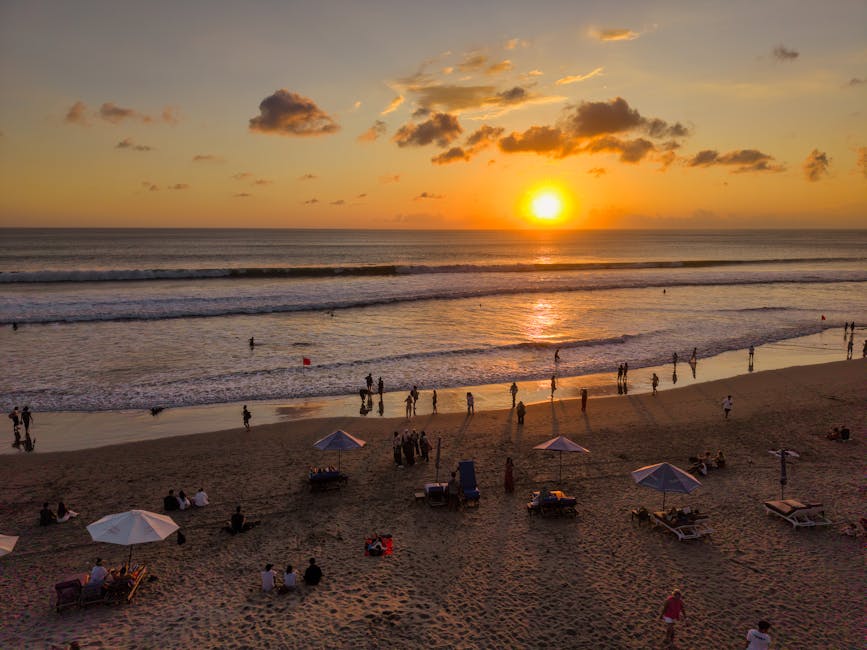
Seminyak Beach at sunset. The beach club to the right of frame is Potato Head. The beach club to the left is La Plancha. Pick a side.

Seminyak is what Kuta wanted to grow up to be. It’s the polished, spendy, brunch-and-boutique version of south Bali, and the area where you’ll spend the most money the fastest. The strip runs from Jalan Kayu Aya (also called Eat Street, a slightly painful name) down to the beach, where Potato Head Beach Club, Ku De Ta, and La Plancha sit. The beach itself is a long, wide, dark-sand stretch with a respectable shorebreak and a dramatic sunset. There are good shops (Magali Pascal, Biasa, Drifter Surf), the food scene is solid even if it’s expensive, and Petitenget Temple at the north end is photogenic at golden hour.

Who Seminyak is for: couples on a short trip who want easy beach plus easy nightlife, honeymooners who want a villa-pool base near a beach club, the bachelor and hen weekend crowd at the higher end (the Bounty crowd is in Kuta, not here), shoppers, first-timers who want the most polished introduction to south Bali.

Who Seminyak is wrong for: budget travellers (you’ll spend twice as much for less than Sanur or Canggu), anyone seeking a trace of pre-tourist Bali (Seminyak is the most fully developed area on the island), surfers (the wave is closeout-prone, and Canggu is fifteen minutes north).

Where to stay in Seminyak: Petitenget at the north is the highest-end pocket. Oberoi Street has the boutique hotels. Anywhere south of Eat Street starts to bleed into Legian and gets cheaper. Tier prices: budget around Rp 600,000-900,000 ($38-58), but you can do better in Sanur. Mid-range pool villas Rp 1,800,000-3,500,000 ($115-225). Luxury (The Legian, Alila Seminyak, the Oberoi) Rp 5,000,000-15,000,000 ($320-960). Our Oberoi Seminyak guide covers the Bali luxury benchmark in detail.

Two notes if you book Seminyak: the traffic on Jalan Petitenget into the Kayu Aya area between 6 p.m. and 8 p.m. is genuinely terrible. Walking is faster. And a beer at the rooftop bars now lands at around Rp 110,000 ($7), a cocktail at Potato Head is Rp 250,000 ($16), and a sun lounger with minimum spend will cost you the same as a mid-range hotel night by sunset.

Canggu: surf, cafes, digital nomads, traffic

Surfer riding waves at sunset on a Canggu beach in Bali
Canggu’s wave is good for intermediates and forgiving for beginners on the sand-bottom inside. The crowd in the water is the bigger problem.

Canggu was a quiet rice-field village fifteen years ago. Today it’s the most-talked-about area in Bali, the digital-nomad capital of Southeast Asia, and a town that has visibly outgrown its road infrastructure in real time. The pull is the trifecta: surf (Echo Beach, Batu Bolong, Berawa peaks), cafes (the laptop scene around Crate, Milk and Madu, Nüde, KYND Community is genuinely impressive), and the social/dating/yoga community that feeds all of it. The vibe is twenties-to-mid-thirties, internationally mixed, gym-on-Sunday, espresso-tonic-at-three, and it’s a brilliant base for a long stay. For a one-week beach holiday it’s also fine, with caveats.

Who Canggu is for: intermediate surfers, remote workers planning to stay a month or more, the gym-cafe-yoga crowd, returnees who want the social scene, anyone who finds Seminyak too try-hard and Ubud too sleepy.

Who Canggu is wrong for: people who hate traffic (the spine road, Jalan Pantai Berawa, can take 45 minutes to crawl 4 km at sundown), beginners who can’t surf at all (the wave breaks over rocks and reef in places, less forgiving than Kuta), the over-fifty crowd unless you’ve been before, anyone seeking quiet (it’s not).

Where to stay in Canggu: the area divides into rough sub-zones. Berawa at the south is the most developed, closest to Seminyak, with the Atlas Beach Club crowd. Batu Bolong is the spiritual centre, with Old Man’s, Deus Ex Machina, and the main strip. Echo Beach at the north is quieter and surfier. Budget homestays Rp 350,000-650,000 ($22-42). Mid-range pool villas Rp 1,200,000-2,800,000 ($75-180). Luxury Rp 4,500,000+ ($290+). Note: the value tier above $200/night in Canggu shifts in favour of villas over hotels, you get a private pool and full kitchen for the same money as a high-end resort room.

Tropical villa pool surrounded by lush garden in Bali
This is what your $130 a night gets you in Berawa or Echo Beach. The kitchen and the pool are why villas beat hotels above the mid-range tier in Canggu.

Berawa and Echo Beach: Canggu’s quieter siblings

Sunset on a Bali beach near Berawa, Canggu
Berawa runs into Canggu without a clear border. The volume of construction is what tells you which side of the imaginary line you’re on.

If you want Canggu’s coffee and surf without quite Canggu’s intensity, the answer is Berawa or Echo Beach. Berawa sits between Seminyak and Batu Bolong proper, with the giant Atlas Beach Club anchoring the south end and a beach that’s wider and slightly less crowded than Batu Bolong. Echo Beach (Pantai Echo, also called Batu Mejan) is at the north end of the Canggu sprawl, where the road runs out and Pererenan begins. The wave is bigger and more consistent than Batu Bolong, and the crowd thins.

Who these are for: surfers who don’t want to walk far in the morning, returnees who liked Canggu but found it too noisy, families who want a Canggu-adjacent location with quieter streets.

What to know: Echo Beach is where La Brisa, Sand Bar, and a handful of beachfront warungs sit. The volcanic black sand here gets genuinely hot at midday, flip-flops are not optional from 11 a.m.

Pererenan: the next Canggu, currently in the act of becoming Canggu

Pantai Pererenan beach in Bali
Pererenan beach (Pantai Pererenan) at low tide. This is what Canggu looked like in 2014. Photo by I Gede Sujana / Wikimedia Commons (CC BY-SA 4.0)

Pererenan is the area just north of Echo Beach, separated from Canggu by the Yeh Poh river. Five years ago there were rice fields. Today there are fifteen new villa developments with construction crews working through the night. It’s still a beat or two quieter than Canggu, the cafes have a more local-international mix, and the surf at Pantai Pererenan is one of the better intermediate waves in the south. By 2027 it will probably be indistinguishable from Canggu, but right now it occupies the Canggu-five-years-ago niche.

Who Pererenan is for: returnees who liked Canggu in 2019 and want that energy back, surfers, long-stay nomads who can’t deal with Berawa traffic, anyone willing to scooter for cafe variety.

What to know: the unfinished construction is real and will be your morning soundtrack at any villa within 50 metres of a building site. The trade-off is that prices are still 20-30% lower than equivalent Canggu villas. Use that window while it lasts.

Kuta and Legian: cheap, central, and a bit of a mess

People at sunset on Kuta Beach, Bali
Kuta Beach still holds one of the best surf-school setups on the island, even if the strip behind it has seen better days.

Kuta gets a deserved rough write-up in most modern guides, and it’s not where I’d send most readers, but it has a real role for one specific kind of trip. The strip on Jalan Legian runs hard with mass-market clubs (Sky Garden, Bounty), boutiques selling fake football shirts, and a beach that’s actually quite good but feels like a film set for everyone’s worst Bali stereotype. Legian, immediately north, is the calmer cousin: more package-tour hotels, less of the heavy nightlife, the Padma Hotel families come back to year after year.

Who Kuta is for: first-time surfers (the Kuta Beach surf school scene is excellent and the wave is genuinely beginner-friendly), backpackers who want the absolute cheapest accommodation in Bali, transit travellers with one night before an early flight (it’s ten minutes from DPS), and the under-25 stag-do crowd who actually want what Kuta sells.

Who Kuta is wrong for: almost everyone else. The truth is: if your friends are pressuring you to “stay near the airport”, choose Sanur (15 minutes) or Jimbaran (10 minutes) instead.

Where to stay: Poppies Lane I or Poppies Lane II are the historic budget alleys with cheap homestays from Rp 250,000 ($16). Our deeper Poppies Kuta guide covers the surf-school-and-budget angle. Mid-range hotels along Jalan Pantai Kuta or in Legian run Rp 800,000-1,500,000 ($50-95). The Padma Resort in Legian and the Sheraton Kuta are the two reliable family-resort picks.

Uluwatu and the Bukit: clifftops, surf, dramatic

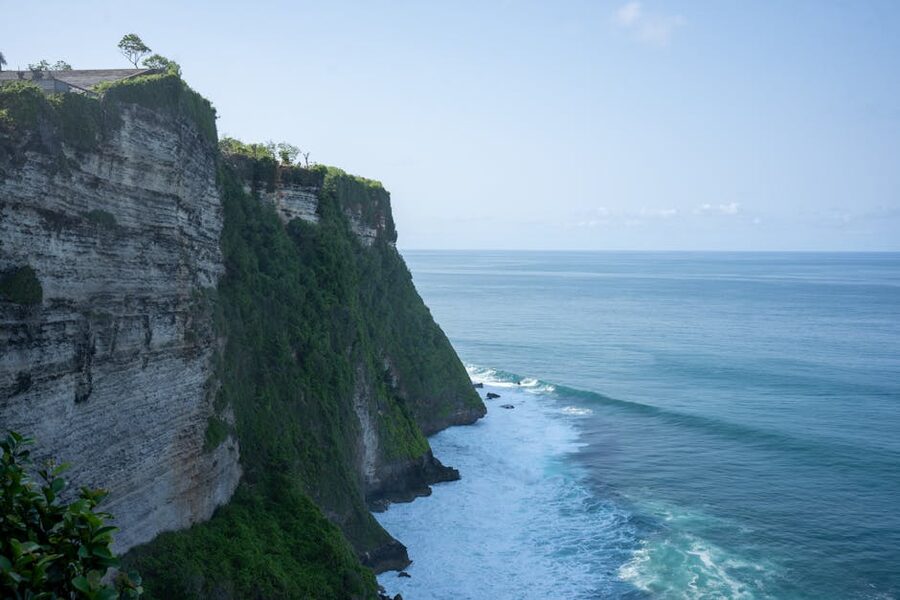
Uluwatu Cliffs meeting the Indian Ocean in Bali
The Uluwatu cliffs are the most dramatic coastline in Bali. Stay anywhere within ten minutes of Single Fin and you’ll be back here every sunset.

The Bukit peninsula is the limestone tongue at the south of Bali, and Uluwatu, on its west cliffs, is the most dramatic accommodation zone on the island. Cliff-edge villas, infinity pools that visually drop into the Indian Ocean, the famous kecak fire dance at Pura Uluwatu at sunset, and the wave at Uluwatu itself, which is one of the legendary right-handers of world surfing. The beaches under the cliffs (Padang Padang, Bingin, Suluban, Dreamland, Balangan) involve real walking down stairs cut into the rock, which keeps the casual crowds away.

Who Uluwatu is for: intermediate to advanced surfers, honeymooners who want drama (the cliffside resorts are spectacular), returnees who already know they don’t need a town to wander, anyone who can scooter or wants to hire a driver for the duration.

Who Uluwatu is wrong for: first-timers who want walkable streets, anyone who dislikes being driven everywhere, beginner surfers (the waves break over reef), the no-stairs crowd (every beach involves a descent).

Where to stay: Pecatu and Ungasan are the residential villa zones inland from the cliffs. Bingin and Padang Padang have the surfer guesthouse scene from Rp 500,000 ($32). Mid-range cliffside boutique villas run Rp 2,000,000-4,500,000 ($130-290). Real cliff-edge luxury (Bulgari, Six Senses, Alila Villas, the Edge) starts at Rp 12,000,000 ($770) and runs to genuinely silly numbers.

Aerial view of Uluwatu cliffs in Bali at sunset
Sunset at the Uluwatu cliffs is genuinely worth it. Single Fin’s terrace fills up by 5:30 p.m., so get there earlier or sit on the rocks below.

Nusa Dua: resort enclave, family-friendly, planned

Tranquil sandy beach with calm sea in Bali
Nusa Dua’s beach is reef-protected and groomed. Whether you find that relaxing or a bit Truman-Show is the question that decides the trip.

Nusa Dua is a planned resort area on the east side of the Bukit peninsula, gated, manicured, with white-sand reef-protected beaches and a who’s-who of international hotel chains (Ritz-Carlton, St Regis, Mulia, Grand Hyatt, Conrad, Westin, Sofitel). It’s the most planned area in Bali, the closest the island comes to a Maldives-style resort enclave, and it serves a specific traveller really well. The trade-off is that you can spend a week here and barely interact with Bali at all.

Who Nusa Dua is for: families with young kids (the reef-flat sea is genuinely safe), travellers who want a fly-and-flop resort holiday with kids’ clubs and buffet breakfast, golfers (the Bali National Golf Course is here), conference-and-leisure trips, anyone who specifically does not want the chaos of Canggu or Seminyak.

Who Nusa Dua is wrong for: independent travellers, food adventurers (you’ll eat at the resort), anyone for whom “Bali” means the cultural and visual texture they saw on Instagram (Nusa Dua looks like a polished tropical resort anywhere in Asia).

Where to stay: the BTDC (Bali Tourism Development Corporation) zone is the gated cluster. Outside it, Tanjung Benoa and Mengiat are slightly cheaper. Mid-range resort rooms Rp 2,500,000-4,000,000 ($160-255). Luxury Rp 5,500,000-12,000,000 ($350-770). Cheap doesn’t really exist here; Nusa Dua’s mid-range is most of the island’s luxury.

Jimbaran: seafood grills and airport-adjacent

Aerial view of Jimbaran beach in Bali at sunset
Jimbaran Bay at sunset, looking back towards the airport runway. The seafood grill row is on the curve at the south end of the bay.

Jimbaran is a long crescent bay on the east of the Bukit, ten minutes from the airport, famous for two things: the row of beachfront seafood grills (Menega, Lia, Furama) where you sit at plastic tables on the sand and eat grilled red snapper at sunset, and a handful of high-end beachfront resorts (Four Seasons Jimbaran, Ayana, Rimba, the Intercontinental). The fishing market in the morning is the real working version of what the rest of Bali has tidied away for tourists. The middle of the bay is residential and a bit charmless; the resort ends at north and south are where you stay.

Who Jimbaran is for: first-or-last-night travellers who want one quieter night near the airport, romantic couples doing the seafood-grill night, families wanting a less-formal alternative to Nusa Dua, sunset photographers (the bay faces west across the water back to the airport runway, with regular plane silhouettes against the sun).

Where to stay: the south end (around Four Seasons) is the calmer luxury zone. The north end (Kedonganan) is where the seafood grills sit and where mid-range hotels concentrate. Mid-range Rp 1,200,000-2,500,000 ($75-160). Luxury Rp 6,000,000+ ($385+).

Lovina: north-coast slow, dolphin tours, black sand

Aerial shot of traditional fishing boats in Lovina, Bali
The Lovina fishing fleet head out at 5:30 a.m. They double as the dolphin tour boats by 6 a.m. Whether the tour is worth doing is genuinely debatable.

Lovina sits on Bali’s north coast, about three hours’ drive from the airport and two hours from Ubud over the mountains. It’s a string of small black-sand beach villages (Kalibukbuk, Anturan, Tukad Mungga) anchored by the famous dolphin-spotting tours that leave at sunrise. The pace is properly slow, the prices are 30-40% lower than the south coast for the same standard, and the area pairs beautifully with two or three nights up in the Munduk highlands. The water is calm, the snorkelling at Pemuteran an hour west is solid, and there’s a Buddhist monastery (Brahma Vihara Arama) in the hills that does ten-day silent retreats.

Who Lovina is for: returnees who’ve done the south, slow-travel couples on a longer trip, divers using it as a base for west-coast trips (Menjangan), anyone seeking a base for the north and central highlands. Pair with our Singsing Waterfall guide for the day-trip details.

Who Lovina is wrong for: first-timers on a short trip (the drive eats half a day each way), anyone who specifically wants white sand or surf, travellers prone to sea sickness on dolphin boats (the swell isn’t bad but the boat is small).

Where to stay: Kalibukbuk has the densest cafe-restaurant scene. Anturan is quieter. Budget homestays Rp 250,000-450,000 ($16-29). Mid-range pool resorts Rp 700,000-1,500,000 ($45-95). The high end caps out around Rp 4,000,000 ($255) here; Lovina doesn’t have proper international five-stars.

One note on the dolphin tour: the boats can crowd the dolphins, and the experience is mixed. If you go, choose an operator that limits boat numbers and stays back. If you don’t go, you’re not missing the trip-defining experience.

Munduk: mountain village, cool nights, waterfalls

Munduk village in the Bali highlands
Munduk village, sitting at about 800m. You’ll need a light layer in the evening and a real jacket if you walk before dawn. Photo by Mike Dickison / Wikimedia Commons (CC BY 4.0)

Munduk is the highland village I keep coming back to. It sits at about 800 metres, two and a half hours’ drive from the airport, in clove and coffee plantations above the Buyan and Tamblingan twin lakes. Nights are properly cool (you’ll want a light layer), the air smells of cloves, and there’s a network of waterfall walks through the surrounding jungle (Munduk waterfall, Melanting, Banyumala, Sekumpul about 45 minutes east). The Pura Ulun Danu Beratan temple, the famous one floating on Lake Beratan, is a 30-minute drive south. Read our deeper Munduk area guide for a real itinerary.

Who Munduk is for: returnees who want temperature relief from the south coast humidity, hikers, photographers, couples who want two or three quiet nights in the middle of a longer trip, anyone whose Bali fantasy involves mist and rice terraces more than beaches.

Who Munduk is wrong for: beach holidays, anyone who wants restaurant variety (Munduk has maybe a dozen places to eat, mostly small warungs), travellers easily disappointed by rain (afternoon mist and rain are common at this altitude even in dry season).

Where to stay: small bamboo-and-wood guesthouses with valley views are the local speciality. Budget Rp 350,000-600,000 ($22-38). Mid-range eco-resorts and boutique cottages Rp 900,000-2,000,000 ($58-128). The few high-end options (Munduk Moding Plantation, Sanak Retreat) run Rp 3,000,000-5,500,000 ($192-350).

Ulun Danu Beratan Temple on the lake near Munduk, Bali
Pura Ulun Danu Beratan, half an hour south of Munduk. Get there before 8 a.m. for the photo without the crowd, after 4 p.m. for the soft light without the crowd.

Sidemen: rice-terrace valley, quietest base on the island

Sidemen rice terraces in east Bali
Sidemen valley. The rice fields here are working farmland, not photo set-pieces. Stay one night and you’ll book three. Photo by Adimelali Bali / Wikimedia Commons (CC BY-SA 3.0)

Sidemen sits in a wide rice-terrace valley about 90 minutes east of Ubud, in the foothills below Mount Agung. The closest comparison I can give is what Ubud must have felt like in 1990: working rice farms, no traffic, no clubs, no crowds. The view from any decent guesthouse looks straight at Agung’s volcanic cone, and on a clear morning at 6 a.m. it’s the kind of view people fly across continents for. There’s almost nothing to do except walk in the rice fields, drink coffee on a verandah, and read books, which is the entire point.

Who Sidemen is for: returnees who’ve done Ubud and want quieter, couples on a long-stay honeymoon, anyone running on burnout, photographers who’ll be up at sunrise.

Who Sidemen is wrong for: short-trip travellers (it’s not worth a single night, you need three), the nightlife crowd, anyone who needs restaurants, beach holidays.

Where to stay: small valley-view eco-lodges and bamboo houses are the standard. Budget Rp 300,000-550,000 ($19-35). Mid-range valley-view resorts Rp 900,000-2,500,000 ($58-160). The high-end (Wapa di Ume Sidemen, Samanvaya) tops out around Rp 3,500,000 ($225).

Amed: east-coast diving, fishing villages, black sand

Traditional fishing boat on Amed Beach in Bali
Amed’s working fishing fleet. The jukung outriggers double as snorkel-trip boats by 8 a.m. for around Rp 200,000.

Amed is the strip of black-sand fishing villages on Bali’s far east coast, about three hours from the airport, famous for two things: the USAT Liberty wreck dive at Tulamben (a 30-minute drive north, you can shore-dive a WWII shipwreck from the beach), and the calm reef-sheltered snorkelling and diving from beaches like Jemeluk Bay. The pace is genuinely slow, the warungs serve the best grilled mahi-mahi I’ve ever eaten, and the village strung along the coastal road is half-fishing-village, half-divers’ end-of-the-world hangout. Read our Amed area guide for the dive specifics.

Who Amed is for: divers and snorkellers, returnees, couples who want the quietest beach base in Bali, anyone allergic to crowds.

Who Amed is wrong for: short-trip travellers (the drive in eats half a day), nightlife seekers, surfers, the white-sand-and-cocktails crowd.

Where to stay: the strip runs from Bunutan in the south through Amed proper, Jemeluk, Lipah, and on to Tulamben. Jemeluk Bay is the central pocket and most popular. Budget homestays Rp 250,000-450,000 ($16-29). Mid-range dive resorts and boutique villas Rp 700,000-1,800,000 ($45-115). Luxury caps out around Rp 3,500,000 ($225); Amed is not a luxury zone.

Tropical cliffside view over the Bali coast
The east-coast headlands above Jemeluk. Park, climb up, watch the fishing boats come in. No entry fee.

Padangbai: ferry hub that earns a two-night stay

Padangbai village in east Bali
Padangbai’s main bay. Locals call it the prettiest small port in Bali. Most travellers see it through the window of a fast boat to Lombok. Photo by ninpuukamui / Wikimedia Commons (CC BY-SA 3.0)

Padangbai is the small east-coast port that fast boats to the Gilis and Lombok depart from, and 95% of travellers pass through it without stopping. The 5% who book two nights find one of the more pleasant small-town surprises in Bali. The main bay is a horseshoe with a working fishing fleet and a swimmable beach, the Blue Lagoon five minutes’ walk over the headland is one of the best easy snorkelling spots in east Bali, and the coastal walk south to Bias Tugel beach is genuinely lovely. Our Topi Inn Padangbai guide covers the area as a stay rather than a transit point.

Who Padangbai is for: travellers heading to or returning from the Gilis or Lombok who want to break the journey, divers (Blue Lagoon and Tepekong are local dive sites), backpackers on a budget, anyone who likes small ports.

Where to stay: a handful of small guesthouses in the village run Rp 200,000-450,000 ($13-29). Mid-range options are sparse, around Rp 600,000-1,000,000 ($38-65). No luxury here; this is a working port.

Nusa Lembongan: small island, mangroves, sunsets to Mount Agung

Aerial view of Nusa Lembongan island near Bali
Nusa Lembongan from the air. The strip on the south is Mushroom Bay; the long beach on the west is Jungutbatu where the fast boats land.

Nusa Lembongan is the easiest of the three Nusa islands, a 30-minute fast boat from Sanur (about Rp 350,000 / $22 return), small enough to scooter around in an afternoon, with calm reef-protected snorkelling and a mellower vibe than mainland south Bali. The strip at Jungutbatu is where the fast boats land and most accommodation sits. Mushroom Bay on the south is quieter and prettier, with good snorkel reefs offshore. The island links to neighbouring Nusa Ceningan via the famous yellow suspension bridge.

Yellow suspension bridge linking Nusa Lembongan and Nusa Ceningan
The yellow bridge to Ceningan. Scooters only, no cars cross. Photo by Juxlos / Wikimedia Commons (CC BY-SA 4.0)

Who Nusa Lembongan is for: travellers wanting an offshore-island change of pace within an hour of mainland Bali, snorkellers and divers (manta rays at Manta Point, mola mola at Crystal Bay in season), couples on the second half of a longer trip, anyone who wants three days off the scooter-traffic of south Bali.

Where to stay: Mushroom Bay or Sandy Bay for the prettiest and quietest. Jungutbatu for cheaper and busier. Budget Rp 350,000-650,000 ($22-42). Mid-range cliff villas and beach bungalows Rp 1,000,000-2,500,000 ($65-160). High-end (Hai Tide Beach Resort, Batu Karang) Rp 3,000,000-5,500,000 ($192-350).

Nusa Penida: wild, dramatic, day-trip-able but better with a stay

Aerial view of Kelingking Beach on Nusa Penida, Bali
Kelingking Beach. The viewpoint is a ten-minute walk from the car park. The descent to the beach itself is a one-hour scramble down a near-vertical staircase that is genuinely not for everyone.

Nusa Penida is the bigger, wilder, less-developed island east of Lembongan, and the source of about 80% of “Bali” Instagram photos in the last five years (Kelingking Beach, Diamond Beach, Angel’s Billabong, Broken Beach all sit here). It’s possible to do as a day trip from south Bali (most travellers do), but you’ll spend half the day in a fast boat and the other half stuck behind 200 other day-trippers in a mini-bus. Stay two nights and you can be at Kelingking at sunrise with no one else there.

Who Nusa Penida is for: photographers, divers (manta rays year-round at Manta Point and Manta Bay, mola mola July-October at Crystal Bay), returnees who want an island that still feels rough and undeveloped, anyone willing to deal with bumpy roads.

Who Nusa Penida is wrong for: luxury travellers (the high-end has caught up only recently and is patchy), anyone with mobility issues (the famous viewpoints involve real stairs and scrambles), nervous scooter riders (the roads are genuinely bad in places).

Where to stay: Toya Pakeh (the port and main town) for convenience. Crystal Bay for the dive scene. The north and east coasts are the harder-to-reach pockets with the most dramatic clifftop villas. Budget Rp 250,000-450,000 ($16-29). Mid-range Rp 700,000-1,800,000 ($45-115). Newer high-end (Adiwana Warnakali, Semabu Hills) Rp 2,500,000-4,500,000 ($160-290).

The Gili Islands: technically Lombok, but a Bali staple

Gili Air island near Bali with clear blue water
Gili Air, the middle Gili and the one I’d send most readers to. No motorised vehicles, easy to walk around in two hours, snorkel turtles from the beach.

The Gilis (Trawangan, Meno, Air) sit east of Bali in Lombok’s water, but every Bali trip longer than ten days should consider including them. Fast boats from Sanur or Padangbai run 90-150 minutes (around Rp 750,000-1,200,000 / $48-77 return) and the islands are small (no cars, only horse carts and bicycles), with easy snorkelling, sea turtles you can find from the beach, and a vibe that flips between three distinct characters. Trawangan is the party island. Meno is the quietest, with the famous underwater statue circle. Air sits between them and is the one I’d recommend most travellers for.

Where to stay: all three have full ranges from Rp 350,000 ($22) backpacker bungalows to Rp 5,000,000+ ($320+) beachfront luxury. Air is the best value mid-range. Trawangan has the most accommodation density. Meno has the fewest options but the prettiest beach.

The big comparisons travellers actually ask

Ubud vs Canggu

This is the most-asked Bali question. The real answer: they are not interchangeable. Ubud is inland, cultural, no beach, food-and-yoga, slower-paced. Canggu is coastal, surf-and-cafe-and-nomad, faster-paced, traffic-heavy. If you have one week, you can do both, three nights Ubud, four nights Canggu, with a private driver Rp 600,000 ($38) for the transfer. If you have to pick one for a short trip, pick by your answer to question one of the matrix above. The trip you actually want will pick itself.

Seminyak vs Canggu

Seminyak is more polished, more expensive, more shopping, more rooftop bars. Canggu is more surf, more cafes, more digital-nomad, more rice fields visible between the construction. Seminyak’s beach is genuinely better for swimming. Canggu’s wave is genuinely better for surfing. For a five-day couples trip with no interest in surfing, Seminyak. For a two-week stay with any surf interest, Canggu. The drive between them is fifteen minutes when traffic is good and 45 minutes at sundown.

Sanur vs Nusa Dua (the family question)

Nusa Dua is more controlled, more resort-like, more swimming-pool-and-buffet. Sanur is more local, more walkable to a real town, cheaper at the same standard. For under-fives who’ll basically stay at the resort all week, Nusa Dua wins on the kids’ clubs and the buffet. For seven-and-up who’ll do day trips and eat out, Sanur wins on the walkable street scene and the variety. For the parents specifically, Sanur wins on the “feels like Bali” factor. Nusa Dua feels like an upscale resort that happens to be in Indonesia.

Villa vs hotel: the real value question

The crossover line in Bali sits at about $200 per night. Below that, hotels usually win on amenities (pool, breakfast, daily housekeeping, on-site restaurant) for the same money. Above that, villas usually win, for $250 a night you can have a private two-bedroom villa with your own pool, full kitchen, and private staff in Canggu, Seminyak, or Uluwatu. That same $250 buys you a nice room at a four-star hotel and nothing else. For groups of four or more, this calculation tips even harder in favour of villas: a four-bedroom villa at $400 a night ($100 a head) gives you something a hotel can’t match at any price under $1,500.

Couple at infinity pool overlooking Bali coastline
The villa-with-infinity-pool calculation: above $200 a night, this is what you get. Below that, you’re better off in a hotel.

How to combine areas in one trip

If you have less than five nights, base in one area and stay there. The transfer time costs more than the variety adds. If you have five to seven nights, pair south coast (3-4 nights) with Ubud (2-3 nights). If you have eight to twelve nights, add a third area: a cultural trip works as Ubud + Sanur + Sidemen or Amed; a beach-and-surf trip works as Canggu + Uluwatu + Nusa Lembongan; an everything trip works as Canggu + Ubud + Munduk. If you have fourteen nights or more, you can sensibly do four or even five areas, and you should: that’s how Bali repays a longer trip.

For specific day-by-day planning, our 7-day Bali itinerary walks through the classic Canggu-Ubud combination, and our seasonal calendar guide covers when to go for what.

Booking practicalities you’ll wish you knew first

A few things almost no first-time guide spells out. Most listings on the major platforms ( Booking.com Bali, Agoda Bali, GetYourGuide Bali) include the 21% government tax and service charge in the headline price now, but check before booking, the same villa on a direct-to-owner site may be 15-20% cheaper without the platform fees, and a WhatsApp message to the property often gets you a better rate for stays of seven nights or more. The Indonesian tourism levy (Rp 150,000 / about $9.60 per person, introduced February 2024) applies on arrival, separately from your accommodation. Pay it online before you fly via the official portal to skip the airport queue.

Booking platform photos often show the property from its absolute best angle. Two specific things to look for in the listing photos before committing: the actual view from the room (not the property’s hero shot, which may be from a different building), and the road in front of the property (a beautiful villa on a busy spine road in Berawa is a noisy villa). Check the location pin against Google Maps satellite view rather than trusting the marker the property set.

For longer stays, the digital-nomad two-month trips that are a meaningful share of Canggu and Ubud’s accommodation now, almost everything serious is booked off-platform on monthly contracts at 50-70% of nightly rates. Facebook groups like Bali Long Term Rental and Canggu Community are where the listings actually circulate. The platform listings for monthly stays are a starting reference point, not the deal you should accept.

Quick area snapshot for the impatient

If you skipped the matrix at the top: Seminyak for the polished beach-club holiday. Canggu for surf, cafes, and a young scene. Sanur for families and slower beach days. Nusa Dua for the resort-bubble holiday. Jimbaran for the airport-adjacent quiet night. Uluwatu for the dramatic clifftop villa stay. Ubud for culture, yoga, rice fields, no beach. Munduk for the cool mountain detour. Sidemen for the quietest base on the island. Amed for diving and the slow east coast. Padangbai for two nights between Bali and the Gilis. Lovina for the slow north and dolphin tours. Nusa Lembongan for an easy offshore island. Nusa Penida for the dramatic landscape and the overnight stay that beats the day trip. The Gilis for a Lombok-water bolt-on if you have ten nights or more. Pererenan, Berawa, Echo Beach for travellers who liked Canggu but want it just a touch quieter. Kuta and Legian if you specifically want what they sell.

For the next layer of detail on specific areas, browse our Where to Stay category, and for what to do once you’ve booked, our Things to Do in Bali pillar walks through the actual itinerary fillers across all the areas covered here.

Sunset over Tanah Lot Temple in Bali
Tanah Lot at sunset. Whichever area you base in on the south coast, the drive out here for the last hour of light is the easiest evening trip on the island.

Pick the area straight. The rest of the trip looks after itself.

Padangbai, Bali: Stay Two Nights, Not 30 Minutes

Almost everyone you ask about Padangbai will say the same thing. It’s the port. The 30-minute pit stop on the way to the Gilis. You roll in by Grab from Sanur, you wait an hour for a fast boat, you eat a bad nasi goreng next to a stray dog, and you leave. The whole town becomes a Wikipedia entry in your head: ferry, scam, boat, gone.

I want to make a different argument. Stay two nights. Skip the boat the morning after you arrive, sleep in, and walk out to the Blue Lagoon snorkel with a Rp 30,000 (about $1.90) coconut from the warung on the way. The east coast has a real fishing town here, with a thousand-year-old temple on the headland, a white-sand cove ten minutes south, some of the cheapest scuba diving on the island, and zero clubs and zero rooftop bars. By the time you actually get on a Gili boat on day three, you’ll know why the people working that pier live here.

Aerial view of Padang Bai Bay in east Bali with the harbour, cove, and forested hills
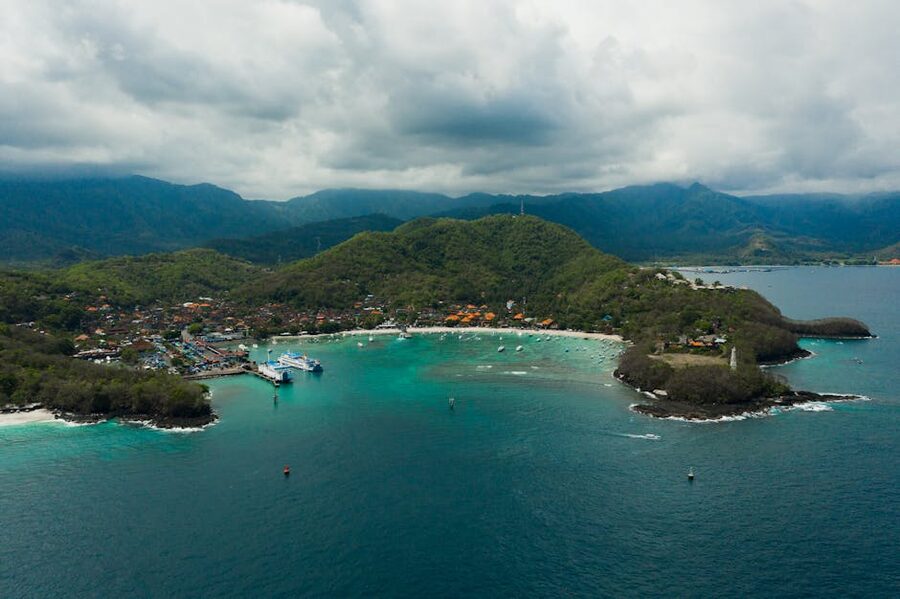
Padang Bai from the air. The pier and ferry terminal are bottom-left, the cove with the boats is the village beach, and the white-sand stretch on the far left is the start of the path to Bias Tugel.

This guide is the case for slowing down. Where to stay (Topi Inn is still the cheap-bed anchor), what’s actually here that’s worth your time, the dive shops that have been operating since the late nineties, the food, and the practical bits, including the harbour-tout scam that catches almost every backpacker on the Gili boat back. If you’re already deep in east-Bali planning, our pieces on Amed and Sanur pair with this one for the wider east-coast loop.

Why Most People Skip It (And Why That’s Their Problem)

Padangbai sits on the southeast coast of Bali, in Manggis sub-district of the Karangasem regency. From Ngurah Rai airport it’s about 75 to 90 minutes by car if traffic behaves, slightly less from Sanur, slightly more from Canggu. The whole built-up village is maybe 800 metres long and three streets deep. You can walk across it in eight minutes.

And that’s the problem, in the eyes of most travellers. There’s nothing flashy here. No Bingin-style cliff villas, no DJ sets, no smoothie bowls plated like art. The town beach in front of the village is a working stretch of sand with painted jukung (traditional Balinese outrigger fishing boats) hauled up at the water line, dive boats coming in and out, and a pleasant amount of plastic at the tide mark after a windy night. If you arrive expecting Seminyak in fishing-village clothing, you will be disappointed within twenty minutes and you will write a one-star Tripadvisor review about the harbour smell.

A traditional Balinese jukung outrigger boat parked on a sandy beach
A jukung at rest. Most of these go out before sunrise and are pulled up the sand by 8 a.m.

The contrarian read: that working-village quality is exactly what’s worth two nights of your trip. The cost of accommodation runs forty per cent under Sanur for similar rooms. The dive shops have small groups (four max at most operators) and prices that are noticeably under what you’ll pay in Amed or Tulamben. The Blue Lagoon is a three-minute walk from your guesthouse. There’s a 1,000-year-old temple on the headland that nobody visits because nobody’s heard of it. You can do nothing for two days and have it work.

The Harbour, the Boats, and the Tout Scam to Watch For

Padangbai harbour with fast boats lined up at the pier and turquoise water
Mid-morning at the pier. Most fast boats run to Gili Trawangan in around 1h 45m. Buy your ticket inside the terminal, not from anyone in the parking lot. Photo: Magul / CC BY-SA 4.0 (via Wikimedia Commons)

The harbour is the reason Padangbai exists in the modern tourist map. Three things leave from here:

  • Slow ferry to Lembar (Lombok). About 4 hours, runs roughly hourly day and night. Foot passenger Rp 65,000, motorbike Rp 175,000, car Rp 1.2 million and up. This is what locals and freight take. It’s slower, much cheaper, and entirely fine if you’re not in a hurry.
  • Fast boats to Gili Trawangan, Gili Air, Gili Meno. Around 1h 45m to Trawangan with operators like Eka Jaya, Blue Water Express, Gili Gili, Semaya One. Roughly 20 daily departures across operators. Prices typically run $23 to $40 (Rp 370,000 to 640,000) one way per person, with hotel transfer from south Bali sometimes bundled. Common departure clusters are 08:00, 09:00, 10:30, 12:30, and 16:00.
  • Fast boats to Nusa Penida and Nusa Lembongan. Shorter run, around 45 minutes to Penida, slightly less to Lembongan. Less frequent than from Sanur, so most travellers actually do these from Sanur instead.

Now the scam. This is real and it is well documented and it has been catching backpackers at this pier for years.

You arrive on the Gili boat back from Trawangan. You step off into a parking lot. A friendly man in a fake company t-shirt tells you the included shuttle to Seminyak isn’t running today, or that it’s broken down, or that there’s a problem with the road and it’ll take six hours, or that you’d be much better off in his cousin’s car for “only” Rp 800,000. He sounds plausible. He has a clipboard. The actual shuttle is sitting twenty metres away with a driver who genuinely is going to Seminyak in forty minutes for the price you already paid. Walk past the man. Walk into the official terminal building. Show your ticket at the kiosk for the boat company you arrived with. The shuttle is real. The man is not.

Same logic on outbound: only buy fast-boat tickets from the official kiosks inside the terminal or pre-book online with a named operator. Anyone selling tickets from a folding table in the car park is either marking up by 100 per cent or selling you on a boat that doesn’t exist. The harbour has a perfectly functional ticket office. Use it.

View of Padang Bai harbour from the deck of the Lombok ferry
Pulling out of Padang Bai on the slow ferry to Lembar. The crossing takes about four hours and costs around Rp 65,000 for a foot passenger. Photo: Felix Dance / CC BY 2.0 (via Wikimedia Commons)

Topi Inn, the Long-Running Anchor

Topi Inn sits on the eastern end of the bay, on Jalan Silayukti, between the village beach and the path that climbs to the Blue Lagoon. It’s a three-storey bamboo and timber thing, sea-view rooms above a noisy ground-floor restaurant, the kind of place where the staff remember the regulars and the regulars are mostly returning divers. It has been doing the same job for a long time.

What you actually book here: a clean, simple room with a fan or AC, a mosquito net you’ll be glad of, and either a private or shared bathroom. Dorm beds run from around Rp 60,000 (about $3.80) and private rooms from Rp 200,000 to 400,000 (about $13 to $26) depending on AC and view. There’s no breakfast included, but the Topi Inn restaurant downstairs bakes its own bread and serves a long menu of Western and Indonesian plates from morning until late. Free WiFi works in the restaurant and most rooms.

The catch: the restaurant is loud, the building is right on the harbour-side road, and a 4 a.m. ferry crew can wake light sleepers. Pack earplugs. The room is cheap for a reason. If you want quiet luxury, you’re in the wrong town and this is the wrong guesthouse.

I’d still book it for one night purely because it’s a fixed point in the local geography. You step out the door, turn left along the seawall, and you’re at the Blue Lagoon path in five minutes. Turn right, and you’re at the harbour ticket kiosks in three. The breakfast banana porridge is genuinely good. And the staff are some of the friendliest people working in tourism on this coast, which after a few weeks in the south is its own kind of holiday.

Blue Lagoon, the Snorkel That Doesn’t Need a Boat

Snorkeler in clear blue water near a rocky shore in Bali
Snorkeling at Blue Lagoon. Best visibility is between June and October during the dry season; the rest of the year you can still get clear mornings if the wind has been off the land.

Blue Lagoon is the easiest world-class snorkel in south-east Bali. From the eastern end of the village, walk up the small road past Pura Silayukti for about ten minutes. You drop into a small bay with a strip of coarse sand, four or five warungs selling Bintang and grilled fish, snorkel and fin rental for around Rp 50,000 a day, and a couple of dive shops with their boats lined up on the sand.

The reef sits maybe twenty metres off the beach. You can swim straight out from the rocks on the south side, drift along the wall, and come back in. No boat needed. On a calm morning the visibility is genuinely good (15 to 20 metres), and you’ll see angelfish, butterflyfish, the odd reef shark on a deeper wall, and occasionally a turtle. Conditions vary: when the wind blows up after lunch, the surface chops out and visibility drops, so go early. By “early” I mean walk out of your guesthouse at 7:30 a.m. with a bottle of water.

If you want to go a little further, the warungs and dive shops will set you up with a jukung ride for Rp 100,000 to 150,000 (about $6.40 to $9.60) for a couple of hours, taking you over to the wall on the east side and the small reef in the middle of the bay. It’s worth it once. Negotiate the price before you get on the boat.

One real downside, and I’d rather you knew: there is sometimes plastic on the tide line at Blue Lagoon, especially after a storm or a strong onshore wind. The local warungs clean the beach most mornings but the sea brings more in. Don’t arrive thinking you’re going to a Maldives postcard. Arrive thinking you’re going to a working east-Bali bay where the snorkel is great and the beach is okay.

Bias Tugel, the White-Sand Walk South

A white sand beach at Padangbai with rocks and a forested headland and Lombok in the distance
Bias Tugel beach, a 15 to 20 minute walk south of the village over a hill. White sand, no boats, and a view across the strait toward Lombok.

Bias Tugel is the secret-beach upgrade. From the village, walk south up the small hill on the right (the road that climbs out of town toward Candidasa). You’ll pass a couple of homestays and after about 200 metres there’s a marked path on your left descending steeply down to a cove. It’s a bit of a scramble in flip-flops and the signage is half-hearted, so don’t expect Disney-style markers. The descent takes five minutes and ends on a 200-metre crescent of properly white sand framed by black volcanic rocks at both ends.

This is the prettiest beach within easy walk of any town on the east coast. There are usually two or three small warungs at the back doing fresh young-coconut juice (Rp 30,000), Bintang (Rp 35,000), and a small grilled-fish menu around Rp 70,000. Bring cash. There’s no ATM and no card reader and there is unlikely ever to be one.

The water can get rough, especially in the afternoons when the swell builds, so swim with care and don’t go out far if you’re not a strong swimmer. There’s no lifeguard. The snorkel is okay on a calm day along the rocks at the south end. The big draw is just lying on white sand with no boats and no port noise, twenty minutes after you left a working harbour. That contrast is the whole point.

One quirk: bring a small towel for the climb back, and good shoes if you can. The path is loose stone and dust, and after rain it’s slippery. I have done it in Havaianas, badly, on multiple occasions. Don’t be me.

The Diving: Cheaper Than Amed, And the Shops Have Been Here Forever

A scuba diver exploring underwater near a wreck and coral fans in Bali
The Liberty wreck at Tulamben sits about 25 minutes north up the coast and is a standard day trip from any Padangbai dive shop.

This is the reason a lot of people stay. Padangbai has its own decent dive sites within ten minutes of the harbour (Blue Lagoon for beginners, the Jetty for macro and a strange shipwreck-y collection of debris, Channel for drift dives), plus easy access to the bigger named sites at Gili Tepekong, Gili Mimpang, and the famous Liberty wreck and drop-off at Tulamben to the north.

The shops here run small groups and price below the Amed and Tulamben competition. A 3-day PADI Open Water typically runs around Rp 5.5 to 6.5 million ($350 to $415), against Rp 6.5 to 7.5 million further north. Two fun dives at local sites with full kit are usually Rp 1.0 to 1.3 million ($65 to $85).

The four operators with the longest track records and the most consistent reviews:

  • OK Divers Resort & Spa. PADI 5-Star centre, brand-new training pool, on-site rooms and a smarter restaurant called The Colonial. The biggest operator in town and a sensible default for an Open Water course. OK Divers Bali.
  • Geko Dive Bali. A PADI 5-Star Resort and TecRec facility operating in Padangbai since 1997. Multilingual staff (English, French, German, Spanish, Italian), strict 4-max group cap, very good for nervous first-timers. Geko Dive Bali.
  • Absolute Scuba Bali. On the bay shoreline, attached to its own small dive resort. Good for combined accommodation-plus-dive packages.
  • Paradise Diving Bali. German-run, tighter focus on certified divers and tech courses. Less of a beginner shop, more an intermediate-to-advanced choice.
School of fish near a wreck underwater in Bali
Fusiliers around the Liberty’s wreckage. The shallowest sections are at about 5 metres, the deepest around 30.

One real note on visibility. Padangbai’s water can be variable. June to October is the dry-season window with the best conditions (often 20 metre visibility, calmer surface). November to March can drop to 8 to 12 metres after rain, and the currents at Channel and at Tepekong get serious. If you’re chasing crystal-clear postcard diving, plan for the dry season. If you’re learning, the shallow-reef sites are fine year-round.

Pura Silayukti, the Temple Almost Nobody Visits

Pura Silayukti temple gateway with ceremony decorations and yellow umbrellas in Padangbai
Pura Silayukti during a temple ceremony. The temple is dedicated to Mpu Kuturan, an 11th-century spiritual reformer who shaped much of modern Balinese Hindu practice. Photo: Torbenbrinker / CC BY-SA 3.0 (via Wikimedia Commons)

Walk five minutes east of Topi Inn, up the road to Blue Lagoon, and you’ll pass a small temple complex on a low headland to your right. From the road it looks unremarkable. Walled, slightly weathered, a couple of incense sticks burning. This is Pura Silayukti, and it is one of the older and quietly more important temples in Bali.

The temple is dedicated to Mpu Kuturan, the 11th-century Javanese-Balinese spiritual reformer who was sent to Bali to harmonise the various competing Hindu sects on the island. Mpu Kuturan settled at Padang (now Padangbai) and is credited with establishing the tri murti framework of three main deities (Brahma, Vishnu, Shiva) within Balinese temple architecture, and with shaping the basic structure of village temples that you see across the island today. He was also instrumental in setting up the basic banjar (village council) structure that still governs Balinese community life. The temple is built on the spot where, by tradition, he meditated and eventually achieved moksha.

Carved golden doors of Pura Silayukti temple in Padangbai Bali
The carved golden doors of one of the inner shrines. Wear a sarong, drop a small donation, and don’t enter the inner courtyard during a ceremony unless invited. Photo: Anandajoti Bhikkhu / CC BY-SA 4.0 (via Wikimedia Commons)

The visit is short, twenty minutes is plenty, and there’s no entrance fee. You’ll need to wear a sarong (you can borrow one at the gate or bring your own), and a small donation in the box at the entrance is appropriate. Don’t enter during a ceremony unless someone clearly invites you. The view from the temple grounds out over the bay is one of the best in town, particularly in late afternoon when the light slants in across the water.

For broader context on what you’re actually looking at and the system Mpu Kuturan helped build, our piece on Balinese Hinduism and the Agama Hindu Dharma covers the temple structure, the daily offerings (canang sari), and the bigger ceremonies you’ll come across. The Padangbai temple is one of the earliest physical pieces of evidence we have for the system that became modern Balinese culture.

Where to Eat

Padangbai food is not a destination. It is, however, perfectly fine and very cheap, and you can eat well for under Rp 100,000 a meal almost anywhere in town. Don’t expect Ubud’s brunch scene or Seminyak’s fine dining. Expect grilled fish, nasi goreng, mie goreng, the occasional pizza, and a lot of cold Bintang.

The places that consistently come up across the dive crowd and the slow-traveller crowd:

  • Topi Inn restaurant. Long menu, in-house bread, banana porridge for breakfast, decent grilled fish for dinner. The on-site default. Around Rp 40,000 to 90,000 a plate.
  • Ozone Cafe. On Jalan Silayukti, just up from Topi Inn. The expat hangout. Italian-influenced menu (pasta, pizza, schnitzel) plus standard Indonesian. Floor cushions, low benches, busy from sundown. Around Rp 60,000 to 130,000 a plate. Cash and card. Ozone Cafe.
  • Warung Bu Jeno. Small family warung doing the best fish and shrimp in town according to most divers I’ve talked to. Around Rp 60,000 to 90,000. Cash only.
  • The Colonial at OK Divers. The smartest restaurant on the bay, with hammocks, beanbags, and its own swimming pool. You don’t need to be a guest. Western and Asian, around Rp 90,000 to 180,000 a plate. Open all day.
  • Kerti Restaurant. Sea-front warung with traditional decor and the best view in the immediate harbour area. Fresh fish, around Rp 70,000 to 110,000 a plate.
  • Martini’s Warung. Where the minivans leave from, so it gets busy mid-morning. The food is solid Balinese plate (nasi campur, gado-gado), the woman who runs it is sharp and friendly, and a meal will run you around Rp 35,000 to 50,000.
Sunset over Padang Bai harbour with moored jukung outrigger boats
Sunset on the village beach. The boats are mostly moored here for the night by 6 p.m., then back out by 5:30 the next morning. Photo: Jasmine Halki / CC BY 2.0 (via Wikimedia Commons)

Where to Stay

Padangbai accommodation breaks into three plain tiers. There’s no luxury here. If you want a $400 villa with a pool butler, you’re booking the wrong town and you should look at our broader where-to-stay archive.

Budget (Rp 60,000 to 400,000 a night)

Topi Inn. Already covered above. Dorm beds from Rp 60,000, simple privates from Rp 200,000. Anchor of the budget scene.

Bamboo Paradise Guesthouse. Clean, friendly, walking distance to the harbour. Around Rp 250,000 to 350,000.

Zen Inn Padangbai. Small guesthouse, decent for a first night before a Gili boat. Around Rp 200,000 to 300,000.

Bagus Homestay. Family-run, Balinese-style, 5-minute walk from the harbour. Around Rp 250,000 to 350,000.

Mid-Range (Rp 500,000 to 1,200,000 a night)

OK Divers Resort & Spa. Attached to the dive operation. Sea-view rooms, brand-new training pool, breakfast included, the smartest restaurant in town. Around Rp 700,000 to 1,200,000. The default if you’re booking a multi-day dive course and want everything in one spot.

Bloo Lagoon Eco Village. Up on the bluff above the village, on the path between Padangbai and Blue Lagoon. Open-sided villas with full kitchens, an outdoor yoga studio with an ocean view, a real spa, and the most thoughtful design in town. Worth knowing: the open-air design means you’ll get the occasional ant and frog visitor. Not all rooms have AC. Around Rp 800,000 to 1,400,000. Bloo Lagoon.

Puri Rai Hotel. Old-school mid-range across from the harbour. Large pool, big rooms, decent restaurant. Around Rp 500,000 to 800,000. Reliable, not exciting.

Absolute Scuba Bali Dive Resort. Bay-shore dive resort with garden bungalows and standard rooms. Direct beach access, 16-minute walk to Bias Tugel. Around Rp 600,000 to 900,000.

What I’d actually book

For a first-time Padangbai visit, two nights at Topi Inn or Bamboo Paradise. For a dive course or a longer stay, three nights at OK Divers. For a slow couple’s stay with no diving, Bloo Lagoon. For a Gili-boat-tomorrow overnight, anything walking distance to the harbour, including the Topi Inn dorm if you don’t mind the noise.

Padangbai as a Hub for East Bali

Tirta Gangga water palace fountain and statues in Karangasem east Bali
Tirta Gangga water palace, about 50 minutes north of Padangbai by scooter or driver. Foreign entry is around Rp 50,000. Photo: Umar Khatab Eko Putrawan / CC BY-SA 4.0 (via Wikimedia Commons)

Two nights here gives you east Bali at half the driver fee you’d pay from Sanur or Ubud. Hire a private car for a day for around Rp 600,000 to 800,000 (about $38 to $51) and you can comfortably loop:

  • Tirta Gangga. The 1946 water palace at Karangasem, with stepping stones over koi-filled pools and an eleven-storey fountain in the back garden. Foreign entry around Rp 50,000. About 50 minutes north of Padangbai.
  • Pura Lempuyang. The “Gates of Heaven” temple with the much-photographed split gateway frame. Be aware: the famous mirror-pool reflection is not a real reflection (it’s a piece of glass held under a phone by a temple staffer). The temple itself is genuinely beautiful and a serious climb if you go all the way to the top. About 1h 15m drive.
  • Sidemen. The valley of green rice terraces and quiet homestays that Ubud was thirty years ago. The drive itself is the experience. About 45 minutes from Padangbai. A natural overnight if you want to add a third night to the loop.
  • Tulamben and the Liberty wreck. If you’re a diver, go up for a full dive day. About 50 minutes north. We round up the wider east-coast options in our things to do in Bali archive.
  • Amed. Quiet diving and snorkel village stretched along 14km of coast. About 1h 15m. Read our Amed area guide if you’re considering pairing it with Padangbai for a longer east-coast trip.
  • Candidasa. 11km east, a quieter strip of mid-range hotels and a famous lotus lagoon. Worth a stop if you’re driving past, not a destination on its own.
Lush green rice terraces in the Sidemen valley of east Bali
Sidemen valley, about 45 minutes from Padangbai. The drive itself is part of the trip.

Boats Out: Gili, Lombok, the Nusas

Aerial view of cliff coastline and turquoise water near Nusa Lembongan Bali
The Nusa Lembongan and Penida cliffs across the Badung Strait. Most travellers do the Nusas from Sanur, but Padangbai works too if you’re heading on to the Gilis next.

Quick reference for what leaves from Padangbai and where it makes sense to go:

  • Gili Trawangan. Around 1h 45m by fast boat. Party island of the three. From around Rp 370,000 one way. Schedule on Gili Ferries.
  • Gili Air. Around 2 to 3 hours depending on operator and stops. The middle-ground island, has bars and bungalows and a more local feel.
  • Gili Meno. Around 2 to 3 hours. The quietest of the three, best for honeymoons and people who genuinely want to read a book for a week.
  • Lombok (Bangsal). Several fast-boat operators run direct to Lombok’s main port. From around Rp 350,000 to 500,000.
  • Lombok (Lembar) by slow ferry. 4 hours, Rp 65,000 foot passenger. The traveller-budget option, very common with motorbike riders crossing for the Rinjani trek.
  • Nusa Penida. Around 45 minutes. Less frequent than from Sanur, so most people skip Padangbai for the Nusa boats.
  • Nusa Lembongan. Around 35 to 40 minutes. Same logic as Penida, Sanur is usually easier.

If your route is “Bali, then Gilis, then Bali again”, Padangbai is the perfect overnight stop both directions. If your route is “Bali, then Penida or Lembongan”, just go from Sanur. Our piece on flights to Bali covers airport-to-east-coast logistics, which often shapes whether you stop in Padangbai on the way in or on the way back.

Getting There

A Bali fisherman returning home with a bright blue triangular sail
A jukung under sail. Most go out at 4 to 5 a.m. and are back by mid-morning.

From Ngurah Rai airport, count on 75 to 90 minutes by car if traffic is normal, longer through the worst of the Sanur and Sukawati afternoon snarl. From Sanur, around 1h 15m. From Ubud, 1h 30m. From Canggu or Seminyak, around 2 hours.

Practical options:

  • Private driver. The default. Pre-book through your hotel or via a transfer-booking platform for around Rp 350,000 to 500,000 (about $22 to $32) one way from south Bali. The driver waits at the kerb with your name on a board.
  • Airport taxi (Bluebird or coupon counter). Around Rp 365,000 with the official airport taxi coupon. Use the official counter inside, not a freelance driver in the car park.
  • Perama shuttle. The veteran tourist-shuttle operator runs a Kuta-to-Padangbai bus for around Rp 150,000, but only if they have at least two passengers. Frequency is limited.
  • Scooter from Sanur. Around 1h 30m on the bypass road. Doable, but not pleasant if you’ve just landed. If you’re already on a scooter from a longer trip, fine.
  • Grab and Gojek. Will drop you here from the south but won’t pick you up here, because there’s no driver pool stationed in town. Plan a return ride before you arrive or have your guesthouse arrange a driver.

Cash and ATMs: there’s a BCA ATM next to the 2 Combi convenience store on the main strip, plus a Mandiri and a BRI within 50 metres. They’re fine to use during the day. Be cautious with any ATM at night or that looks tampered-with. There are reliable accounts of skimmer devices on Bali ATMs (one traveller in our research had a thousand-dollar cash-advance fraud after using a sketchy machine). Stick to ATMs attached to bank branches or convenience stores in plain sight.

The Verdict

Padangbai is not for everyone. If your trip is fourteen days and your priority is south-Bali nightlife, Ubud yoga, and Penida cliffs, it’s a 30-minute pit stop on the way to a Gili boat and that’s fine. Don’t force it.

If your trip is ten days or more, or you’re doing a second Bali visit, or you dive, or you want one stop on the east coast that isn’t Amed, two nights here will repay you. The dive prices are real. The Blue Lagoon snorkel at 8 a.m. is a genuinely good morning. Bias Tugel is the prettiest beach within a 90-minute drive of the airport. Pura Silayukti is one of the older temples on the island and you’ll have it to yourself. And the food is cheap enough that you can eat dinner three nights for the price of one beach-club appetiser in Seminyak.

The harbour is what gets travellers in the door. The fact that almost nobody stops past the parking lot is what keeps the rest of it usable. Go slow, eat at the warungs, dive cheap, walk the headland at sunset, and skip the boat the next morning. The boat will still be there at 10:30.

Bali Luxury Hotels: The Top Tier Ranked by What’s Worth the Price

The doorman at The Oberoi Seminyak wears a sarong and a pressed white jacket, and when my taxi pulled up at half past eleven on a humid Tuesday night, he opened the door, took my bag, said my name back to me before I had given it, and offered a cold towel scented with frangipani. I had been on a plane for fourteen hours. I was sweaty, cranky, slightly wobbly on the cocktails. He did not register any of this. He just walked me past the koi pond to a low pavilion where a lady with a clipboard and a kebaya did the check-in standing up, no counter between us, while a gentleman behind her brought ginger tea in a small ceramic cup. The whole thing took maybe four minutes. I was in a lanai cottage with the doors open to the sound of the surf by midnight. That is what eight hundred and fifty US dollars a night buys you in Bali, and once you have felt it, the rest of this article makes more sense.

Tropical pavilion on the beach in Seminyak, Bali

A thatched beachfront pavilion in Seminyak. The Oberoi has had this view since 1971.

The contrast is the point. A Rp 350,000 (about $22) homestay in Penestanan with a host family, frangipani on your pillow, and the morning canang sari (the small palm-leaf offerings Balinese Hindus place on doorways at dawn) at the gate, delivers a different but equally valid Bali. Price is not the same as quality. Eight hundred dollars is not better than thirty dollars; it just buys a very specific thing. What it buys is what this guide is about. I have stayed at, eaten in, or walked the grounds of every property below, ranked by what they actually deliver against what they cost. The Oberoi anchors the list because it more or less invented luxury hospitality in Bali in 1971, when the rest of Seminyak was still rice fields and a fishing path. Everything else on this catalogue exists because the Oberoi proved a market existed.

Why this list is not the usual press-trip roundup

Most Bali luxury roundups come from press trips. Hotel pays for the flights, the agency does the writing, the article tells you the spa is “transformative”. You can usually spot them: every property is a 10/10, no opinions, the same five adjectives recycled. This list is not that. I have paid my own way at most of these and stayed on points or comp at a few; either way I will say a room smelled of mould or the breakfast was nothing special. Both have happened. You will find that kind of comment below, because it matters more than the brochure copy.

If you want the short version: Mandapa, Amankila, Bulgari, and Alila Villas Uluwatu are the top tier on quality of the actual experience. The Oberoi Seminyak is the one that keeps drawing me back because the staff have been there for twenty years and remember your order. Soori is the architecture pilgrimage. Capella is the most fun. Aman properties are great but quietly losing edge to COMO Shambhala Estate. Most of the Nusa Dua corporate giants are skippable unless you have a corporate rate and want a pool with no surprises. Read on for why.

The Oberoi Seminyak: where the catalogue starts

Sunset on Seminyak Beach, Bali

Seminyak Beach at six p.m., the half hour the Oberoi sunset tables sell out.

The Oberoi opened in 1971 as Kayu Aya, a beach club run by Australian artist Donald Friend and a small group of friends. The Oberoi Group bought it in the late 1970s and kept the bones. That is the thing nobody else in Bali can claim. Every other “iconic” property is twenty, thirty, forty years younger. The Oberoi has been refining the same lanai cottages on the same patch of Seminyak Beach for half a century. The staff turnover is glacial. The bartender at Kayu Bar made my Negroni the same way he made it three years earlier when I was last there, with the same wedge of orange and the same wink about the gin pour. That continuity is rare in Bali, where staff churn at most resorts is eye-watering.

What you actually book

The Garden View Lanai is the entry room, and the catch is right there in the name: garden view, not ocean. Around $450-650 a night low season, $700-900 high. It is a free-standing thatched cottage with a king bed, a sunken bathroom open to a small private courtyard, and a small lanai porch with two chairs. Mine smelled faintly of mildew on arrival, which I called down about and which they fixed by the end of the day. (One review I trust mentioned the same mildew issue. This Is Luxury Travel flagged it too. So it is a known thing, and worth requesting the back of the property if you are sensitive.)

The brochure shot is the Luxury Lanai Ocean View, which is a row of cottages along the front lawn, fifty metres from the surf. They are roughly $750-1100 a night. Worth it on a special trip; I would not pay it on a stopover.

The actual best room category is the Royal Villa, around $1800-3500. Two bedrooms, walled compound, plunge pool, private courtyard, a butler. Honeymoon territory or families splitting the cost.

What justifies the cost

Tropical villa pool in lush Bali garden

The kind of plunge pool the lanai cottages were inventing decades before plunge pools were standard.

One detail. The grounds are roughly nine hectares of garden in the middle of Seminyak. Walk five minutes through Seminyak now and you are in a wall-to-wall mash of beach clubs, cafes, traffic, surf rentals, and people on scooters with surfboards. Walk five minutes inside the Oberoi grounds and you are still in 1980s Bali, with the bougainvillea and the koi ponds and the sound of nothing but the ocean. That gap is what you are paying for. The Indonesian dance theatre on grounds runs traditional legong performances most evenings; non-guests can book the Saturday gala. Kayu Bar at the back of the property is the sunset drink, with the open-air pavilion looking down the beach toward the airport.

Eat at Frangipani for breakfast (the Indonesian set with sambal matah is the move; skip the Western buffet, which is fine but ordinary). The pool lunches are overpriced and bland; I had a bad poke bowl there once, and three of my group got mild food poisoning from the same sitting. So I avoid it now and walk five minutes to Warung Bernadette instead, which charges Rp 80,000 for an actually good nasi campur. The romantic dinner on the beach (set menu, candles, petals, white sand under your feet) is genuinely lovely in the non-cliched sense and worth doing once.

Spa is solid. Not the best in Bali (that crown belongs to Mandapa or COMO Shambhala), but the open-pavilion treatment rooms over lily ponds are atmospheric and the therapists have been there long enough to know what they are doing. Check rates on Booking.com or visit the Oberoi official site.

Ubud: where the river-villa luxury lives

Ubud has six properties that genuinely sit at the top tier. They cluster around the Ayung River gorge north and west of the town, where the topography lets architects build down a hillside with infinity pools that drop into jungle. Read on for what each actually delivers.

Mandapa, a Ritz-Carlton Reserve: the gold standard

Ayung River valley near Ubud, Bali

Photo: Fabio Achilli / Wikimedia Commons (CC BY 2.0)

The Ayung River. Mandapa, COMO Shambhala, and Four Seasons Sayan all sit above this gorge.

Mandapa is the property I send people to when they ask me where to stay in Bali for one trip in their life. Roughly $1100-1800 a night for a Suite, $2000-4500 for the river-pool villas. It sits on the Ayung River below Ubud, and the bones are a working rice terrace and a private temple, both of which are still in active use. (The temple actually belongs to the local banjar, the village council, so when there is a ceremony you might see priests and offerings move through the resort grounds. That is not staged for guests.)

The room to book is the One-Bedroom Pool Villa, around $2100 a night low season. It has a private pool, a riverside deck, a bathroom with a sunken tub looking onto the rice paddy, and a butler who actually butles. (Most “butler service” in Bali is a person you can text for towel deliveries. At Mandapa it is a person who notices your husband prefers cold-brew over espresso and just starts bringing one each morning without being asked.)

The detail that justifies the cost: the pool. The infinity edge does not face the Ayung River, which would be the obvious move. It faces the rice terrace, with three working farmers in conical hats wading through it most days. You sit in the pool and watch agriculture happen ten metres away. It is the most Bali thing I have experienced at the top tier.

Eat at Sawah Terrace, the open-air restaurant above the rice paddy. Indonesian small-plates set menu around Rp 1,800,000 a head. Non-guests can book a table; you should. The kitchen runs an Indonesian high-tea on Wednesday afternoons that is also worth the trip in from town. Mandapa on Booking.com.

COMO Shambhala Estate: the wellness pilgrimage

Aerial view of a Bali jungle resort

The wellness end of the Bali jungle scale.

COMO Shambhala is not a hotel; it is a wellness retreat that happens to also rent rooms. The minimum is three nights and the daily rate is around $1500-3500 with a wellness program included. There are no walk-ins; everyone arrives with a programme (cleanse, fitness, Ayurveda) and a personal practitioner who builds your day. The food is mostly raw, vegan, and weighed; the gym is on a deck above the river; the rooms (residences) are scattered through the jungle on a steep slope above the Ayung. You take a buggy between most things.

I am not a wellness person. I went sceptical and came out of three nights actually feeling, against my judgment, lighter. The yoga teachers are properly senior (most have been with COMO for more than a decade). The personal trainer who took me through a session knew exactly which ankle I had injured before I told her, which was unsettling and impressive. If you want a hotel, do not go here. If you want to be reset, this is the best in Bali.

Detail that justifies cost: the personal practitioner who genuinely tailors the three days. It is not pretend-personalisation; it is a person who actually thinks about you. Skip if you want pool drinks. COMO Shambhala on Booking.com.

Four Seasons Resort Bali at Sayan: the suspension-bridge entrance

Ayung River, Bali jungle valley

Photo: Eka343 / Wikimedia Commons (CC BY-SA 4.0)

Cross the suspension bridge over this river and you are at Four Seasons Sayan.

You arrive at Four Seasons Sayan on foot across a suspension bridge over the river. Then you walk into a two-storey lobby that floats above the gorge. The lobby is the photo, the suspension bridge is the experience. Sixty suites and villas, around $850-1500 for a One-Bedroom Suite, $1500-3500 for villas with private pools.

The Sayan villas tend to feel more “international five-star” than Mandapa, which is more “deeply Balinese”. If you are doing your first Bali trip, Mandapa wins. If you have been before and want something polished and comfortable with less ceremony, Sayan is great. The food at Sokasi (the cooking school’s restaurant) is excellent; Ayung Terrace for the river view at dinner. Four Seasons Sayan on Booking.com.

Capella Ubud: tented villas, properly

Aerial view of a Bali jungle villa with pool

Tented villas with proper bathrooms is the Capella Ubud trick.

Capella is the most theatrical of the Ubud properties. The whole resort is twenty-three “tents” in the jungle, designed by Bill Bensley to look like a 19th-century explorer’s expedition camp. Adults only, around $1500-3500 a night. The trick is that the tents have proper plumbing, marble bathrooms, and air conditioning (Bali heat does not respect canvas). It feels camp without being camping.

The detail: every tent has a copper bathtub on the deck, looking down the jungle, and you really can soak in it under the stars. (I did. It rained halfway through. Still worth it.) Eat at Api Jiwa for the omakase-style flame-grill counter. Skip if you want a beach. Capella Ubud on Booking.com.

COMO Uma Ubud: entry-luxury that does not feel like entry

Ubud Palace and traditional Balinese architecture

Walking distance to Ubud Palace, which is the COMO Uma selling point.

COMO Uma is the budget end of the Ubud top tier. Around $400-700 a night for a Garden Room, $700-1300 for villas. It is in the centre of Ubud, walking distance to Ubud Palace and the Monkey Forest, which is its biggest advantage over the river-gorge resorts. You are paying half the Mandapa rate and getting a smaller version of the same hospitality (Uma is the entry-luxury sister to Shambhala). The pool is glistening green tile, the bar is a tall white pavilion, and the rooms have that minimal Indonesian-meets-modern design COMO does well.

The free walk through the surrounding rice paddies every morning at seven is a small detail that I love. Bring your own coffee, the staff bring water, it takes about forty minutes. You earn breakfast. COMO Uma Ubud on Booking.com.

Bisma Eight: boutique mid-luxury in central Ubud

Pool villa with sunbeds in Bali

Bisma Eight is the boutique mid-luxury option in Ubud, well under the Mandapa price band.

If you want luxury feel without the Ritz-Carlton price, Bisma Eight is the answer. Around $200-380 a night. Thirty-eight rooms on a quiet lane off Jalan Bisma, central Ubud. The pool is a fifteen-metre lap pool above the jungle valley, the rooftop bar (Copper Kitchen) does a decent burger and a good cocktail, and the rooms have an exposed-brick design that does not feel mass-produced. Not a Mandapa replacement; a sane mid-tier choice. Bisma Eight on Booking.com.

Seminyak and the south Bali coast

Outside the Oberoi, the Seminyak coast has a small handful of properties at the top tier. Beyond that, prices are usually for the location and beach club access, not for what is actually in the room.

Alila Seminyak: modern beachfront alternative to the Oberoi

Seminyak Beach, Bali

Photo: Fitri Penyalai / Wikimedia Commons (CC BY-SA 4.0)

Seminyak Beach a few hundred metres south of the Oberoi. Alila sits a block back from this stretch of sand.

Alila is the modern, minimalist counterpoint. Around $400-700 for a Deluxe Studio, $900-1500 for the One-Bedroom Pool Suites. The whole property faces a beach club pool that runs along the front, with the ocean a short walk through the lawn. The rooms are concrete, dark wood, white linen; if you find Oberoi’s thatched-cottage aesthetic dated, you will like Alila instead. It is a good honeymoon pick because the design is photogenic and the sunset bar (Stag) is a real bar, not a poolside hut.

Eat at Seasalt for the Japanese-Indonesian crossover (the wagyu sate is the dish). Skip the breakfast buffet; do the a la carte. Alila Seminyak on Booking.com.

Karma Kandara: the cliffside option south of the airport

Karma Kandara cliffside view, Bukit Bali

Photo: Dare2Leap / Wikimedia Commons (CC BY-SA 4.0)

Karma Kandara hangs over the southern Bukit cliffs above a private beach you reach by inclined elevator.

Karma Kandara is technically on the Bukit, not Seminyak, but it is the easiest cliff-top option to get to from the airport. Around $500-1100 a night for a One-Bedroom Villa with private pool. The selling point is the inclined elevator that takes you down to a private beach club on the sand, which most other Bukit properties do not have (you usually walk down a path). The food at Di Mare (the cliffside restaurant) is genuinely good Italian; book the sunset table.

One caveat: the property is showing its age in places (it opened in the early 2000s). Some villas have not been refurbished recently. Ask for one of the renovated cliff-front villas specifically. Karma Kandara on Booking.com.

Jimbaran: the bay where the seafood grills happen

Jimbaran is the curve of beach south of the airport where the sunset seafood grills set up tables on the sand every evening. Two top-tier resorts here, both worth the cost for different reasons.

Four Seasons Resort Bali at Jimbaran Bay: the village layout

Four Seasons Resort Jimbaran Bay, Bali

Photo: Sarah Lou / Wikimedia Commons (CC BY 2.0)

Four Seasons Jimbaran Bay. The 147 villas spread across 14 hectares of garden behind this beach.

The Four Seasons here is a 147-villa resort built to feel like a Balinese village. Each villa has a thatched roof, carved wooden double doors, a private plunge pool, and a small walled courtyard. Around $900-1700 a night for a One-Bedroom Garden Villa, $1500-3500 for ocean-view. The grounds run for fourteen hectares of palm gardens down to a private stretch of Jimbaran Beach, and the resort is genuinely walkable in a way most Bali resorts are not.

Eat at Sundara, the beachfront restaurant. The coconut negronis at sunset have a cult following, and the kitchen does a proper kaiseki-style Japanese tasting menu on Friday nights. The Healing Village Spa is one of the best spas in Bali, full stop. Treatments around Rp 2,200,000 a session. Four Seasons Jimbaran Bay on Booking.com.

Belmond Jimbaran Puri: the smaller, more intimate alternative

Jimbaran Bay sunset over fishing boats

Photo: alq666 / Wikimedia Commons (CC BY-SA 2.0)

Belmond Jimbaran Puri sits at the quieter southern end of this bay. The sunset seafood grills are a 10 minute walk along the sand.

Belmond Jimbaran Puri is the smaller (sixty-four cottages and villas) and quieter neighbour. Around $700-1300 a night. It feels like a small village clustered around a beachfront pool. The seafood grills you have come to Jimbaran for are a ten-minute walk down the sand from the gate. If you find Four Seasons too sprawling, this is the move. The kitchen at Tunjung is good but not as memorable as Sundara. Belmond Jimbaran Puri on Booking.com.

Nusa Dua: the corporate enclave (mostly skippable)

Nusa Dua is the gated tourism enclave on the east side of the Bukit, built in the 1980s as a planned resort area. It has the whitest sand on the south coast, calm water suitable for kids, golf, and a row of large-format five-star resorts. I would only stay here if I had a corporate rate, was travelling with kids who wanted a calm pool, or had a one-night airport-adjacent reason. Read on for the four worth knowing.

The St Regis Bali Resort: the lagoon-pool option

St Regis Bali Resort beach, Nusa Dua

Photo: Simon_sees / Wikimedia Commons (CC BY 2.0)

The St Regis lagoon beach. Nusa Dua sand is whiter and emptier than Seminyak.

The St Regis is the strongest of the Nusa Dua giants. Around $700-1300 a night for a Suite, $1800-4000 for villa categories. The 3,800 square metre lagoon pool that runs through the property is a real architectural element, not a swim-up bar. The St Regis butler service is the same butler service the brand does everywhere, which means it actually works (proper packing, proper coffee delivery, etc). Eat at Boneka for the Sunday brunch, which is silly and good. St Regis Bali on Booking.com.

The Mulia and Mulia Villas: marble and scale

Mulia Resort Bali, Nusa Dua

Photo: Thank You for views from Fresno / Wikimedia Commons (CC BY 2.0)

The Mulia. Sprawling, marble-heavy, big-resort feel. Some love it, some find it too corporate.

The Mulia is enormous. Three hotels in one (The Mulia, Mulia Resort, Mulia Villas), 526 rooms, 7 restaurants, the lot. My take: I find it overscaled and the rooms feel corporate, with a lot of marble that does not say Bali to me. But families love it because the pool complex is huge and there is a kids club and the buffet has a kids menu. If that is what you need, around $400-800 a night gets you in. The Mulia on Booking.com.

Ritz-Carlton Nusa Dua: the cliff-edge villas

Beachfront resort in Nusa Dua, Bali

Photo: Matt @ PEK / Wikimedia Commons (CC BY-SA 2.0)

Nusa Dua resorts share this enclave; Ritz-Carlton sits a little south of the central beach strip.

Ritz-Carlton Nusa Dua sits a little south, with some villas on a small cliff above the rocks. Around $500-900 a night for a Sawangan Suite, $1500-3500 for cliff villas with infinity pools. It is the more grown-up choice in Nusa Dua compared to Mulia (less marble, more wood). Eat at Bejana for Indonesian on Friday nights. The spa cliff pavilions are the photo. Ritz-Carlton Bali on Booking.com.

Amanusa: the Aman that quietly does its thing

Aerial view of Nusa Dua beach, Bali

Amanusa overlooks this Nusa Dua coastline from a hill behind the Bali Golf Course.

Amanusa is on the hill behind the Bali National Golf Course, looking down at the sea. Thirty-three suites, around $1200-2500 a night. It is the smallest and least-known of the Nusa Dua properties, and that is the appeal. Aman service is famously personal; the staff-to-guest ratio is roughly four to one. The pool is the Amankila prototype, three-tier infinity. The food is fine but not the reason to come. Quick verdict: of the three Bali Aman properties (Amanusa, Amankila, Amandari), this one is the lowest-priority unless you specifically want the golf-and-beach combination. Aman official site for Amanusa (the Aman group is not on Booking).

The Bukit and Uluwatu: cliff-edge architecture

Aerial view of Bali coastal cliffs and ocean

The drive from DPS to Uluwatu takes you along this coastline. Allow 90 minutes in traffic.

The Bukit is the limestone peninsula at Bali’s southern tip. Cliffs, surf breaks, dramatic sunsets. The luxury here is bigger-budget, more architectural, and it skews toward couples and design-led travellers. Three properties in the genuine top tier.

Bulgari Resort Bali: the Italian-Balinese cliffside

Bvlgari Resort Bali cliff villa, Uluwatu

Photo: Simon_sees / Wikimedia Commons (CC BY 2.0)

Bulgari sits 150 metres above the ocean. The private inclined elevator down to the beach club is the detail people remember.

Bulgari is built on a 150-metre limestone cliff at the southern tip of the Bukit, looking out at the Indian Ocean. Fifty-nine free-standing villas, all with private plunge pools and Italian-Balinese fusion design (Indonesian wood, Italian travertine, lava-stone walls). Around $1500-3500 a night for a One-Bedroom Ocean View Villa, $4000-8000 for the larger categories.

The detail that justifies the cost: the private inclined elevator that runs down the cliff face to the beach club. You ride it standing up in a glass capsule, watching the surf break below. Then you arrive at the world’s most exclusive beach club on a tiny patch of white sand the resort essentially owns. It is theatrical in a way that Aman never bothers with, and that is either appealing or off-putting depending on the traveller. The food at Sangkar (Indonesian) and Il Ristorante (modern Italian) is genuine fine dining, both worth booking even if not staying. Bulgari Resort Bali on Booking.com.

Alila Villas Uluwatu: the architectural icon

Cliffs of Uluwatu, Bali

Photo: Jakub Halun / Wikimedia Commons (CC BY-SA 4.0)

The Uluwatu cliffs Alila Villas sits on. The infinity pool above this drop is the iconic Bali resort photo.

Alila Villas Uluwatu is what most architects call the best-designed resort in Bali. Eighty-five villas (50 suites and 35 one- to three-bedroom villas), all with infinity pools, designed by Singapore firm WOHA on a limestone plateau above the Indian Ocean. Around $900-1700 a night for a Cliff Edge Suite, $2500-6000 for villas with private pools.

The clifftop infinity pool dropping into nothing is the Bali resort photo. You have seen it on Pinterest a hundred times; in person it is exactly as good as the photo. The material palette is local lava stone, recycled iron-wood, and concrete that has weathered to look ancient. Sustainability is real here, not greenwashed: the resort runs on recycled water, organic gardens, and local craftsmen. The food at The Warung (Indonesian) is decent; Cire (international) is better. Alila Villas Uluwatu on Booking.com.

Six Senses Uluwatu: wellness with a clifftop

Aerial view of Uluwatu cliffs at sunset, Bali

Six Senses Uluwatu shares this stretch of the Bukit cliffs.

Six Senses Uluwatu is the newest of the Bukit big three (opened 2018). 103 suites and villas on a cliff above Pantai Selonding, around $700-1500 a night for a Sky Suite, $1800-4500 for sky pool villas. The Six Senses brand is wellness-led, and that shows in the spa programme (the cliff-edge yoga pavilion is real, the wellness consultations are useful).

The detail: there is a small but proper sleep clinic on site (real sleep tracking, real consultations, a sleep pod). I am not a sleep tourist and I tried it; it actually moved my needle on jet lag. Good for a stopover when you have flown twenty-four hours. Six Senses Uluwatu on Booking.com.

East Bali: Amankila on the cliffs above Manggis

Amankila: the original Aman in Bali

Amankila resort, East Bali, Aman

Photo: Richard Michael Shaw / Wikimedia Commons (CC BY 2.0)

Amankila on the cliffs above Manggis. The three-tier infinity pool cascades down the hillside.

Amankila (“peaceful hill”) sits on the cliffs above Manggis, on the east coast of Bali, looking across the Lombok Strait. Thirty-four free-standing thatched-roof suites connected by raised walkways, each with views of the strait and Mount Agung in the distance. Around $1500-3500 a night.

The signature is the three-tier infinity pool that cascades down the hillside. It has been photographed more than anything else in Bali hospitality. There is a black-sand beach club below, accessible by a long flight of steps (or a buggy). The location is the trade-off: you are two hours and a bit from the airport, and a long way from anything else. That is either the appeal (no traffic, no crowds, no Seminyak) or the deal-breaker (you are stuck on the property). I think it is the appeal. Pair Amankila with a few nights in Amed for the diving and you have an east-coast trip. Amankila official site (Aman is not on Booking).

The west coast outlier: Soori Bali

Soori: architectural pilgrimage on a black sand beach

Black sand beach with traditional fishing boats, west Bali

Soori Bali sits on this black-sand stretch of the south-west coast, an hour-plus from anywhere.

Soori was designed by Singaporean architect Soo K. Chan as a personal project; he and his family lived on the property at one point. Forty-eight villas, all with private plunge pools, scattered across rice fields and a stretch of black volcanic sand on the south-west coast. Around $1200-2500 a night.

The reason to go: the architecture. This is the most beautifully designed Bali resort I have stayed at, full stop. The lines are minimal, the volcanic stone walls have weathered to look ancient, the villas open completely to the elements. It is also the most isolated. You are an hour and a half from Seminyak, in farm country, with nothing nearby. Eat at Cotta (local) and Ombak (international). The squid ink beef is the dish. Book a private driver if you want to get out for a day; otherwise plan to stay on the property. Soori Bali on Booking.com.

What this catalogue actually buys you

Tegalalang rice terraces with coconut trees, Bali

A Rp 350,000 a night homestay in Penestanan delivers this view too. Price is not the same as quality.

Here is the unromantic truth. Eight hundred dollars a night does not buy you a better Bali. It buys you privacy, space, staff-to-guest ratio, food made from ingredients you trust, a bathroom that opens to a garden, and the absence of small frictions. It does not buy you better sunsets, better rice terraces, better beaches, friendlier people, or a more meaningful cultural experience. A Rp 350,000 ($22) a night homestay in Penestanan, ten minutes’ walk from the centre of Ubud, will give you an arguably better Bali. The host family will share their breakfast. Their kids will teach you to fold canang sari. You will see the morning offerings happen at six a.m. on the front step, not staged for you in a hotel lobby. That is also Bali. It is not a worse Bali; it is a different one.

The right answer to “where should I stay in Bali” is usually a mix. Two nights at Mandapa, then four nights at a Penestanan homestay, then two more at Amankila on the way out. You spend less than you would on a week at any one of these resorts, and you see more of the island. Use Sanur as a calmer base if you want a beachfront town that is not Seminyak; the long-running Tandjung Sari is a mid-luxury alternative I rate highly that did not make this list because it is a tier below the Mandapa-Bulgari level on price.

For arrival logistics on the high-end end of the trip (private transfers, lounges at DPS, business-class fares), see the flights to Bali guide. If you are coming from Australia and considering layered itineraries through Munduk or the north, the eco-lodge angle there pairs nicely with one or two top-tier nights at the start or end. And if you want to ground the comparison at the other end of the price scale, the Poppies Kuta piece walks through what Rp 200,000 a night actually feels like, and the south Bali beaches guide covers the public stretches the resort guests share with everyone else.

The short version: my actual rankings

One trip in your life: Mandapa.

You want the design pilgrimage: Alila Villas Uluwatu, then Soori.

You want to feel reset: COMO Shambhala Estate.

You want continuity, beach, and that 1980s Bali feel: The Oberoi Seminyak.

You want quiet east coast and a long view of Mount Agung: Amankila.

You want theatre: Bulgari with the inclined elevator, Capella with the tents.

You want corporate-points luxury that still feels Balinese: Four Seasons Sayan or Four Seasons Jimbaran Bay.

You want to keep it under $400 a night and still feel boutique: Bisma Eight or COMO Uma Ubud.

You want to skip a hotel altogether and live in a Penestanan homestay for two weeks: also valid. Sometimes the right move. See you at the warung.

For more on staying across Bali at every tier and area, browse the full Where to Stay archive.

Sanur, Bali: Why the Slow Coast Wins on the Second Trip

Everybody arriving in Bali for the first time books Seminyak. They land at Ngurah Rai, fight the traffic up the west coast, drop their bags somewhere within walking distance of a beach club, and start the trip with a Rp 250,000 (about $16) cocktail at sunset. I have been there. I have done that. I have come back the next morning with a hangover and a sunburn and the dim feeling that I was paying mainland prices for a beach that smelled like cigarettes.

Here is the contrarian case. Your second Bali trip should be Sanur. Your first Bali trip probably should have been too. Sanur sits on the southeast coast, faces the sunrise, has a four-kilometre paved bike path, restaurants that close at ten, and a reef-protected swim that means the water is calm at every hour of every day. The crowd skews older and more local. The prices run twenty to thirty per cent under Seminyak for similar quality. The mopeds do not snarl down narrow lanes at midnight. And the morning light, when it comes up over Nusa Penida and washes the painted jukung outriggers (traditional Balinese fishing canoes) on the sand, is genuinely the best two hours of the day in south Bali.

Morning at Sanur Beach Bali with calm water and palm trees
First light at Pantai Sanur, around 5:50 a.m. Get there twenty minutes before the sun, with coffee. Photo: Danangtrihartanto / CC BY-SA 4.0 (via Wikimedia Commons)

This is not a sales pitch. Sanur is not for everyone. If you came to Bali for surf, you will be disappointed at Sanur Beach because the reef break sits a kilometre offshore and you need a boat to get to the wave. If you came for nightlife, you will get a cocktail bar and a beachfront beer garden and a night market and that is more or less it by ten. If you came to be photographed in front of cliff temples in flowy white linen, the Instagram crowd genuinely skips Sanur and there are reasons for that. Fine. The article below is for travellers who want a base that lets them do the rest of Bali at half the stress, and a sunrise walk that does not require a 4 a.m. taxi to Mount Batur.

Why Sanur Exists at All

Museum Le Mayeur Sanur Bali interior with Balinese art
Museum Le Mayeur sits next to the Inna Bali Beach hotel. The Belgian painter built it as his house in 1932 and lived here until 1958. Photo: Andy Mabbett / CC BY-SA 4.0 (via Wikimedia Commons)

Sanur is older than every other resort area in Bali. Walter Spies, the German painter who shaped what the world thinks Bali looks like, came through here in the 1930s, and the Belgian painter Adrien-Jean Le Mayeur de Merpres built a house on the beach at Sanur in 1932 and lived there until he died in 1958. His widow Ni Pollok donated the house to the Indonesian state and it is now Museum Le Mayeur (open Tuesday to Sunday, 8 a.m. to 3:30 p.m., entry around Rp 50,000 / about $3.20). It sits beside the old Inna Bali Beach hotel, which was the first international-class hotel on the island when it opened in 1966.

The point of that history is not that Sanur is a museum. The point is that Sanur was designed, from the start, around the kind of traveller who wanted Bali without the rave. The grid of streets back from the beach is laid out in a way that Kuta and Canggu were never laid out, with proper pavements, a main road that runs parallel to the sand, and side gangs (narrow alleys) feeding off it. You can walk it. You can cycle it. You can let your kids cycle it. None of that is true in Seminyak.

If you are reading this knowing nothing about Bali at all, the wider context lives in our where to stay in Bali archive, which compares the main areas on price, vibe, and traveller fit. Sanur is one slice of that.

The Beach Itself, in One Paragraph

Traditional jukung outrigger boat parked on Sanur beach
The painted jukung outriggers are not props. The fishermen still take them out at first light most days. Photo: Imadedana / CC BY-SA 4.0 (via Wikimedia Commons)

Let me be straight with you. Sanur Beach is not the prettiest beach in Bali. The sand is grey-gold rather than white, there is a fair amount of seaweed at certain tides, and the four-kilometre stretch from Mertasari in the south to Padang Galak in the north is broken up by hotel frontages, beach warungs, and the occasional ugly sea wall. If you ranked Bali beaches purely on swimwear-shoot photogenics, Sanur would not crack the top ten.

What Sanur Beach has, that almost nothing else on the south coast has, is a fringing reef that sits about a kilometre offshore. The reef breaks the swell. The water inside the reef is shallow and calm and warm and you can swim, properly swim, as far as the reef line at low tide without ever feeling out of your depth. For a family with kids, that is the only metric that matters. We rank the south coast on a few different axes in our south Bali beaches guide; Sanur is not the prettiest but it is the easiest.

The other thing Sanur Beach has is the four-kilometre paved promenade that runs the full length. It is wide enough for cyclists and walkers to share without anyone getting hit. The local government renovated it in 2023 to widen the worst sections, and from 2026 they have banned electric bikes from the path entirely. Push bikes and pedestrians only. This means you can rent a regular bike from any of the rental shops along Jalan Danau Tamblingan for around Rp 30,000 to 50,000 a day ($2 to $3.20) and ride from one end to the other in about twenty-five minutes if you stop for nothing.

People walking on Sanur Beach with mountains in distance
The Sanur boardwalk is busiest between 6 and 8 a.m. After 9 the heat takes over.

I will not pretend the seaweed problem isn’t real. After the rainy-season storms (roughly November to March) the seaweed and some plastic does pile up on the tide line and the hotel staff are out raking it most mornings. The Tandjung Sari and Hyatt Regency frontages get cleaned daily. The public stretches in between get cleaned less, and there are days when it is a real eyesore. I am telling you this because I do not want you arriving in February and feeling lied to.

Sunrise Is the Reason

Sanur Beach sunrise with red sky and silhouetted boats
Pantai Sanur at sunrise. The sky goes red around 5:55, the sun breaches the horizon at about 6:10. Photo: Nleni1976 / CC BY-SA 4.0 (via Wikimedia Commons)

The single best argument for Sanur is the morning light. Bali sits eight degrees south of the equator and the sunrise here happens fast, in maybe twelve minutes from first colour to the sun being properly up. The Sanur shore faces east, the Nusa Penida and Lembongan silhouettes sit on the horizon, and the painted jukung on the sand reflect into wet ribbed sand at low tide. On a clear morning, particularly between May and September when the sky has fewer clouds, Mount Agung shows on the northeast skyline, sometimes with a thin cap of cloud, sometimes bare.

Get out of bed at 5:30. Walk the boardwalk for ten minutes north of wherever you are staying. Do not bring a phone, do not bring breakfast, do not even bring a coffee, the warungs are not open yet. Watch the sky. Then walk back to one of the hotel frontage cafes that opens at 6:30 and order a Bali coffee. This is the single ritual that justifies the whole Sanur trip and you will see fifty other people of all ages doing the same thing.

Traditional outrigger boat on Sanur beach at sunrise
Most jukung skippers go out before dawn and are back before the heat. By 8 a.m. the boats are pulled up the sand for the day.

Sunset, by contrast, is a non-event in Sanur. The sun sets behind the island, behind the volcanoes. You can watch the sky go pink for about ten minutes from the boardwalk at the right angle, but if you came to Bali for the iconic west-coast sunset you will be making the drive over to Seminyak or Canggu. The only Sanur exception I have found is the rooftop at Maya Sanur Resort, which sits high enough to catch some of the western sky, but you are paying restaurant prices for the view.

The Two Temples Worth Walking To

Prasasti Blanjong inscription pillar at Pura Blanjong Sanur
The Prasasti Blanjong stone inside Pura Blanjong is the oldest dated inscription on the island, year 914 CE. Photo: DayakSibiriak / CC BY-SA 4.0 (via Wikimedia Commons)

Sanur is not a temple-tour town in the way Ubud or the Bukit are. There are dozens of small village temples scattered through the back streets, but the two that earn a deliberate visit are Pura Blanjong and Pura Segara. Both are near the south end of the area, walking distance if you are based on Jalan Danau Tamblingan, otherwise a short Grab from anywhere else in Sanur.

Pura Blanjong sits on Jalan Danau Poso. From the street it looks like any other small village temple, walled, slightly weathered, with a couple of incense sticks burning. What makes it worth the walk is what stands inside the courtyard: the Prasasti Blanjong, a stone pillar carved in the year 914 CE during the reign of the Balinese king Sri Kesari Warmadewa. The inscription on the pillar is in two scripts (early Nagari and Old Balinese) and two languages (Sanskrit and Old Balinese), and it commemorates a military victory. It is the oldest dated artefact on the island and you are looking at the moment Bali enters written history. The temple itself is small, the pillar is housed under a simple shelter, and the whole visit takes about fifteen minutes. There is no entrance fee, but you should be wearing a sarong (you can borrow one at the gate) and a small donation in the box at the entrance is appropriate.

If the broader story of how Balinese Hinduism evolved interests you, our deeper dive sits at a traveler’s guide to Agama Hindu Dharma. The Prasasti Blanjong is one of the earliest pieces of evidence we have for the Hindu kingdoms that became modern Balinese culture.

Pura Segara temple gateway at Sanur
Pura Segara sits right on the beach. Best visited late afternoon when the light is soft and the offerings are fresh. Photo: Anandajoti / CC BY-SA 4.0 (via Wikimedia Commons)

Pura Segara (literally “sea temple”) is the other one. It sits at the back of Mertasari Beach, accessible from the boardwalk. As a building it is more architecturally rewarding than Blanjong: a multi-tier meru shrine, painted guardian statues at the entrance, fresh canang sari offerings at every shrine. Visit late afternoon when the sun is dropping behind the trees, the air cools, and the local women are doing the daily round of offerings. Same etiquette: sarong, donation, do not climb on anything, do not photograph anyone praying without asking. Twenty minutes is enough.

Daily Balinese canang sari offering on a temple shrine
The daily canang sari offering. You will see them on every doorstep, dashboard, and shrine in Sanur from about 7 a.m.

Where to Eat

Sanur eats well. It is not Ubud-level for vegan brunch and it is not Seminyak-level for fine dining, but the spread between Rp 25,000 warung lunches and Rp 600,000 hotel-restaurant dinners is wider here than almost anywhere else on the south coast. Below is what I would actually point a friend at if they asked, sorted by tier rather than ranking, all of these came up in my research scrapes and I have eaten at most of them on previous trips.

Warungs (Rp 25,000 to 70,000 a plate)

Warung Mak Beng, at the north end of Jalan Danau Tamblingan near the Inna Bali Beach, has been doing the same three-item menu (fried fish, fish soup, plate of rice and sambal) for decades. There is a queue at lunch most days. The fish is whatever came in that morning. Skip if you are not eating seafood; otherwise this is the single Sanur food experience I would not skip. Cash only. Rp 65,000 will feed you well.

Warung Wardani, on Jalan Danau Tamblingan, does proper Balinese plate food, the kind of nasi campur (rice plate with several small portions of curry, sate, urap, sambal) you would get at a Balinese family meal. Open lunch only, queue forms by noon, gone by 2:30. Around Rp 45,000 a plate. The history of the dish itself we cover in our piece on nasi goreng and where to eat it; Wardani is doing the older, less travelled cousin.

Warung Krishna, on Jalan Danau Tamblingan opposite Maya Sanur, is fully vegetarian and has been since long before the digital nomads decided plants were a personality. The gado-gado and tempeh dishes are the picks. Rp 35,000 to 50,000 a plate.

Warung Pregina, slightly off the main strip on Jalan Danau Tamblingan north end, does serious Balinese specialities (sate lilit, lawar, babi guling on Wednesdays). Sit-down rather than canteen-style. Rp 80,000 to 130,000 a plate, expect a wait at peak.

Colourful Sanur jukung boats with offering flags
The fish soup at Warung Mak Beng was probably caught from one of these.

Mid-Tier Cafes and Restaurants (Rp 90,000 to 250,000)

Genius Cafe at Mertasari Beach is the all-day brunch and bowls institution. Smoothie bowls, gluten-free everything, vegan nachos, a dedicated kids’ menu. You can dig your toes in the sand at the table. Rp 120,000 will get you a serious breakfast. Live music in the evenings.

Sala Bistro on Jalan Danau Tamblingan is two floors of Australian-style brunch downstairs and a wine bar upstairs. The hash benedict is the order. Open from 7:30 a.m. to 10 p.m. About Rp 130,000 for breakfast.

Soul on the Beach at Mertasari is the relaxed beachfront sister to Genius. Big breakfast plates, smoothies, beachfront tables. Around Rp 150,000 a head.

Char Ming, on Jalan Danau Tamblingan, is the smarter dinner pick. Indonesian-fusion, candlelit, garden-style room, decent wine list. Around Rp 250,000 to 350,000 a head with one drink.

Cafe Smorgas, in north Sanur, does Scandinavian breakfast, open sandwiches, proper coffee. The Swedish expat scene in Sanur is bigger than you would think; this is their canteen. Around Rp 110,000 for the open-sandwich plate.

Shotgun Social, on Jalan Pantai Sindhu, is a brewhouse with sixteen craft beers on tap, a treehouse for kids, a doggy menu, and big NYC-style pizzas. This is where the Sanur expat families end up on a Friday. Around Rp 180,000 with a beer.

The Italian Thing

Aerial view of Sanur stone pier
The Sanur Harbour pier, viewed from above. Boats to Lembongan and Penida leave from here.

One quirk of Sanur worth knowing: this is the gelato capital of Bali. There has been a small but persistent Italian community in Sanur since the 1970s, and the result is that you can get genuinely good gelato in five different places, more variety than you will find anywhere else on the island. Massimo, on Jalan Danau Tamblingan, is the one. Two scoops cost about Rp 40,000 ($2.60). The pistachio is the obvious order; the watermelon sorbet in dry season is the sleeper. There is also a sit-down trattoria on the same site if you want a proper bowl of pasta after.

For pizza, Bella Italia on Jalan Danau Tamblingan does wood-fired Neapolitan-style. Around Rp 140,000 for a margherita with a beer. Not life-changing, but better than the touristy pizza places in Seminyak by a meaningful margin.

Sindhu Night Market

Indonesian sate ayam being grilled over coals at night
The sate ayam stall at Sindhu is the order. Twenty-five thousand rupiah for ten sticks and a bowl of peanut sauce.

Most evenings around 5 p.m., the empty lot on Jalan Pungutan in north Sanur fills up with food carts and turns into Pasar Malam Sindhu (the Sindhu night market). This is the cheap proper-Indonesian dinner. Plates of sate ayam for Rp 25,000, martabak from the legendary cart-flipping master for Rp 30,000 to 60,000 depending on filling, fresh juice for Rp 15,000. Communal tables. Smoke and chatter. It runs until late, usually past 11. Closed on the major Hindu ceremony days, so check before you go.

Where to Stay, by Budget

Sanur Beach with Mount Agung in the distance
From the right Sanur hotel pool you can see Mount Agung on a clear morning. Andaz, Hyatt, and Maya all have this angle.

Sanur has the deepest budget-to-luxury hotel spread of any south Bali area. The west side of the bypass (away from the beach) is where the homestays and family-run guesthouses cluster. The east side, between the bypass and the beach, is where the resorts sit, with their gardens running right onto the sand. The closer to Jalan Danau Tamblingan you stay, the more you pay and the less you walk to dinner.

Budget (under Rp 600,000 / about $38 a night)

Walk the back gangs off Jalan Danau Poso and Jalan Danau Tamblingan and you will find proper Balinese homestays charging Rp 250,000 to 500,000 for a clean room with breakfast and often a small pool. Many do not list on Booking.com at all. If you are on a long stay or just want zero corporate vibe, knock on a few gates and ask about monthly rates. Ari Putri Hotel in south Sanur is the well-known mid-budget pick: two pools, breakfast included, around Rp 550,000 a night.

Mid-Range (Rp 1,500,000 to 3,500,000 / about $95 to $220 a night)

Tandjung Sari (check rates on Booking.com) is the one I would book if I had to pick one Sanur hotel for a special trip. Eleven thatched bungalows on the original Sanur beachfront, opened in 1962, restored thoughtfully, the sand right there at the gate. Mick Jagger and David Bowie stayed here in the 1970s and the photos are still on the wall. Bungalows from around Rp 2,800,000 a night low season.

Beachfront gazebo at Sanur
The classic Sanur thatched beach pavilion. Half the older hotels still have one of these on their lawn.

ARTOTEL Sanur (check rates on Booking.com) is the design-hotel pick at the budget end of mid-range. Inspired by the Bali Kite Festival, painted murals throughout, rooftop pool, around Rp 1,400,000 a night. Best for couples and solo travellers.

Sudamala Suites (check rates on Booking.com) just off the main street, twelve suites, garden pool, the kind of place where the staff remember your coffee order on day two. Around Rp 2,200,000 a night.

Top-End (Rp 3,500,000+ / $220+ a night)

Hyatt Regency Bali (check rates on Booking.com) sits on nine hectares in the middle of the beachfront, three pools, the best beachfront stretch of any Sanur hotel. Reopened in 2020 after a full rebuild on the original 1973 plot. From around Rp 3,300,000 a night low season.

Andaz Bali (check rates on Booking.com) is the first Andaz in Asia and is laid out as a Balinese village with a central grass square the staff call the Village Square, koi pond at entry, lagoon pools. From around Rp 4,800,000 a night.

Maya Sanur Resort & Spa (check rates on Booking.com) is the more modern luxury pick. Direct beach access, infinity pool, three restaurants. From around Rp 6,100,000 a night for the suites with private pool.

For a wider comparison of Sanur against the louder west-coast strips, see our guide to Poppies Lane Kuta; same island, different planet.

Getting Around Sanur

This is the part Sanur quietly does better than anywhere else on the south coast. The whole area is walkable. The main strip, Jalan Danau Tamblingan, runs roughly north-south for about two and a half kilometres parallel to the beach, and almost everything that matters (warungs, cafes, spas, hotel entrances, gelato shops) sits along it. The boardwalk runs parallel to that, on the beach itself. Everything else feeds off these two lines.

If you are not walking, the order I would put the options in is this. Bicycle is the single best Sanur option for actually getting around within the area. Rent for Rp 30,000 to 50,000 a day from any rental shop, ride the boardwalk, lock it at the cafe or hotel and walk the last bit. The boardwalk is genuinely flat and well-maintained.

Grab and Gojek work everywhere in Sanur and the local taxi mafia does not block them the way it does in Ubud. A car ride within Sanur is Rp 20,000 to 35,000. A scooter (faster, cheaper, slightly riskier) is Rp 10,000 to 20,000 on the same routes.

Bemo (the small green minibus vans you see honking down the main street with one door open) is the local option. About Rp 5,000 to 10,000 a person to anywhere on the main strip. Wave one down, get in, tell the driver where you want off.

Scooter rental for the day is Rp 60,000 to 80,000 from any of the dozens of rental shops. Helmet provided. International driving permit with motorcycle endorsement is genuinely required by police, the 2024 to 2025 enforcement has been real, and our Bali health and safety guide covers what your travel insurance probably will and will not cover for moped accidents.

Bluebird metered taxi still works for longer rides and unlike the random taxis is reliable on the meter. Use the app rather than flagging on the street.

From Ngurah Rai Airport, Sanur is about 25 to 40 minutes by taxi depending on traffic. A Bluebird from the airport rank costs about Rp 200,000 to 250,000. Booking an airport transfer through your hotel runs Rp 250,000 to 350,000 for the same trip in a private car. Grab from the airport is technically allowed but the official taxi pool can be hostile about it; use the airport rank and pay the small premium for an easy life.

Day Trips Out of Sanur

View from Sanur Beach looking out to Nusa Lembongan
Looking east from Sanur to Nusa Lembongan and Nusa Penida. The boats leave from the harbour at the south end of the boardwalk. Photo: WMWis / CC BY-SA 4.0 (via Wikimedia Commons)

The single best argument for using Sanur as a base, beyond the sunrise and the pace, is the Sanur Harbour. The new pier at the south end of the area, finished in 2022, is the main jump-off point for the Nusa islands. Boats to Nusa Lembongan take about 30 minutes and cost Rp 75,000 to 150,000 each way depending on the operator. Boats to Nusa Penida take about 45 minutes. You can do Penida as a long day trip from Sanur (leave 7 a.m., back by 6 p.m.), but most people who go to Penida end up wishing they had stayed a night.

If you want the day trip done for you, the Nusa Penida day tour from Sanur Harbour on Klook handles the boat, the transport on the island, and Kelingking, Angel’s Billabong, and Broken Beach in one shot. Around $45 per person.

Island in calm water at sunrise
The view of Nusa Lembongan from the boardwalk at first light is reason enough to come here. Boats start running at 7 a.m.

Other day trips that work well from a Sanur base:

  • Ubud is 60 to 90 minutes by car each way (longer in afternoon traffic). A full-day private driver costs around Rp 600,000 to 800,000 for up to four people. Worth it for one day if you have not been to Ubud before.
  • The east coast (Padangbai, Candidasa, Amed) opens up if you have your own scooter or a driver. Amed in particular is where Sanur travellers go when they want quieter, properly clear water and the diving scene. Two and a half hours each way; consider an overnight.
  • Pura Tirta Empul and Pura Besakih (the central temples, both important) are doable as a full day from Sanur with a driver.
  • Ngurah Rai Airport for a domestic onward, 25 to 40 minutes. Sanur is the rare south-coast area that is genuinely close to the airport without the traffic that the Kuta-Seminyak strip suffers.

What to Do Inside Sanur

A solo walker on Sanur Beach shoreline
Most of what you do in Sanur happens on the boardwalk or just off it. The pace is the point.

Truthful answer: not a huge amount, and that is part of the appeal. The list below is what I would actually do on a four-day Sanur stay.

  • Sunrise on the boardwalk, every single morning. See the section above.
  • Cycle or walk the full four kilometres from Mertasari Beach in the south to Pantai Padang Galak in the north. Stop for coffee at one of the hotel beachfront cafes around the Hyatt or Maya halfway through.
  • Pura Blanjong and Pura Segara. See the temples section above.
  • Museum Le Mayeur, half an hour, painter’s house from 1932 next to the old Inna Bali Beach hotel.
  • Massage at The Nest Beachside Spa or Body Karma. Sanur’s spa scene is good without being trendy. A 90-minute massage runs Rp 250,000 to 450,000.
  • Yoga. There is a free morning yoga class at Pantai Karang at 7:30 a.m. most days, instructor uses a microphone, anyone can join. Bring a towel or mat.
  • Hire a SUP or kayak from any of the beach vendors and paddle out to the reef line at low tide. Around Rp 100,000 an hour.
  • Snorkel from the beach. The reef itself is not great (the visibility is mediocre, the coral is patchy), but if you take a boat out to the reef edge you can see decent fish life. Real take: snorkel as a day trip from Sanur to Nusa Penida (manta rays, mola mola if you are lucky), do not snorkel in Sanur itself.
  • Sindhu Night Market, at least once. Cash, plates of sate, fresh juice, communal table.
  • Bali Kite Festival in July or August if you are around for it. The kites are four metres wide and ten metres long and the local banjar villages compete with them on Sanur Beach. Free.
Kitesurfing off Sanur Beach during the windy season
Sanur catches strong easterlies from May to August. The kitesurf scene is small but real.

The Genuine Reasons to Choose Sanur

Stripping out everything above, the case for Sanur over the alternatives comes down to about six things. I will be specific.

  1. Sunrise side of the island. The morning light is excellent and the beach faces it. If you are a morning person at all, this is worth more than any pool view.
  2. Calm swim, every day. The reef breaks the swell. Kids can swim. People who do not like big waves can swim. There are no rip currents. This matters more than the photogenic-beach factor for most travellers.
  3. Family-friendly grid layout. Wide pavements, walkable streets, restaurants with high chairs, hotels with kids’ clubs. None of these are Sanur-exclusive but the combination at the price point is.
  4. Twenty to thirty per cent cheaper than Seminyak or Canggu for similar-quality hotels and meals. The mid-range bracket in particular is much better value here. The luxury bracket is roughly the same.
  5. Less moped chaos. The 2024 to 2025 enforcement on moped permits has cleared up the worst of it, but Sanur was always less moped-dense to begin with. The wide main street and the pedestrian boardwalk help. You can let a child walk to the corner shop.
  6. The Sanur Harbour for Nusa. If you are doing the Nusa islands and especially Nusa Lembongan and Penida, basing in Sanur for two or three nights either side is the sensible play.

The Genuine Reasons Not to Choose Sanur

Equally true, the other side. Sanur is wrong for some travellers and you should know which side you fall on.

  • No surf for non-experts. Sanur Beach has no surf. The break sits on the reef offshore and you need a boat. Beginners and intermediates: stay at Kuta or Canggu.
  • The nightlife is mild. A few bars, a beer garden, the night market, dinner restaurants. By 11 p.m. most things are closing. If you came to club, this is the wrong area.
  • The Instagram crowd skips it. Which is great for you if you are over that, but means there are not the dramatic cliff-temple shots, the rice-terrace selfies, the swing-over-the-jungle setpieces. Sanur is not photogenic in the contemporary social-media sense.
  • The beach is not the prettiest in Bali. See above. The reef is a feature; the seaweed is a bug.
  • The crowd skews older. Sanur has been the family and retiree pick for thirty years. The bars are quieter. The dinner-time conversations at adjacent tables are about grandchildren more than about Bingin barrels. If you are 22 and travelling solo and want to meet other 22-year-olds, this is not the place.

Practical: Money, ATMs, the Tourism Levy

One small thing because I keep getting asked about it. Bali introduced a Rp 150,000 (about $10) tourism levy in February 2024, payable per visitor on entry. You can pay online before you arrive (the official site is lovebali.baliprov.go.id) or at the airport on landing. It applies once, not per day. Sanur hotels do not collect it; you do.

ATMs are everywhere on Jalan Danau Tamblingan. Use the Bank Mandiri or BCA ones, ideally inside a bank lobby rather than freestanding kiosks; the skimmer scams in tourist areas are real. Withdraw Rp 1,500,000 to 2,500,000 at a time, the per-transaction fee is the same regardless of amount.

Cash is still preferred at warungs, the night market, taxis, and the bemo. Cards work at hotels, mid-range and up restaurants, and Massimo. Most spas take both. Browse the rest of our food and drink coverage for more on where the cash-only places cluster.

How Many Days You Need

Painted Sanur jukung outrigger boat on the sand
If you do nothing else in Sanur, walk past these boats once at low tide and once at sunrise.

Three nights is the minimum for Sanur to make sense. You need two full sunrise mornings and one whole day to wander the beach and have lunch at Mak Beng. Two nights and you will not slow down enough to feel why people pick this place.

Four to five nights is the sweet spot if Sanur is a leg of a wider Bali trip. Day-trip to Nusa Lembongan, day-trip to Ubud, two relaxed Sanur days, and you have the area properly covered.

Seven nights or more is what Sanur was built for, and you will see why the long-stay expat community loves it. The pace of the area gets noticeably better the longer you stay. Mornings stop being about itinerary and start being about routine. Coffee at the same cafe. Same spa lady. Same warung lunch. This is not a thing you can do in three nights.

One Last Thing

Sanur Bali morning silhouette and sunrise sky
If you only do one Sanur ritual, do this one. Set the alarm for 5:30. The phone stays in the room.

The thing nobody tells you about Sanur is how quickly it stops feeling like a holiday and starts feeling like a place. Three days in, you have a regular warung. Five days in, you know which spa lady is the masseuse you want and which is the one who scrolls on her phone. A week in, you are walking to dinner without checking Google Maps. None of the places in Bali that get the Instagram love can do that for you.

That, more than the sunrise or the reef-protected swim or the gelato or the harbour or the price gap to Seminyak, is the actual case for Sanur.

Go for the second trip. Or if you are still planning the first, swap two of your Seminyak nights for two Sanur nights. You can keep the cocktails. You can lose the moped chaos.

A Guide to Poppies Lane Kuta

Poppies Lane is named after Poppies Restaurant, which opened on 12 January 1973. The story is a bit messier than the usual telling. Two former owners of a California restaurant called Poppies took a holiday in Bali in 1972, met two old friends called George and Bob, and the four of them got into business with a Balinese woman named Zenik (everyone calls her Jenik) Sukenny who was already running a small streetside warung off what was then a dirt track behind Kuta Beach. They expanded her kitchen, added a bamboo bar, and one of them, John, dug out a garden with ponds and winding paths. The previous California owners, who had named their place after the state flower, gave their blessing for the name to live on. Within months the three travellers had wandered off, and Zenik kept the place running. The dirt track later became a proper street, named after the restaurant, and is now Jalan Poppies Lane 1.

Entrance to Poppies Lane 1 in Kuta Bali next to Circle K minimart
The mouth of Poppies Lane 1 off Jalan Pantai Kuta, with the Circle K that everyone uses as a meeting point. Photo: Panoramio (archived) / CC BY 3.0 (via Wikimedia Commons)

The restaurant is still there. The narrow gang (alley) it sits on has filled and emptied a hundred times since, has weathered two Bali bombings, the 2008 financial crisis, the COVID-19 shutdown that emptied Kuta for two years, and the post-2024 wave of tourism that has shoved most of the surf-traveler scene up the coast to Canggu. But if you walk the lane at 6 a.m., before the bars on Jalan Legian start unloading the night before and before the warung ibus light their stoves, you can still see why this is where the original Bali surf-traveler scene took root. It is narrow. It is shaded. It smells of frangipani and last night’s kretek (clove cigarettes). The lane bends. You hear roosters. You can imagine, with very little effort, a 1970s overlander stepping off a bus from Java with a damaged surfboard and asking around for a cheap room.

Poppies Lane 1 and Poppies Lane 2: how the geography actually works

Older man walking on a Bali beach at sunrise with sandals in hand
Walk Kuta Beach at 6 a.m. and the sand belongs to the early surfers and a couple of beach cleaners. The bars on Legian don’t unload until about eight.

Two lanes, parallel to each other, run from Jalan Legian (the main north-south party drag) west to Jalan Pantai Kuta (the beach road). They are short. Walking either one end-to-end takes about eight minutes if you don’t stop, and you will stop, because the lane is too narrow for two scooters to pass cleanly and you’ll be flattening yourself against a homestay wall every thirty seconds.

Poppies Lane 1 (Jalan Poppies I) is the original, the one named after the restaurant. It runs from the Legian roundabout area down to the beach road, with Poppies Restaurant about two thirds of the way down. This is the busier of the two by day, with most of the surf shops, the long-running cafes, and the souvenir stalls.

Poppies Lane 2 (Jalan Poppies II) sits about 200m north and runs roughly parallel. It is even narrower, more residential at the eastern end, and used to be where the lowest-budget homestays clustered (the first four Poppies cottages were built here in 1974/75, before the bigger Poppies Bali hotel went up across from the restaurant on Lane 1 in 1980/81). Lane 2 is also the noisier of the two at night because the back of Sky Garden Nightclub spills onto the eastern end. The lane that I’d actually pick for sleep is Lane 1, west half, past the restaurant.

Both are dead-ends for cars, by design and by chaos. Scooters and pedestrians only. There is no continuous footpath, just whatever uneven bit of cement is in front of each warung or homestay. If it has rained the night before the lanes will have shallow puddles and you should walk slowly because the local stray dogs (Kuta has a lot of them) sleep in the dry patches.

The genuine reasons to stay on Poppies

Pantai Kuta beach at golden hour with crowd silhouettes
Kuta Beach is a ten-minute walk from anywhere on Poppies. Show up by 5 p.m. for a flat patch of sand. Photo: Stepgun / CC BY-SA 4.0 (via Wikimedia Commons)

The pitch hasn’t really changed in 50 years. You stay on Poppies because:

  • It is cheap. Walk-in rooms with breakfast, fan-cooled, in a clean homestay still go for Rp 200,000 to Rp 450,000 (about $13 to $29 USD) a night if you ask in person. Online prices are usually higher. The cheap ones are not on Booking.com.
  • The beach is ten minutes on foot. Anywhere on either lane to the sand at Pantai Kuta. No moped needed, no Grab needed.
  • Kuta nightlife is five minutes away. Sky Garden, the Bounty, Bounty Discotheque, all on Jalan Legian. You walk there, you walk back, you do not negotiate a midnight ride.
  • Bemo Corner (the intersection where Jalan Pantai Kuta meets Jalan Bakung Sari) sits at the south end of the Poppies area. From here you can flag a metered Grab car or moped, walk to Discovery Mall and the southern end of the beach in 12 minutes, or get a bemo (the shared minibus, though most travellers now skip these) up the coast.
  • It is walkable in a way that almost nothing else in south Bali is. Seminyak you need a scooter for. Canggu you need a scooter for. Ubud you need a scooter for. Poppies you need feet for.

The genuine reasons not to

Crowd along Kuta Beach with umbrellas at sunset
The Kuta sunset crowd is reliably big, reliably cheerful, and reliably leaves a lot of plastic behind.

It would be dishonest to skip the downsides. There is a reason a lot of repeat Bali travellers don’t come back to this part of the island.

The noise is real. Sky Garden and the Bounty pump music until 3 a.m. on weekends, and on Lane 2 you will hear a thumping low-end bass even with the windows shut. If you are a light sleeper, ask for a room at the western half of either lane (further from Jalan Legian, closer to the beach), pay an extra Rp 100k for an air-conditioned room, and shut the windows.

Kuta itself has gotten run-down in spots. The footpath on Jalan Legian is in poor shape, sections are flooded after monsoon, and the strip of cheap tattoo parlours, cigarette warungs, and timeshare touts on the main road has not been refreshed in a decade. If you came to Bali for elegant cafes and eucalyptus-scented yoga studios, you came to the wrong neighbourhood. Try Canggu, Berawa, or Pererenan.

The beach itself has a rubbish problem after monsoon (roughly November through March), when the currents wash plastic onto the sand from across the strait. Volunteers from the Bali Sea Turtle Society and a rotating cast of NGO clean-ups do their best, but on a bad morning you’ll see a brown high-tide line of bottle caps and noodle wrappers. Locals have largely stopped pretending this isn’t a thing. Plan to swim in dry season (April to October) or to walk further south past Kuta into Tuban for cleaner water.

Where to actually stay (the real budget reality)

Inside an Indonesian warung sharing snacks at a wooden counter
Most Poppies homestays are run out of a family compound. The room costs you Rp 250k. The hospitality is free.

Three tiers, in increasing price.

The walk-in homestays. If you turn up on Lane 1 or Lane 2 with a backpack and ask “ada kamar?” (any rooms?) at three or four signs that say kamar or homestay, you will find a clean fan room with breakfast for Rp 200k to Rp 350k. Air-con bumps it to Rp 350k to Rp 450k. These places do not all have websites. Some have a single Booking.com listing that is more expensive than the door rate. The trick is to book one night online to get off the airport, then walk the lanes the next morning. I’d point you to specific names but the operators turn over fast and the recommendation rots in six months.

Mid-range hostels and small hotels. Bread and Jam Hostel is on a quieter side gang off the Lane 2 area, modern boutique style, with private twin rooms and dorm beds. Borough Capsule Hostel up on Legian has the airport-shuttle convenience that matters if your flight gets in late. The Pavilion (the original wing, not the 2015 extension which is reportedly worse) is a long-running budget boutique with a pool that you can sometimes book through Agoda for under $30. Stay away from any “boutique” room above Rp 600k that doesn’t include the pool, the breakfast, and air-con. At that price you should be in Sanur or Seminyak.

Poppies Cottages I, the old-school original. The four cottages built in 1974/75 on Lane 2 are still operational in their original form. Poppies Bali, the larger hotel built across from the restaurant in 1980/81, has 20 cottages set in a serious garden with a bougainvillea-framed pool that was added in 1987. Rates are Rp 1.5 million to Rp 3 million depending on the season, which is properly mid-range, not budget. If you want the Poppies experience, this is the real version, and it pays for itself in atmosphere. Reservations through their website, not the discount aggregators, get you the best room placement. Worth knowing the cottages were renovated in 1996, 2006, 2017 and most recently 2022. This is not faded grandeur, it is functional grandeur.

If hostels in general aren’t your thing and you want the cheap Bali stay without the noise, the calmer alternative is to skip Kuta entirely and go to Sanur. The room rate is Rp 50k or so higher, you get the sunrise side of the island, and you sleep through the night. But you also lose the ten-minute beach walk and the five-minute nightlife walk, so it depends what you want.

Eating on the lanes

Sate skewers on charcoal at an Indonesian street stall
The Bemo Corner satay carts come out around 6 p.m. and run until they sell out, usually before 11.

Three categories: the long-running expat-friendly cafes on the lanes themselves, the small warungs that change hands but never disappear, and the food at Bemo Corner.

Made’s Warung, actually two restaurants now (the original near Kuta beach and a second branch in Seminyak), has been on Poppies-area maps since the late 1960s when Made started serving Western breakfasts to surfers from a wooden stall. It is no longer a single warung; it is a proper restaurant, the menu is bigger than it needs to be, and prices are double what you’d pay at a true street warung. But the nasi campur is consistent, the staff still wear the same checked shirts, and at 9 a.m. it is the quietest spot for a quiet breakfast on the strip. If you want to read more about the dish, my history of nasi goreng and where to eat it in Bali walks through the warung scene in more detail.

Aromas Cafe (vegetarian, Lane 1) does big breakfast plates with eggs and avocado, the kind of thing Australian backpackers crave on the third day. Take is a tiny Japanese place at the southern end that has been there forever, does a passable katsu-don for Rp 65k and a salmon teriyaki set for Rp 95k that comes out fast. Ketupat on Lane 1 is the closest thing to a proper Indonesian-fine-dining option in this neighbourhood, set in a garden, mid-range pricing (mains Rp 80-150k), and it gets full at 8 p.m. Book ahead.

Smiling sate vendor grilling skewers at a Bali street stall
Local sate vendors pop up around Bemo Corner from late afternoon. Rp 25k for ten skewers and rice is the going rate.

For genuinely cheap food, walk to Bemo Corner. From late afternoon you’ll find sate ayam carts (chicken skewers, peanut sauce, lontong rice cake), nasi goreng warungs, soto ayam (chicken broth) carts, and the whole rotating cast of Indonesian street eats. A plate of nasi goreng with a fried egg is Rp 18-25k. Sate ayam with rice is Rp 25-30k for ten skewers. Es teh manis (sweet iced tea) is Rp 5k. If you want to eat for a week on Rp 200k a day, this is how. The sambal at the cart with the green awning at the southern Bemo Corner is genuinely spicy; ask for “sedikit sambal” (a little) the first time.

One real warning. Avoid ice in places that look brand new and clearly serve mostly tourists, especially on Jalan Legian itself. Ice at proper warungs is usually delivered in standardised cubes from a bag from a freezer, which is fine; the suspicious stuff is the broken-up block of ice in upmarket-looking bars where the staff are using a hammer. The full breakdown of how to avoid Bali belly is in the Bali health guide, but the short version: peeled, cooked, or bottled.

Kuta Beach access from Poppies

Lone surfer paddling out at Kuta Beach Bali on a clear day
Mid-morning is when you’ll get the cleanest waves at Kuta. After 11 the chop and the tour-bus crowd both pick up.

Walk west on either lane to the beach road (Jalan Pantai Kuta). Cross. You’re on the sand. The whole exercise from a Lane 1 homestay is between eight and twelve minutes depending on where you started.

The beach itself is roughly five kilometres long if you count the connected stretches of Tuban (south, near the airport), Kuta (the famous bit, in front of you), Legian (a kilometre north of Poppies), and Seminyak (further north again, where the beach clubs cluster). The Kuta section in front of Poppies is the section everyone Instagrams, with the soft sand bar that produces the long mellow waves the surf schools love.

Board hire from the beach vendors runs Rp 50,000 to Rp 80,000 a day, more if you want a leash and rashguard included. The vendors are generally on the level but the price always opens at “Rp 100k” so haggle politely. They will hold your bag while you surf. Tip them Rp 20k when you give the board back.

Sunset at Kuta is the local ritual. By 5:30 p.m. the sand fills up. Vendors push beanbags at Rp 50k for two hours including a Bintang. The sun drops behind the horizon at roughly 6:30 p.m. year-round (8 degrees south of the equator means very little seasonal variation), and the whole strip applauds when it touches the water. It is a cliche and it is also pleasant. For sunset photographs the south end of the beach is less crowded.

Surf schools at Poppies

Beginner surfer riding a small Kuta-style wave on a long board
Kuta is a beginner wave. The drop is forgiving, the bottom is soft sand, and your group instructor will push you onto your first ten waves.

The genuine reason the surf schools cluster here is not nostalgia, it is the wave. Kuta’s break is sand-bottom, slow, and forgiving, and at low to mid tide it produces the kind of soft long waves that beginners need. You will not bash a reef. You will get pushed around by a chop you weren’t expecting. You will make it up onto your knees on lesson 2 and onto your feet on lesson 3 if your instructor is any good.

The big three on the lanes:

  • Pro Surf School on Jalan Pantai Kuta, group lessons Rp 600-750k for a half day, includes board, rashguard, instructor in the water with a 1:3 ratio. They have been running since the early 2000s and the head instructors are local Kuta surfers who actually surf when they’re not teaching.
  • Rip Curl School of Surf at the Hard Rock Hotel side, more polished, more expensive (Rp 850k-1.1M), and you get the Rip Curl-branded gear and a video review. Worth it if you want a souvenir, less worth it if you want maximum water time.
  • Odysseys Surf School, slightly south near Tuban, intermediate-friendly with smaller class sizes. Worth it if you’ve already had a beginner lesson somewhere and want to progress.

Surf school injuries do happen. The most common are reef cuts (not at Kuta itself, but if your school takes a van trip to Padang Padang or Balangan as a “level two” lesson) and ear infections from constant water. The Bali health guide has the practical detail on what to do for surfer’s ear and where to go for stitches.

The crowd reality

Bali surfer carrying his board at golden hour silhouetted against the waves
Kuta still pulls a surf-traveller flow, but the crowd skews younger and louder than it did in the 1990s.

Be straight about who you’ll be sharing this with. Kuta in 2026 is younger, partier, and more Australian-skewed than just about any other part of Bali. The 18-25 year-old gap-year flow comes through here. The 21st-birthday-trip groups come through here. The Western Australian school-leavers (the “schoolies”) arrive in numbers in late November and December. The Indian and Chinese package-holiday tour groups stay here because the airport is close. Surfers who actually live in Bali long-term mostly do not stay here; they’re in Canggu, Pererenan, or up in the Bukit.

That doesn’t mean the lanes themselves feel like a frat party. Plenty of solo-traveller backpackers in their thirties and forties stay on Poppies because the price is right and the location works. The yoga-and-green-juice crowd skips it for Ubud, which is fine. The cliff-villa-and-rooftop-bar crowd skips it for Uluwatu and Seminyak, which is also fine. What’s left on Poppies is people who are passing through, people who are surfing, and people who like a cheap clean room they can walk to from the beach.

Using Kuta as a base

Airplane descending over Kuta Bali coastline with traditional jukung boats below
Ngurah Rai Airport’s runway runs out into the bay south of Kuta. Window seats on the right of an inbound flight get this.

Kuta is the airport-area choice for a first night. Ngurah Rai International is a 15-minute Grab from Bemo Corner if traffic is light, 25 minutes if it isn’t. Coming off a 7-hour flight from Sydney or a 14-hour from Europe, the last thing you want to do is then drive 90 minutes to Ubud. Stay one night in Kuta, sleep, do the longer trip in the morning. The full breakdown of routes and which airlines into Bali are worth the upgrade is in the flights to Bali guide.

From Poppies, the practical day-trip ranges:

  • The Bukit beaches (Padang Padang, Bingin, Balangan, Suluwban, Pandawa) are 30-45 minutes south by Grab car or scooter. A full day trip is the right move; rent a moped from your homestay for Rp 60-80k. The full beach catalogue is in the south Bali beaches roundup.
  • Ubud is 90 minutes in normal traffic and two hours when it isn’t. Full-day private driver Rp 600-800k for four to six people, which is cheaper than four Grabs.
  • Tanah Lot for sunset is 45 minutes northwest, probably better skipped if you’re already on the Kuta sunset.
  • Sanur is 25 minutes east by Grab if you want a different beach for a half day. Easier from here, the boats to Nusa Lembongan and Nusa Penida go from Sanur Beach.
  • Seminyak and Canggu are 20 and 35 minutes north respectively. Worth a beach-club afternoon, especially if you want the Seminyak sunset bar scene without staying there.

Transport from Bemo Corner

Mopeds parked in rows at Kuta Beach in Bali
Most Poppies homestays will rent you a moped for Rp 60-80k a day. Wear the helmet. Bring your home licence with an international permit. Photo: Photowiki1 / CC BY-SA 4.0 (via Wikimedia Commons)

Bemo Corner is the practical transport hub. From here:

  • Grab is the default. Use the app, not the unmetered street taxi, ever. Airport pickup is roughly Rp 60-80k. Seminyak is Rp 35-55k. Canggu Rp 70-100k. Ubud Rp 250-350k. Surge pricing kicks in around 10 p.m. on weekends.
  • Gojek is the same idea, slightly cheaper for short rides, with the moped-taxi (GoRide) option that beats traffic but you don’t want it with luggage.
  • Metered Bluebird taxis are the legit street alternative if your phone is dead. Insist on “argo” (meter). The drivers in front of the malls or on Jalan Legian who quote a fixed price for the airport are double the meter rate.
  • Bemos (the original shared minibus, hence the name “Bemo Corner”) barely run any more. Don’t plan on them.
  • Scooter rental from your homestay is Rp 60-80k a day. Honda Scoopy or Vario, automatic. Ask for the helmet (most don’t volunteer it). You need to be carrying your home country licence and an international driving permit if Indonesian police stop you. Enforcement of the IDP requirement was ramped up in late 2024 and can mean an Rp 250-500k “fine” on the spot if you don’t have one.

Practical tips for first-timers on Poppies

Bali back lane at dusk with a woman walking and moped passing
The Poppies side gangs at night are mostly safe but quiet. Carry your bag across your body, not on the road shoulder.

A short list of things that catch first-timers off-guard. None are deal-breakers but knowing them up front saves money and aggravation.

Don’t take an unmetered taxi. If a driver outside Discovery Mall or in front of the Hard Rock quotes you “Rp 200k to Sky Garden”, which is a five-minute walk, smile and walk on. Use Grab or Gojek for everything. Even short rides. The Bluebird metered taxi guys are okay, but only the ones who put the meter on without being asked.

Watch for moped-snatch in the back gangs at night. Two men on a scooter, the back rider grabs your bag from your shoulder as they pass. It is very rare on the main lanes, more common in the unlit cuts between Lane 1 and Lane 2. Carry your bag across your body so the strap can’t slide off, walk on the inside of the lane (not the shoulder), and if you’re staying out late take Grab back to the western end of the lane and walk the last bit toward your homestay.

The legitimate massage parlours have signs in English on the lanes themselves. Plus or minus Rp 100-150k for an hour-long Balinese massage is the going rate. The “spas” with no menu, no price list, and a tout in the doorway who follows you down the street are something else and you can probably guess what. Just say no thanks and keep moving.

Timeshare touts on the main road. A friendly Australian-accented guy will try to engage you on Jalan Legian about a “free champagne breakfast” or a “scratch card you’ve won”. This is a 90-minute timeshare presentation pitch. Polite “no thanks, not interested” works fine. Don’t take the scratch card.

The 2024 Bali tourism levy. All foreign tourists pay Rp 150,000 (about $9.50 USD) on arrival, payable online via the Love Bali portal before you fly or at the airport on arrival. It is a one-time payment per visit. Have the QR code ready or stand in the levy queue at Ngurah Rai. The money is supposed to fund cultural-heritage maintenance and waste management.

Kembali, the bottle return system, isn’t a thing here. Refill stations exist (look for the “Refill Bali” signs at some of the cafes; Aromas has one) where you can refill a bottle for Rp 5-10k instead of buying a new plastic one. On a week-long trip that’s twenty plastic bottles you don’t add to the rubbish problem. Bring a reusable bottle.

The Poppies sunset hour

Kuta Beach sunset with red and purple sky over the ocean
From Lane 1 you walk west, cross the beach road, and you’ve got fifteen minutes to find sand before the colour goes.

If you do nothing else on a Poppies stay, do this at least once. Walk out of your homestay around 5:45 p.m., follow Lane 1 west to Jalan Pantai Kuta, cross the beach road, and get onto the sand. Don’t rent a beanbag the first time; just walk barefoot south along the high-tide line until the crowd thins out a bit. Sit. Watch.

Sunset waves at Kuta Beach with two surfers in the line-up
The last surfers stay out until the sky goes orange. The water is warm, around 27 degrees year-round.

The colour does what it does, the surfers stay in until they can’t see the sets coming, and the kite vendors and the bracelet sellers do a slow patrol up and down the sand. Around 6:50 p.m., once the sun has dropped, the crowd starts walking back to the bars. Walk with them. Stop at the Bemo Corner satay cart on the way for a Rp 25k dinner. Take it back to your homestay, eat it on the steps, and feel the heat of the day finally come off the lane.

That is what Poppies is for. It has not been the cool part of Bali for at least fifteen years. It is, however, still the cheapest way to be a few minutes from a long beach and the loudest sunset bar strip on the island, and the lane itself still smells like 1973 if you wake up early enough. The travellers who built the original Poppies didn’t stick around. Zenik did, and so did the lane, and so, against all the odds, did the restaurant on the corner. It is still there. You can have a Henry Wallbanger at the bar and watch the garden ponds the way Alistair Speirs did in 1979 and a thousand surfers did before him.

For the wider Kuta strip and how it stacks up against Sanur, Seminyak, and Canggu as a base for a week in Bali, see the where to stay in Bali category for the area-by-area comparison.