
The History of Nasi Goreng (And Where to Eat It in Bali)
Just before dawn on 17 August 1945, in a Japanese admiral’s house on what is now Jalan Imam Bonjol in Jakarta, three men sat down to eat nasi goreng (Indonesian fried rice). Sukarno, Mohammad Hatta and Ahmad Soebardjo had been up most of the night drafting the proclamation that would declare Indonesia independent from Dutch rule. It was the fasting month of Ramadan, and the plate in front of them was sahur (the meal eaten before sunrise, before the day’s fast begins). A few hours later, Sukarno would walk out and read the proclamation aloud. Indonesia would be a country. The dish on his plate that morning is the same one I order from a kaki lima cart in a Sanur back-gang for Rp 25,000 (about $1.60), and the same one a beach club in Seminyak will charge me Rp 165,000 for, and it has more history packed into a wok than most national flags.
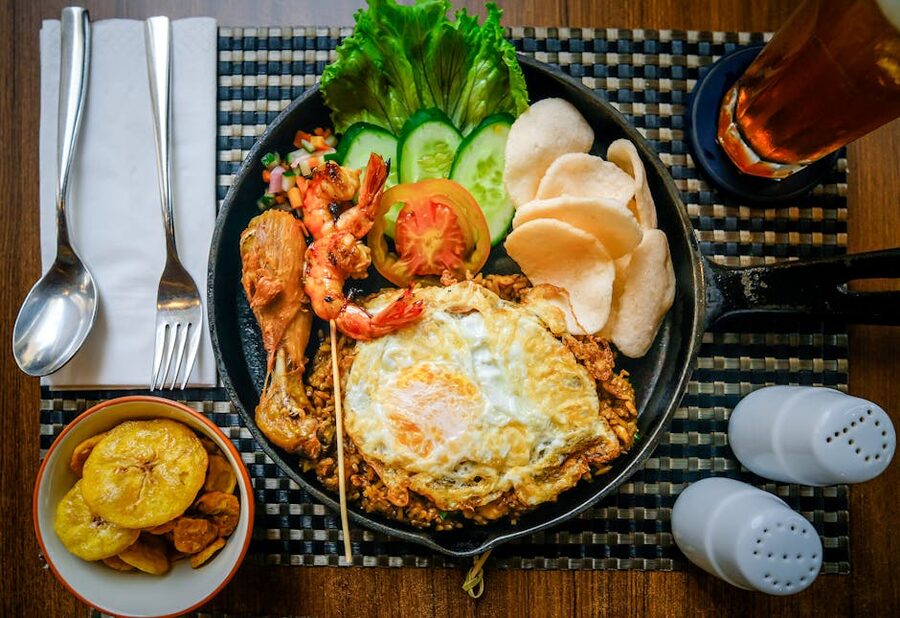
This article is mostly history because nasi goreng deserves it. Indonesia made it the national dish in 2018, CNN’s readers voted it the second most delicious food on earth in 2011 (behind Padang’s rendang, in case you were wondering), and there are at least 104 documented regional variants according to a Gadjah Mada University food researcher. None of that is a recipe. If you want a recipe, fifty thousand bloggers have you covered. What you probably haven’t read is the actual story of how leftover rice from a 10th-century Hokkien trader’s pot turned into a dish that gets served at state dinners, drafted independence proclamations, and now sits on every Bali menu from Kuta beach shacks to the Mandapa. So let’s get into it. Then I’ll tell you the only thing that actually matters about eating it in Bali, which is where to go and what to ask for.
In This Article
- Fried Rice Before It Was Indonesian
- The First Written Mention, and a Theory Nobody Likes
- Local Adaptation, and the Sauce That Changed Everything
- Colonial Documentation: 1918 and 1925
- How the Dish Travelled Outside Asia
- 17 August 1945: The Sahur That Made a Country
- From the New York World’s Fair to a National Dish
- Diplomasi Nasi Goreng
- 104 Variants, and Why You’ll Eat Different Versions in Different Places
- The Anatomy of a Plate
- Where to Eat Nasi Goreng in Bali
- Kaki Lima Carts in Residential Gangs
- Warung Lunches and Family Restaurants
- Beach Grills in Jimbaran
- Hotel Restaurants and Beach Clubs
- One Last Thing
Fried Rice Before It Was Indonesian
Nasi goreng is, structurally, a Chinese dish. That isn’t controversial; the Wikipedia entry says so, every Indonesian food historian I read says so, and the technique that makes it work, fast stir-frying in a Chinese carbon-steel wok, comes from the Ming dynasty. The wok itself, the high-heat method, and the principle that you should never throw away cooked rice all arrived in the Indonesian archipelago with Chinese traders.
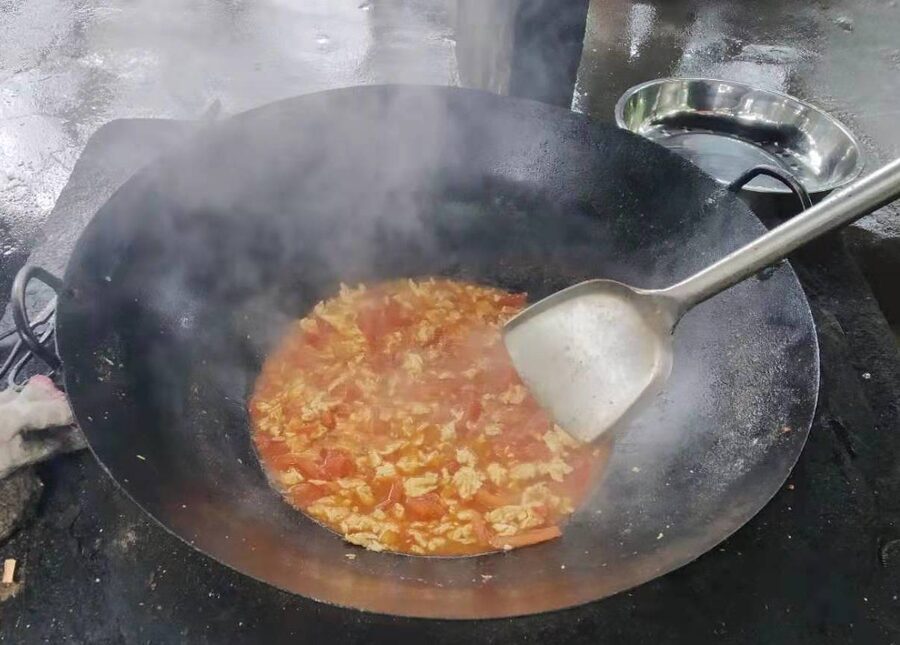
The trade route is the part that often gets glossed over. Chinese maritime expansion really kicked off during the Tang dynasty, between the 7th and 10th centuries CE, when ships out of Guangzhou and later Quanzhou started running regular routes to ports across Java, Sumatra, the Malay Peninsula, Borneo, the southern Philippines and what is now Vietnam. By the time the Srivijaya empire was at its peak around the 10th century, trade between China and the Indonesian archipelago was a permanent feature of the region. It intensified again under the Majapahit empire in the 15th century. Chinese traders weren’t just dropping off ceramics and silk and sailing home; they were settling. Hokkien, Cantonese, Hakka and Teochew communities planted themselves in port cities like Batavia (the Dutch name for what is now Jakarta), Semarang, Medan, Malacca, Penang, Singapore and Manila. They built temples, they ran businesses, and crucially for our purposes, they cooked.
Among the dishes they brought were stir-fried noodles (which became mie goreng), dumplings, stir-fried vegetables, and fried rice. Soy sauce came with them too, dating back to 2nd-century CE China; without that ingredient, you don’t get the dark base note that anchors the flavour of nasi goreng to this day. But the most important thing the Hokkien settlers introduced, in my opinion, was a cultural attitude: don’t throw away cooked food. In Chinese custom, food waste is taboo, and refrigeration didn’t exist. So the night’s leftover rice was reheated for breakfast the next morning. Frying it was the safest way to do that in a tropical climate, because the high heat kills the dangerous bacteria that grow on cooked rice at room temperature. (This, incidentally, is why your overnight rice from the warung never makes you sick. The wok takes care of it.)
That practice of frying yesterday’s rice for breakfast is the seed crystal. Local cooks watched it, adapted it, and started doing it themselves. From there it had a thousand years to evolve.
The First Written Mention, and a Theory Nobody Likes
The earliest written reference to fried rice in the Indonesian archipelago appears in Serat Centhini, an enormous early-19th-century Javanese encyclopedia of stories, customs and recipes compiled in the court of Surakarta. The dish there is called sekul goreng (the Javanese term for fried rice). According to the food historian Harry Nazarudin, the sekul goreng in Serat Centhini isn’t quite what we eat today. It uses no soy sauce, and it’s served as one component of a larger meal rather than a dish on its own. The closest modern equivalent is the gagrak Sundanese style of fried rice, which leans savoury rather than sweet.
That early form of fried rice still tracks with the Chinese-origin story. But there’s a counter-theory, and it’s worth taking seriously because the academic who proposed it, Fadly Rahman of Padjajaran University, is one of the most respected food historians in Indonesia. Rahman argues that there isn’t actually any hard evidence nasi goreng is native to Indonesia, and that one branch of it might descend not from Chinese fried rice but from Middle Eastern pilaf, the rice cooked in seasoned broth that you find from Iran across to North Africa.
The exhibit Rahman points to is nasi goreng kambing, the Betawi (Jakarta) variant made with mutton or goat. Kambing nasi goreng uses minyak samin, which is ghee, and a heavy hit of warm spices: cardamom, cumin, cloves. Those are pilaf ingredients. They’re the same combination that Arab traders, who had a long presence in coastal Java and Sumatra, would have cooked at home. The Betawi neighbourhood of Tanah Abang has had an Arab-Indonesian community for centuries, and that’s exactly where you find the best kambing nasi goreng in Jakarta. It’s a clean line. Whether you accept the full pilaf-origin theory or just see kambing as a parallel Arab branch on a mostly Chinese tree, the point stands: nasi goreng is layered. Pinning it on one origin culture flattens what actually happened.
Local Adaptation, and the Sauce That Changed Everything
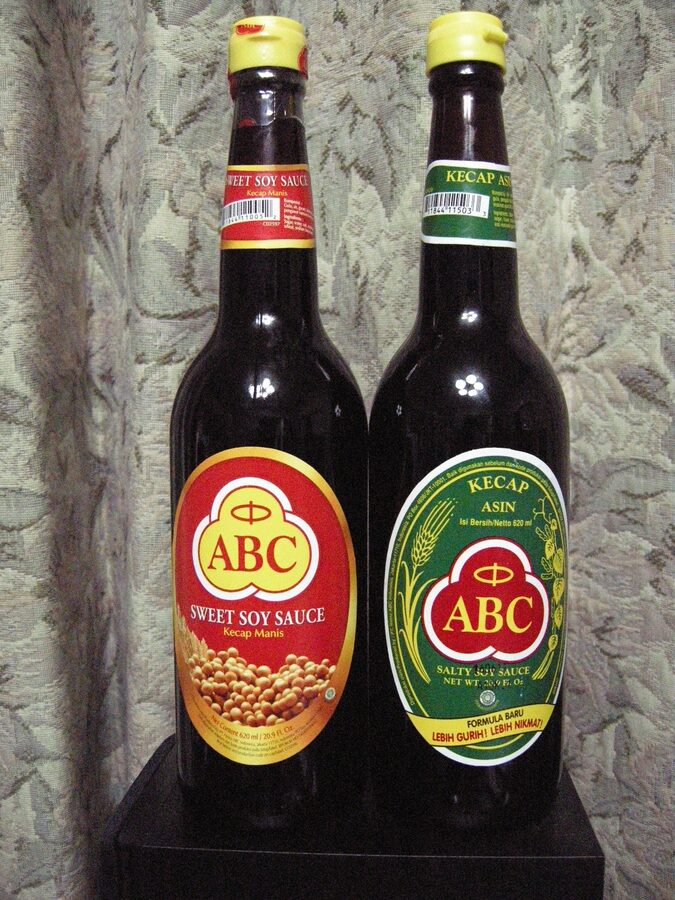
The dish became Indonesian, properly, when local cooks added kecap manis, a syrupy sweet soy sauce thick with palm sugar. Soy sauce has been in Asia since the Han dynasty in 2nd-century China, and it travelled with Chinese migration. But Indonesians took the basic salty soy and dosed it with palm sugar (gula aren from the sugar palm or gula jawa from coconut palm, depending on the region) until it ran like molasses. That’s the ingredient that gives nasi goreng its colour, its sticky texture, and the smoky-sweet caramel note when it hits a hot wok. Without kecap manis the dish is basically Chinese fried rice with extra chilli. With it, you have something the rest of Asia recognises as not theirs.
The other Indonesian addition was the seasoning paste, what’s called bumbu. The basic bumbu for nasi goreng is shallot, garlic, candlenut, fresh chilli and shrimp paste (terasi in Indonesian, belacan in Malay), pounded together in a stone mortar. That last ingredient is the one most non-Indonesians never quite expect. Terasi smells aggressive when raw. Cooked into hot oil at the start of the stir-fry, it transforms into a deep, oceany umami that you can’t get any other way. It’s the third pillar, after the wok-fried rice and the kecap manis, of what makes a Javanese nasi goreng taste the way it tastes. Skip the terasi and you’ve made fried rice, not nasi goreng.
By the 19th century, colonial-era records from European visitors describe fried rice as a daily staple in Javanese and Malay households. Children ate it for breakfast. Workers ate it on the way to the fields. Vendors carried it on shoulder poles down the streets of Batavia. By the early 20th century, Dutch-Indonesian cookbooks were including recipes for it. The dish had stopped being a Chinese loan and become Indonesian property.
Colonial Documentation: 1918 and 1925
The first time nasi goreng shows up in mainstream Indonesian literature is 1918, in Student Hidjo by Marco Kartodikromo, a serial novel that ran in the Sinar Hindia newspaper. The dish is mentioned matter-of-factly as part of daily life. By that point, Marco was a journalist agitating for Indonesian nationalism and writing in Malay rather than Dutch, so the mention itself is a small political act. Nasi goreng was an everyday Indonesian thing, not a colonial import. Putting it on the page in a Malay-language newspaper marked it as part of an Indies identity that was distinct from the Dutch one.
Seven years later, in 1925, a Dutch household cookbook called Groot Nieuw Volledig Oost Indisch Kookboek (“Great New Complete East Indian Cookbook”) came out in The Hague. It included a recipe for nasi goreng. Dutch families in the Indies had been eating Indonesian food for decades, often cooked by babu (Indonesian household staff). What the cookbook did was send those recipes back to the Netherlands. By the 1930s a recognisably Dutch-Indonesian version of the dish was being eaten in Amsterdam dining rooms.
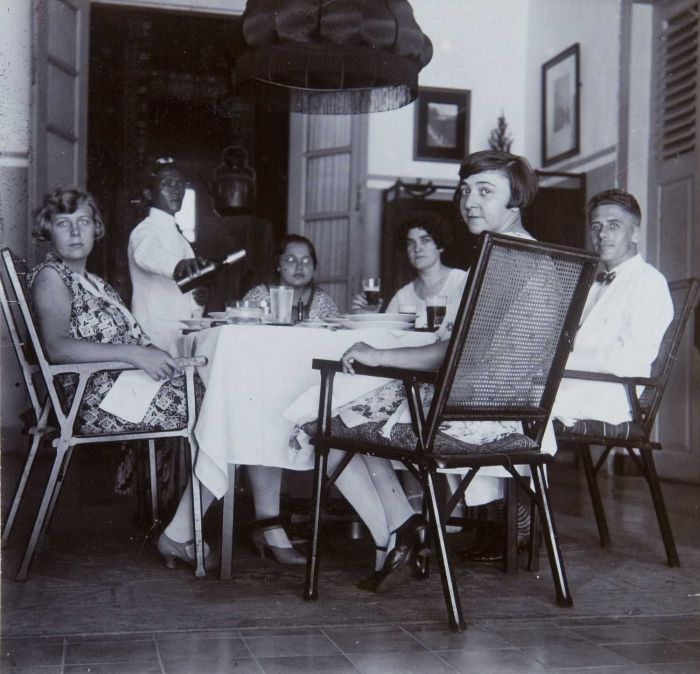
The Dutch took the dish further than just adopting it. They invented their own version, often made with butter and bacon or other pork at the base, which is the standard recipe in older Indo-Dutch cookbooks even now. And then there’s the nasischijf, which is the kind of detail you find in food history that you can’t make up: a deep-fried croquette, breadcrumbed on the outside, filled with nasi goreng, sold in Dutch fast-food shops as a snack alongside the famous frikandel. It’s nasi goreng turned into a fish-and-chip-shop item. There is also a song, Geef Mij Maar Nasi Goreng (“Just Give Me Nasi Goreng”), recorded in 1979 by the Indo-Dutch performer Wieteke van Dort under the stage name Tante Lien. It’s a sentimental number about Indo-Dutch repatriates in the Netherlands missing the food they grew up on. It still gets played on Dutch oldies stations.
How the Dish Travelled Outside Asia
Three diaspora routes took nasi goreng beyond Indonesia, all of them tied to colonial movement of people.
The first goes to Sri Lanka, where the Sri Lankan Malay community brought a version of the dish in the 18th and 19th centuries. The Sri Lankan Malays are descendants of Malay-speaking soldiers and exiles brought to Ceylon by the Dutch when they ruled both Sri Lanka and the Indonesian archipelago. They settled, kept their language and food, and the result is a Sri Lankan nasi goreng (Sinhala: නාසි ගොරේන්) that’s a little different: it leans more on oyster sauce, uses ginger more aggressively, and gets garnished with a sliced omelette on top.
The second goes to Suriname, in South America, where the Dutch ran a colonial plantation economy. Between 1890 and 1939, around 33,000 Javanese contract workers were shipped to Suriname to work the sugar fields after the abolition of slavery. They stayed. Their descendants are still there, and Surinamese-Javanese culture is one of the strongest threads in the country today. Surinamese nasi goreng is its own thing now: the rice is often cooked separately from the meat, served with moksi meti (a mixed roast of pork, chicken and Chinese-style red pork), and accompanied by atjar (pickled vegetables) and bakabana (fried plantain). The dish is so embedded that in Suriname, the word nasi on a menu just means fried rice; you don’t need to say goreng.
The third route, the Netherlands, came after Indonesian independence. When the Dutch lost their colony in 1949, around 300,000 Indo-Dutch (people of mixed Dutch-Indonesian ancestry) repatriated to the Netherlands over the following decade. They opened restaurants. They taught their Dutch neighbours how to cook with shallot and chilli and kecap manis. Today every Dutch supermarket sells bottled boemboe (the bumbu paste in pre-made form) and frozen nasi goreng in foil trays, and a substantial chunk of Dutch take-away is what Dutch people call “Chinees-Indisch”, the slightly Cantonese-influenced Indonesian food that the Dutch consider a national comfort cuisine. In Flanders, “nasi goreng” is now a generic term for any fried rice. The dish has been so thoroughly absorbed that most Dutch people don’t think of it as foreign any more.
17 August 1945: The Sahur That Made a Country
Back to that opening scene, because it deserves more space. By August 1945, Japan had occupied Indonesia for three and a half years. The Allied surrender came on 15 August. Indonesian nationalists who had been waiting for exactly this moment moved fast. On the night of the 16th, a group of younger revolutionaries kidnapped Sukarno and Hatta and took them to Rengasdengklok, west of Jakarta, to pressure them into declaring independence before the Allied forces returned to reinstall the Dutch. By late evening, after negotiation, the leaders were brought back to Jakarta, to the residence of Vice-Admiral Tadashi Maeda, a Japanese naval officer who had been quietly sympathetic to Indonesian independence. They worked through the early hours of 17 August on the proclamation text.
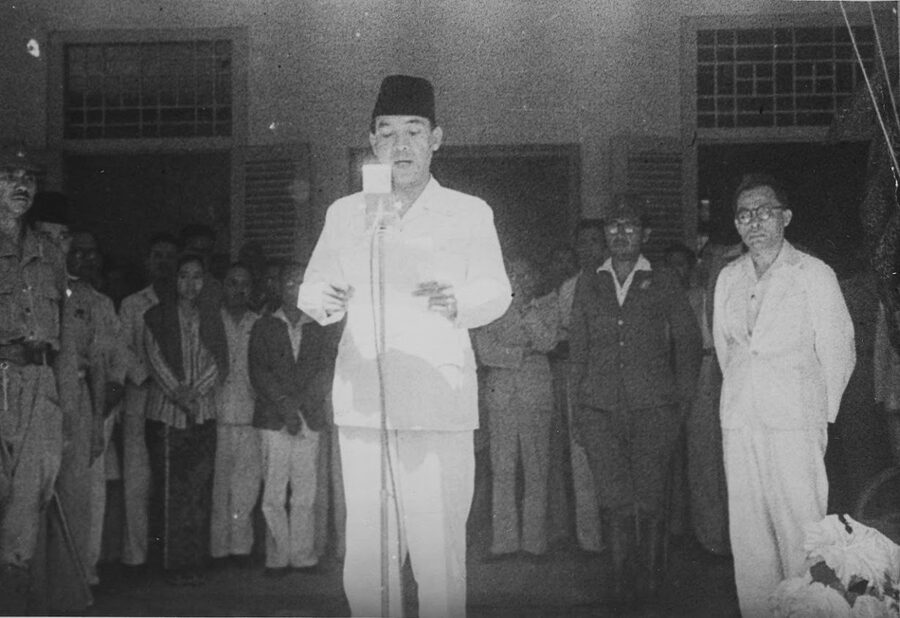
It was Ramadan. The men were fasting. The meal eaten before dawn, before the fast resumes, is sahur, and what they ate that night, according to multiple Indonesian historical accounts, was nasi goreng. Sukarno reportedly said the dish was made by Maeda’s household staff. By dawn the proclamation was finished. A few hours later Sukarno read it from the porch of his home on Jalan Pegangsaan Timur 56. The republic was born. There is no national myth about that morning’s plate of food in the way Americans have a myth about Washington’s cherry tree, but it’s the kind of detail that ought to be on a coin somewhere.
From the New York World’s Fair to a National Dish
After independence, Sukarno used food strategically. At the 1964 New York World’s Fair, the Indonesian pavilion ran an “Indonesian Theater Restaurant” where visitors were introduced to nasi goreng, sate, gado-gado and a handful of other dishes the new government wanted Americans to associate with the country. Howard Palfrey Jones, the US ambassador to Indonesia during Sukarno’s later years, wrote in his memoir Indonesia: The Possible Dream that the nasi goreng cooked by Hartini, one of Sukarno’s wives, was the best he had ever tasted. (Hartini was famously a strong cook. The detail about her nasi goreng has become a kind of soft trivia in Indonesian foodie circles.)
Through the 1970s and 80s, nasi goreng became the de facto national dish in everything but name. Every Indonesian household made it. Every Indonesian restaurant overseas put it on the menu. Bumbu brands in the supermarket sold pre-made nasi goreng paste in sachets, so you could throw together a passable version in five minutes. Convenience stores started selling frozen microwave versions. By the time CNN International ran an online poll in 2011 asking 35,000 readers to vote on the world’s 50 most delicious foods, nasi goreng came in at number two, behind Padang’s rendang. It also placed Indonesia at number one and number two on the same list, which not even France can claim.
In 2018, the Indonesian government finally made it official. The Ministry of Tourism designated five national dishes: rendang, sate, soto, gado-gado, and nasi goreng. Five was the number; nasi goreng was on the list. There are 17,000 islands in Indonesia and at least 800 ethnic groups, so picking five dishes was a political exercise as much as a culinary one. That nasi goreng made it tells you how universal the dish has become. Whether you’re Acehnese in the far north of Sumatra or Papuan in the far east, you grew up eating it.
Diplomasi Nasi Goreng
The dish has its own political vocabulary now. Diplomasi nasi goreng, “nasi goreng diplomacy”, refers to a meeting where political opponents are softened up over a plate of fried rice. The phrase was popularised by Megawati Sukarnoputri (Sukarno’s daughter, herself a former president) in July 2019, when she invited her old rival Prabowo Subianto to her house for dinner. They had just fought a bitter election campaign against each other. She fed him nasi goreng. After the meeting she was quoted saying, with characteristic dryness, that “fortunately for women politicians, there is a tool for melting men’s hearts, which is called nasi goreng politics, which turns out to be effective.” It became a national meme. The dish that fed Sukarno in 1945 was now feeding his daughter’s political reconciliation seventy-four years later. You can read this as cute, or as continuity, or as Indonesian politicians being unusually self-aware about food symbolism. I read it as all three.
104 Variants, and Why You’ll Eat Different Versions in Different Places
According to Dwi Larasatie, a culinary expert at Gadjah Mada University, there are 104 documented types of nasi goreng across Indonesia. Of those, 36 have a clearly traceable region of origin and 59 are considered “developed” variants where the lineage is too tangled to trace. The remaining 9 use base ingredients that aren’t even strictly rice (some include noodles, barley, or corn). Java alone has 20 sub-styles, from west to east: Sundanese, Betawi, Semarangan, Yogyanese, East Javanese, and so on.
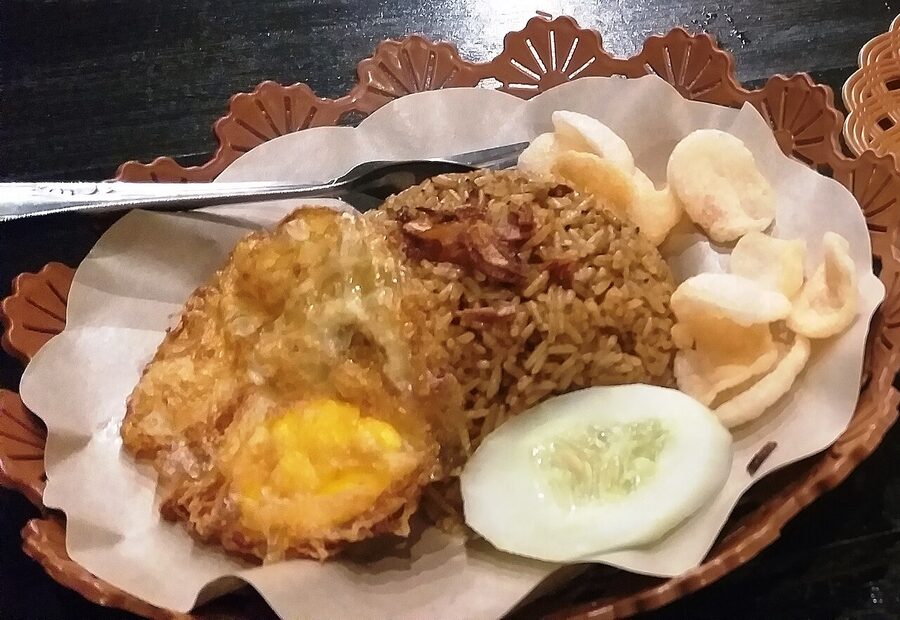
A handful are worth knowing if you’re going to eat your way around Indonesia. Nasi goreng Jawa is the default most travellers encounter: sweet from kecap manis, mid-spicy, fried egg on top. Nasi goreng Sunda, from West Java, is more savoury and less sweet, with a stronger hit of garlic and shallot. Nasi goreng Betawi is the Jakarta version, often served as kambing with goat or mutton, ghee, and the warm-spice profile that points back to Arab-Indonesian influence. Nasi goreng merah, “red fried rice”, comes from Makassar in South Sulawesi: no kecap manis at all, the colour and flavour from tomato and chilli sauce. Eastern Indonesia generally goes red rather than brown. Nasi goreng kampung, “village fried rice”, leans Malaysian now but has roots across the archipelago: anchovies (ikan bilis), water spinach, shrimp paste, smoky and aggressive. And nasi goreng pete, made with petai stinky beans, is the variant you don’t start with unless you already know you like the bean.
Cross the border and you find more. Malaysian nasi goreng branches into belacan (heavy on shrimp paste), kunyit (turmeric-yellow), mamak (Indian-Muslim with curry spices), and Pattaya below. Singaporean hawker centres serve a sambal-driven Malay version, a soy-driven Chinese version, and a curry-spiced Indian-Muslim version, often metres apart in the same food court. Bruneian nasi goreng includes versions made with belutak (a traditional beef sausage) and one called pulau Brunei, “floating fried rice”, plated to look like an island in a sea of sauce.
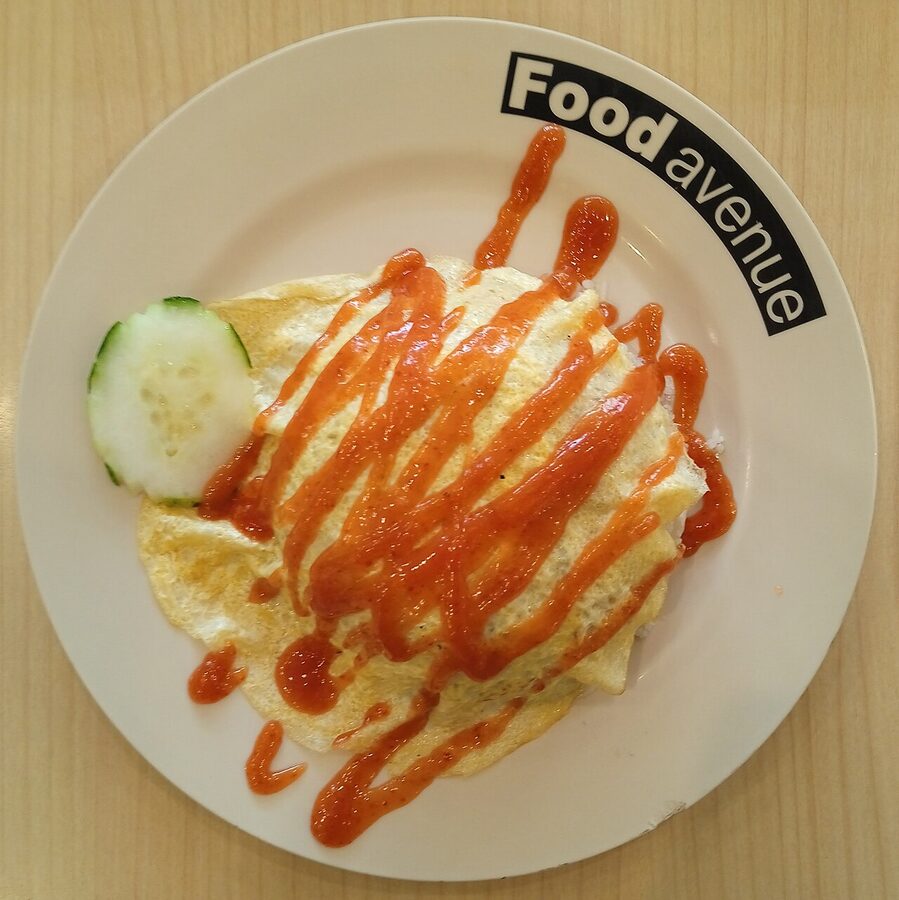
The point is that there is no single nasi goreng. Every region has improvised on the basic structure: pre-cooked rice, hot oil, bumbu, kecap or its substitute, protein, accompaniments. Indonesians sometimes call it the most “democratic” dish for that reason: no rigid recipe, you do what you want.
The Anatomy of a Plate
So what is on a standard plate of nasi goreng when you order one? Strip it down and you get four layers.
The base is day-old rice. Fresh rice is too wet; it clumps in the wok and turns mushy. Yesterday’s rice has dried out enough to take the heat without falling apart. Most warungs cook a giant pot of rice in the morning, eat it through the day, and the leftovers become the next morning’s nasi goreng. This is also why home-cooked nasi goreng often tastes better than restaurant versions: it’s the actual leftover-rice principle in action.
The flavour layer is the bumbu, ground at the start, fried in oil until aromatic, plus kecap manis added near the end so it caramelises against the wok rather than burning. Get those two right and you’ve got nasi goreng.
The protein is whatever is around. Shredded chicken, prawns, beef strips, salted fish (ikan asin), Spam-like luncheon meat in some versions, just a fried egg in the cheapest form. The dish absorbs whatever you have.
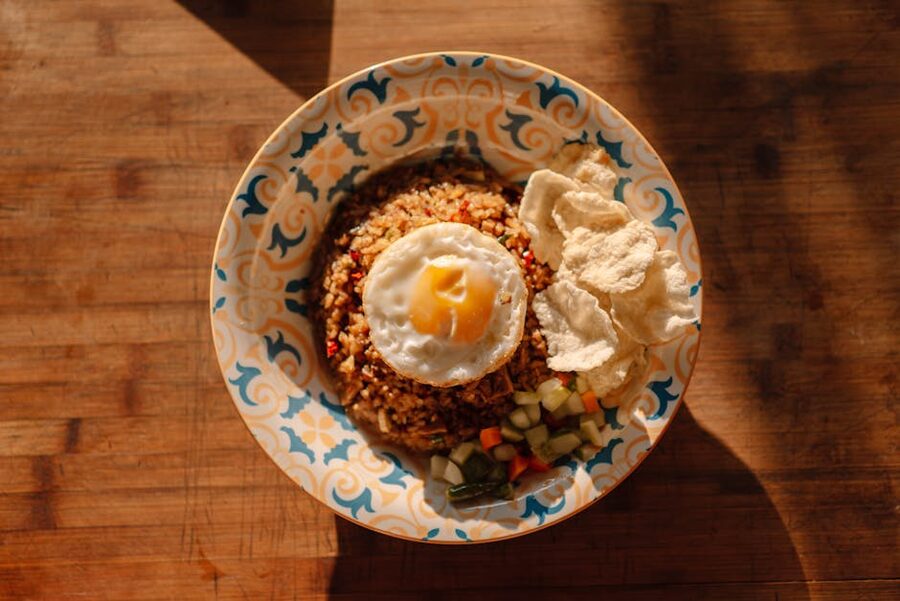
And the toppings: krupuk (rice or prawn crackers, sometimes the colourful red and green ones, always added at the end so they stay crisp), bawang goreng (deep-fried shallots scattered on top), sliced cucumber and tomato for freshness, acar (vinegar-pickled cucumber, carrot and shallot), and a fried egg either scrambled into the rice or slapped on top sunny-side up. The egg-on-top version has its own name: nasi goreng istimewa, “special” nasi goreng. If a warung menu lists nasi goreng at Rp 25,000 and nasi goreng istimewa at Rp 28,000, the only difference is the egg.
You’ll also be asked, at any decent warung, two questions. Pedas? “Spicy?” The expected answer is some version of “ya” (yes), with optional levels: sedikit (a little), sedang (medium), pedas (hot), pedas banget (extremely hot). Don’t say no unless you actually mean it. A nasi goreng with no chilli is missing one of its main notes. The cook will use proportional amounts of fresh red cabai (chilli) or sambal paste accordingly. The second question: Telur ceplok atau telur dadar? “Egg sunny-side up or omelette-style?” Sunny-side up is the more common request, and the runny yolk doubles as a sauce. Omelette-folded is dryer but easier to eat with a spoon.
Where to Eat Nasi Goreng in Bali
The practical part is short. Nasi goreng is on every restaurant menu in Bali, and the price spread is wider than almost any dish I can think of: Rp 20,000 (~$1.30) at a kaki lima cart and Rp 220,000 (~$14) at a five-star hotel for, broadly, the same food. What you pay for is the chair. I’m naming areas and types of place rather than specific warungs, because warungs close, change owners, get rediscovered by Instagram and become unbearable, then become quietly good again. The pattern is what matters. (For more on the Bali food scene, our Food and Drink section is where to dig in.)
Kaki Lima Carts in Residential Gangs
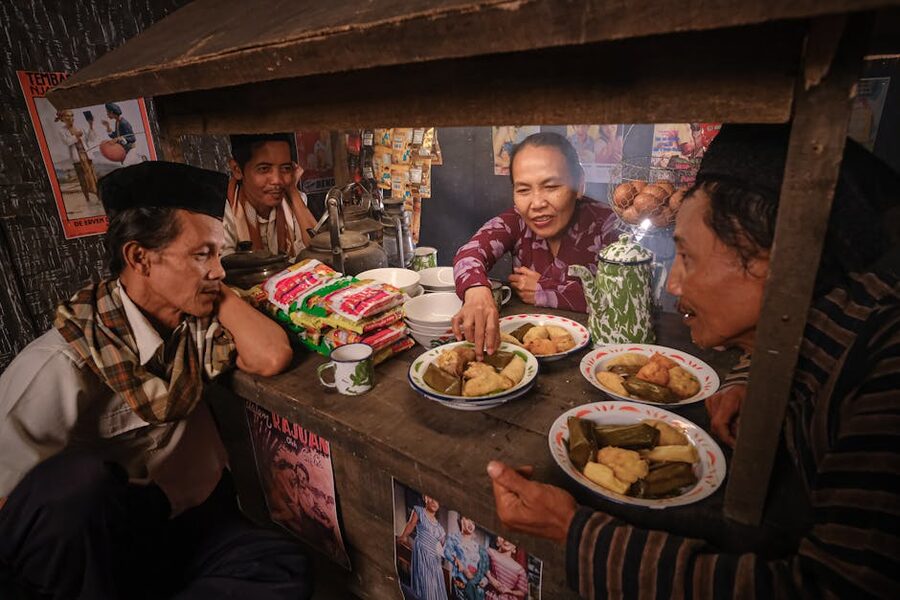
Kaki lima means “five legs”: three from the vendor’s wooden cart and two from the cook. The carts roll into residential gang (back lanes) in the late afternoon, the cook fires up a portable wok over a gas burner, and you eat standing or on a plastic stool. Nasi goreng telur (with egg) runs Rp 20,000-30,000 (~$1.30-2.00). The food is excellent because the volume is high and nobody is trying to impress anyone. Look for clusters of locals on plastic stools; that’s the signal. Strong areas: Sanur back-gangs around Jalan Danau Tamblingan and the smaller lanes inland; Denpasar proper, especially Jalan Hayam Wuruk and Jalan Diponegoro after dark; Ubud’s residential edges, fifteen minutes’ walk from the central market; and Canggu’s quieter side roads off Jalan Batu Bolong toward Berawa.
Warung Lunches and Family Restaurants
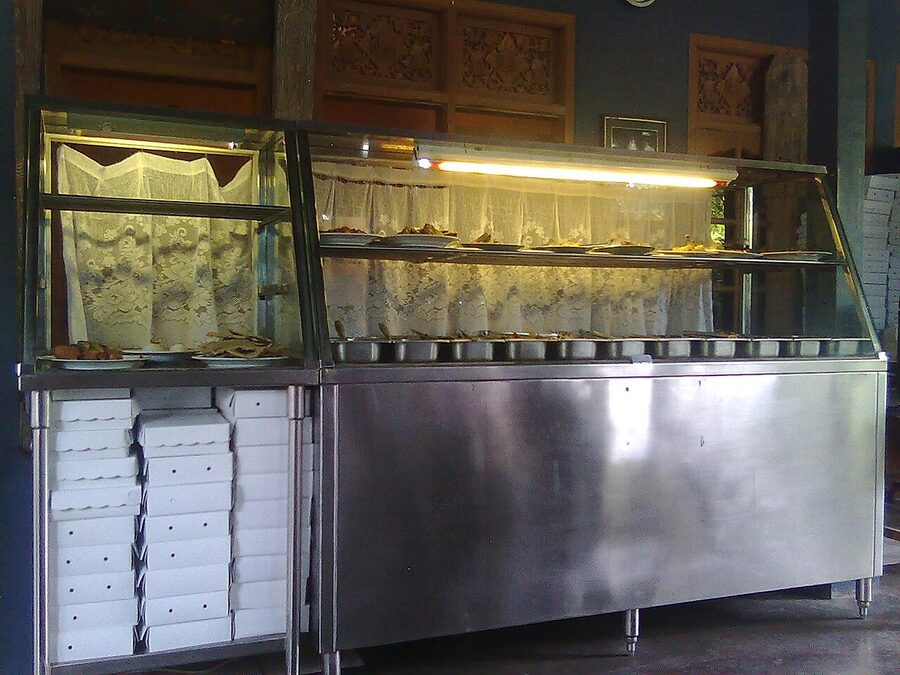
One tier up is a proper warung with tables, family-run, kitchen often visible. Prices run Rp 25,000-45,000 (~$1.60-2.90). The ones that take it seriously cook each plate to order in a separate wok; if they pull a portion from a pre-made tray it’s fine but not great. Strong areas: Ubud, where the rice-belt position means rice culture runs deep, especially the warungs around Tegallalang and Penestanan; Sidemen, where the east-Bali rice valley has basically no tourist pressure (Rp 25k nasi goreng with a Mount Agung view); Munduk and the Lovina villages in the far north (after a morning at the Singsing waterfalls outside Lovina, the warungs back in town do a Rp 30k version that beats anything in Seminyak); and Amed, on the east coast, where the seafood-leaning version with prawns from the morning catch is the right call.
Beach Grills in Jimbaran
Jimbaran is the dedicated stop for seafood-driven nasi goreng. The beach grills along Muaya and Kedonganan buy off the morning fishing boats, then grill prawns, squid, snapper and clams over coconut-shell coals through the evening. Order nasi goreng seafood or udang (prawn) for the heavy prawn-loaded version with smoky char from the grill kitchen. Rp 65,000-120,000 (~$4-7.50), more with grilled fish on the side. Feet in the sand at sunset, plastic chairs, queue of taxis at the entrance. Touristy, but the food is good and the ritual is the point.
Hotel Restaurants and Beach Clubs
Every hotel in Bali has nasi goreng on the menu, and price scales with the room rate. A Rp 65,000 (~$4) plate at a mid-range Sanur or Ubud hotel is almost always good and often great. The Rp 120-180k versions at four-star resorts are usually fine, sometimes excellent. The Rp 200k-plus versions at beach clubs and luxury hotels (Potato Head, Ku De Ta, Mandapa, COMO) are paying for the chair and the cocktail you’ll order alongside. I’ll say the quiet bit out loud: nasi goreng at a Seminyak rooftop or a Canggu beach club costs Rp 150-220k (~$9.50-14) and, honestly, isn’t better than the Rp 35k Sanur warung version. The plating is fancier, the garnish includes some microgreen that has nothing to do with Indonesian food, and you pay for the view. That’s fine if you went for the view. If you went for the nasi goreng, you’re in the wrong place.
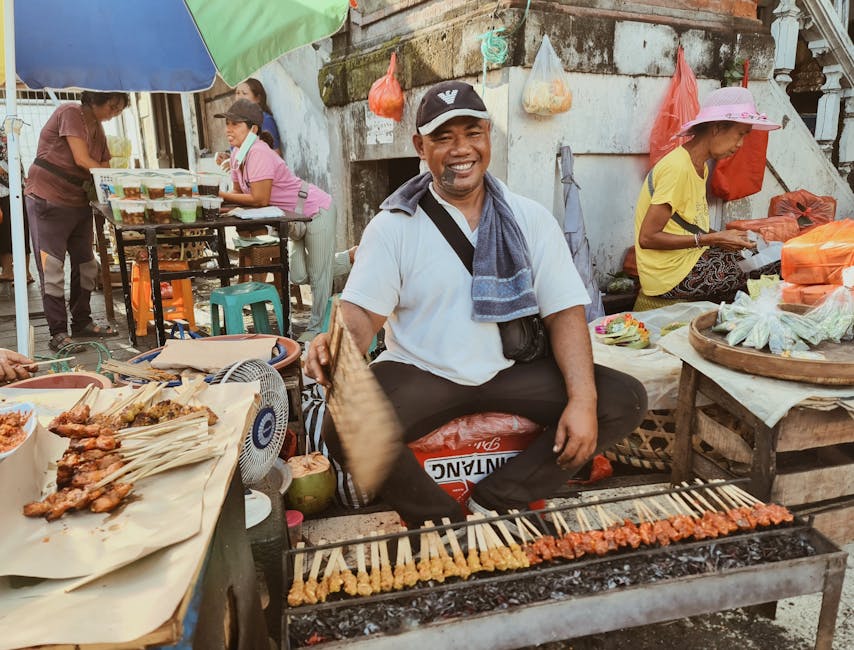
The best plate of nasi goreng I’ve ever had in Bali was Rp 22,000 from a kaki lima cart on a side road in Sanur at 10:30 p.m., eaten standing up because the stools were full. The rice had wok hei. The egg was running. The sambal made my eyes water in a way that felt diagnostic. The dish is also woven into daily life beyond the eating: plates of it set out as banten offerings on temple steps during festivals, smoke from kitchens in the lanes around Balinese Hindu ceremonies, leftovers in the kitchen at dawn after a Galungan family lunch. (Our Culture section goes deeper into the practices.) Treat it accordingly.
One Last Thing
If you only remember one piece of advice from this whole article, make it this: order it istimewa, with the egg on top, and ask for it pedas sedang, medium-spicy, the first time. Then adjust up or down depending on what shows up. If the cook seems pleased that you asked, you’re at the right warung. If they look bored, walk to the next one. The dish is too old and too good to settle for the wrong version of it.
Eating your way round the island is half the trip — happytovisit.com rounds up Bali’s 15 best-reviewed tours with prices, and Wonderful Indonesia, the national tourism site, has the regional food-festival dates.



Planning a Bali trip?
Start with the cornerstones — when to go, where to base, and what's actually worth doing.